Stages of Parkinol addiction treatment
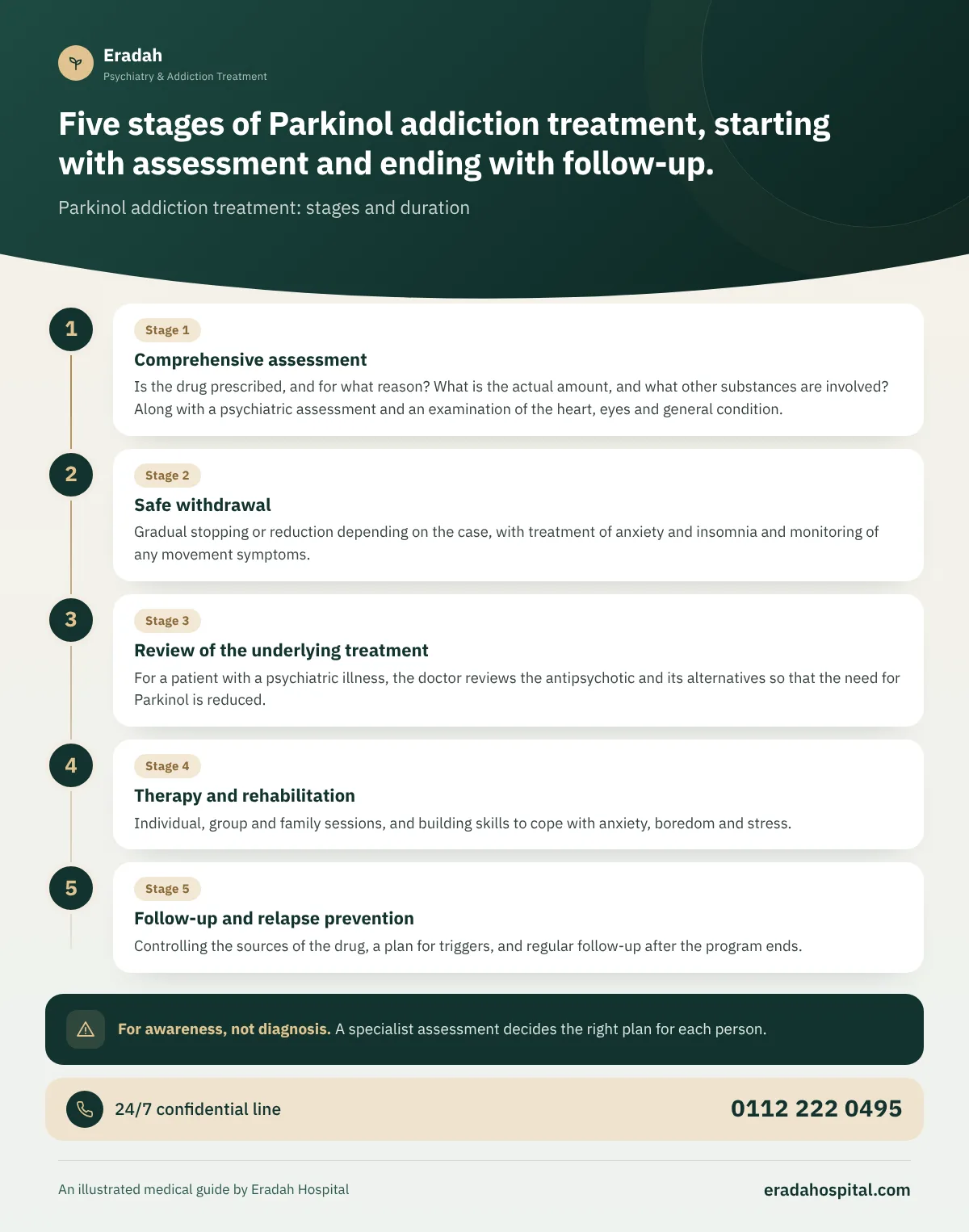
Treating Parkinol addiction differs from treating many substances on one key point: the drug itself may be part of the patient's treatment. For this reason the plan moves through five connected stages.
- Stage 1Comprehensive assessment
Is the drug prescribed, and for what reason? What is the actual amount, and what other substances are involved? Along with a psychiatric assessment and an examination of the heart, eyes and general condition.
- Stage 2Safe withdrawal
Gradual stopping or reduction depending on the case, with treatment of anxiety and insomnia and monitoring of any movement symptoms.
- Stage 3Review of the underlying treatment
For a patient with a psychiatric illness, the doctor reviews the antipsychotic and its alternatives so that the need for Parkinol is reduced.
- Stage 4Therapy and rehabilitation
Individual, group and family sessions, and building skills to cope with anxiety, boredom and stress.
- Stage 5Follow-up and relapse prevention
Controlling the sources of the drug, a plan for triggers, and regular follow-up after the program ends.
Why does treatment start with the question: who prescribed the drug?
Some people who misuse Parkinol are patients with schizophrenia or other psychotic disorders who need antipsychotics, and they may need something to ease the movement side effects. The 2022 systematic review indicates that schizophrenia was the most frequently recorded psychiatric disorder among people who misused trihexyphenidyl, followed by depression and then substance use disorders. So the goal is not always complete discontinuation, but sometimes controlled, supervised use, or a carefully considered move away from it.
On the other hand, there are people who were never prescribed the drug, and who take it alone or with other substances in search of euphoria. Here the goal is complete cessation and treatment of the reasons for use.
How is Parkinol withdrawn safely?
There is no single approved protocol for withdrawing from Parkinol, and the doctor relies on assessing each case. But the research is encouraging: in a study of 20 patients with schizophrenia, 18 of them successfully stopped the anticholinergic after a gradual reduction over several weeks, with no clear deterioration in movement or psychiatric symptoms and with improved mental performance. This result shows that coming off it is possible for many people, provided there is supervision and follow-up.
Are there medications to treat Parkinol addiction?
There is no approved medication for treating anticholinergic addiction, and treatment relies mainly on psychological and behavioral approaches. But medications have a supporting role that the doctor decides:
| Goal | How the doctor helps |
|---|---|
| Anxiety, insomnia and restlessness when stopping | Suitable medications for a defined period under monitoring, taking care not to shift the dependence to another sedative. |
| Movement symptoms from the antipsychotic | Adjusting the dose, changing the drug, or choosing a different alternative depending on the case. |
| The underlying psychiatric illness | Optimizing the treatment of schizophrenia, depression or anxiety with established methods. |
| Other accompanying substances | A separate withdrawal plan for sedatives, alcohol or other substances. |
Do not start or stop any medication without a doctor, and we do not state any doses here.
Psychological and behavioral therapy
Links situations, thoughts and the urge to use, and builds alternatives for coping with anxiety and boredom.
Helps someone who believes “it's medicine, not a drug” discover their own reasons for change.
Teaches the family how to support without suffocating supervision, and how to handle the prescribed medication.
Recognizing triggers and planning for moments of weakness before they happen.
Cognitive behavioral therapy is one of the most widely used approaches in treating substance use disorders in general, and it is adapted for psychiatric patients so that it takes their abilities and condition into account.
Treating the psychiatric illness and accompanying substances
One picture recurs in the studies: a person who misuses Parkinol rarely has a problem with Parkinol alone. In the largest group described for its addiction, 69 patients on Réunion Island, 61% were using another substance with it, chiefly benzodiazepines, cannabis, tobacco and alcohol. For this reason, the psychiatric and addiction conditions are treated together in a dual diagnosis program, with a separate plan for each accompanying substance.
How long does Parkinol addiction treatment take?
| Stage | Approximate duration |
|---|---|
| Assessment and tests | One day to several days |
| Safe withdrawal | From days to several weeks, depending on the case and accompanying substances |
| Review of the psychiatric treatment and its stabilization | Several weeks |
| Psychological and behavioral rehabilitation | Several weeks to a few months |
| Follow-up and relapse prevention | Several months, and it may extend to a year or more |
The duration varies with how long and how much was used, whether there is a psychiatric illness or other substances, and how stable the underlying treatment is. The treatment team sets it according to each person's progress.
Does Parkinol treatment require a hospital stay?
Outpatient treatment may be enough when the problem is an excess of a prescribed drug in a stable patient with good family support. Residential treatment is recommended when there are repeated episodes of delirium, active psychosis, use of other substances, previous failed attempts, or difficulty controlling the medication at home.
Relapse prevention after Parkinol treatment
- One doctor prescribes the medication if it is necessary, and one pharmacy dispenses it.
- An agreement with the doctor about who keeps the prescribed medication at home and how it is given.
- Continuing treatment for the psychiatric illness and not stopping it without the doctor.
- A written plan for moments of craving: who to call and what to do.
- Telling the doctor immediately about any return of movement symptoms instead of increasing the medication on your own.
How do you choose where to be treated for Parkinol addiction?
- A psychiatrist who can review the antipsychotics and the underlying treatment, not just withdraw the drug.
- A comprehensive assessment of the psychiatric condition and all substances used before the plan is made.
- Round-the-clock medical monitoring when there is delirium or mixed substances.
- Proven psychological and behavioral therapy, and involvement of the family in the plan.
- A clear follow-up plan after discharge, and complete confidentiality.
Parkinol addiction treatment at Eradah
At Eradah, treatment of Parkinol addiction begins with a psychiatric and medical assessment to determine why the drug is being taken and what other substances are involved. The psychiatrist then sets a safe withdrawal plan that takes the patient's underlying treatment into account and adjusts it when needed, with individual and group psychological therapy, a family program, follow-up after discharge, and complete confidentiality from the first call.