Physical signs of Parkinol use
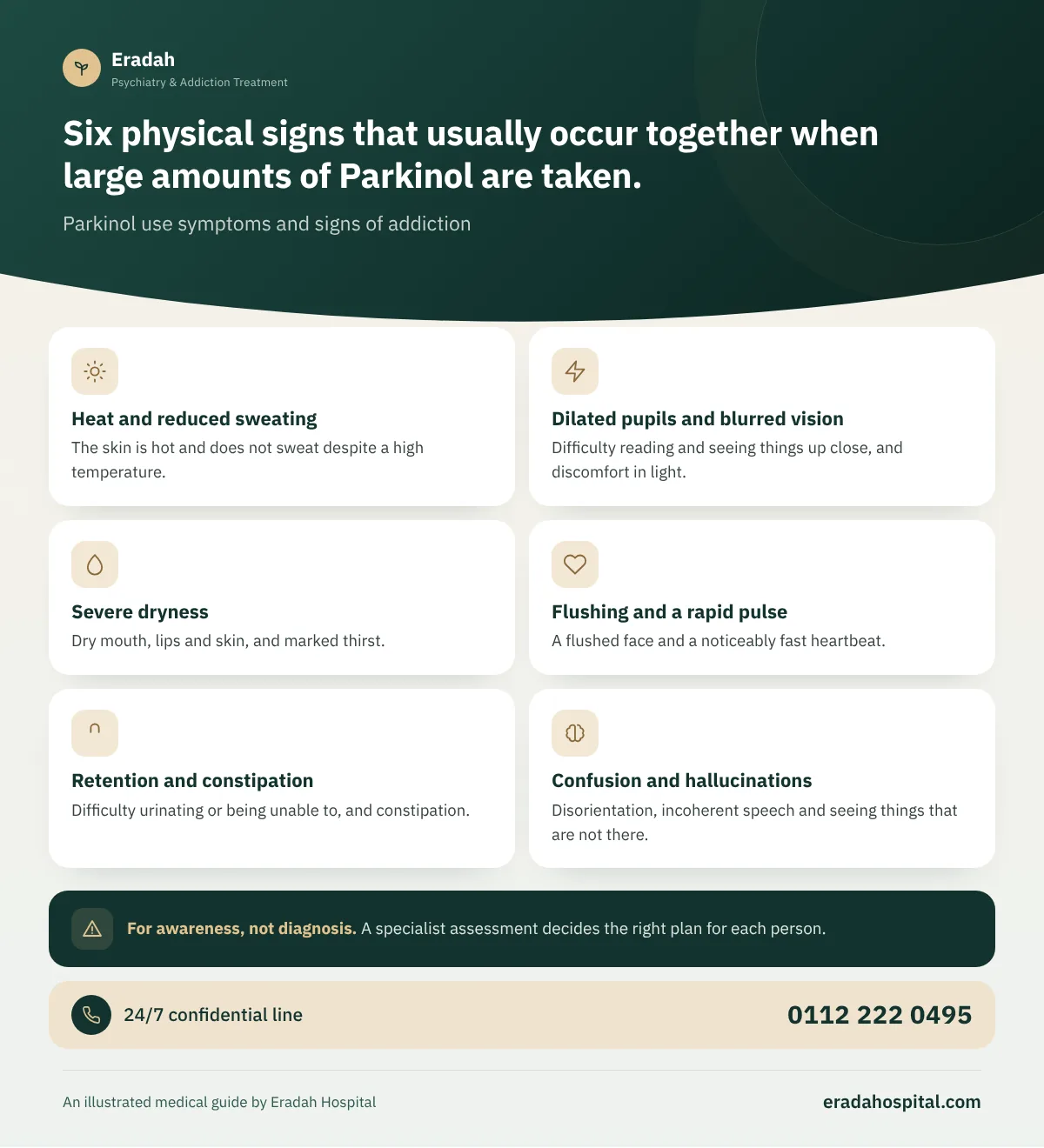
Emergency doctors summarize the picture of anticholinergic poisoning with a well-known English phrase describing the patient as “hot as a hare, blind as a bat, dry as a bone, red as a beet, mad as a hatter.” In simple terms, these are the signs that usually occur together when large amounts of Parkinol are taken.
The skin is hot and does not sweat despite a high temperature.
Difficulty reading and seeing things up close, and discomfort in light.
Dry mouth, lips and skin, and marked thirst.
A flushed face and a noticeably fast heartbeat.
Difficulty urinating or being unable to, and constipation.
Disorientation, incoherent speech and seeing things that are not there.
Behavioral signs of Parkinol addiction
- Prescribed pills running out before they are due, or strips disappearing from a family member's medication.
- Going to more than one pharmacy or doctor to get the same medication.
- Empty strips in unusual places, or pills outside their box.
- A change in friends and staying out late, and declining performance at school or work.
- Swings between being active and talkative, then drowsy and disoriented.
Psychological signs: from euphoria to delirium
The picture varies with the amount and the person. In the 2022 systematic review, hallucinations and perceptual disturbances, along with irritability and agitation, were the most commonly recorded psychological effects, followed by euphoria and then psychosis, while some cases described a sedating effect. In severe cases you may notice the following:
- Talking to people who are not there, or answering voices no one else hears.
- Picking at clothes or bedding as if grabbing things that are not there, a well-known sign in anticholinergic delirium.
- Not knowing where they are, what time it is, or even who the people close to them are.
- Suspiciousness and fear of others, or sudden aggression that is out of character.
- Forgetting most of what happened after the effect wears off.
Prescribed treatment or drug use? How to tell the difference
| Aspect | Therapeutic use | Misuse |
|---|---|---|
| Source | A prescription from a doctor who follows the case | Multiple sources, or no prescription |
| Amount | Fixed, as set by the doctor | Increases over time or is taken all at once |
| Goal | Relieving tremor and stiffness | Euphoria, hallucinations or escape from anxiety |
| Noticeable effect | A stable condition with mild side effects | Episodes of confusion, hallucinations and behavior change |
| When asked | Talks about it openly | Secrecy, denial and irritability |
The two can overlap: some patients start with a legitimate prescription and then increase the amount on their own. An Australian study of 50 psychiatric patients followed by a community team found that a third of them had misused anticholinergics in the previous month, with trihexyphenidyl the most common. For this reason, telling the treating doctor about any observation protects the patient and is not informing on them.
Signs that can be misread
| The sign | Other possible explanations |
|---|---|
| Disorientation and hallucinations | Fever or infection, low blood sugar, other substances, a psychotic episode, or delirium in older adults from medical causes. |
| Dilated pupils and a racing heart | Stimulants such as crystal meth (shabu) and Captagon, severe anxiety, or pupil-dilating eye drops after an eye exam. |
| Dry mouth and constipation | Side effects of psychiatric or allergy medications taken on prescription. |
| Mood swings and withdrawal from others | Depression, stress or other substances that need assessment. |
That is why the safest approach is to gather observations calmly and take them to a doctor. The usual rapid test strips do not normally detect Parkinol, and a special laboratory test may be needed. You can find the details in the guide to drug testing.
Who is most likely to misuse Parkinol?
The 2022 systematic review notes that most people described in the research were young, unmarried men, many of them unemployed or living on the margins of society, and that anticholinergics often appear as part of polysubstance use. This is repeated among people with schizophrenia and severe mental disorders who already receive the drug as part of their treatment, so family observations about them deserve special attention.
One sign recorded in published medical reports is that some patients claimed movement symptoms such as stiffness and tremor, or exaggerated them, in order to get a prescription for trihexyphenidyl or another anticholinergic. If you notice repeated insistence on getting the same drug, or complaints of movement symptoms that only appear before a doctor's visit, calmly tell the treating doctor so they can reassess the real need for it. This step protects the patient and does not mean accusing them.
When does Parkinol use become addiction?
The DSM-5 diagnostic manual does not give anticholinergics a separate category. Addiction to them is diagnosed as “other (or unknown) substance use disorder,” using the same criteria as for other substances over a 12-month period, including:
- Taking larger amounts or for longer than intended.
- A persistent desire, or failed attempts, to cut down.
- A strong craving to use.
- Continuing despite clear health or psychological problems.
- Neglecting school, work or family because of the use.
- Tolerance, and symptoms when stopping.
The more criteria that are met, the more severe the disorder. Symptoms of stopping Parkinol have a particular pattern that we explain on the Parkinol withdrawal symptoms page.
What should you do if you notice these symptoms?
- If they are delirious, have a high temperature or a very fast pulse, call an ambulance (123) before anything else.
- Keep them away from high places, the street and heat, and stay with them calmly.
- Keep the strips or empty boxes to show the doctor.
- If they take it on prescription, contact their doctor to review the plan and how the medication is dispensed.
- Choose a calm time to talk after they come round, focus on your concern for them, and use the guide to persuading a person with addiction to accept treatment.
Danger signs after using Parkinol: call an ambulance (123) immediately
- Delirium or severe agitation with hallucinations, or not knowing where he is or who people are
- A high temperature with hot, dry skin that does not sweat
- A very fast or irregular pulse, or chest pain
- Seizures, loss of consciousness or difficulty breathing
- Complete urinary retention with severe pain in the lower abdomen
Call an ambulance on 123 immediately, and if the person is unconscious but breathing, place them on their side so they do not choke on vomit. Stay with them in a cool, quiet place away from the street and high places, do not give them any medicine, drink or other substance, keep the empty strips, and tell the paramedics everything they took.
Call the ambulance 123