Why does tramadol cause addiction?
Tramadol has properties that make it more appealing and more deceptive than many painkillers:
Its active product in the liver activates opioid receptors, which releases dopamine in the brain's reward circuits.
Its effect on serotonin and norepinephrine gives a feeling of energy and confidence that the person comes to associate with the pill.
The same amount has less effect over time, so the person raises the amount and the risk of seizures goes up.
Physical and psychological symptoms appear when stopping, so the person goes back to the pill to escape them.
Many people do not feel they are “addicts,” because in their eyes they are not using a drug but a “painkiller” that helps them work, and this is precisely what delays seeking treatment.
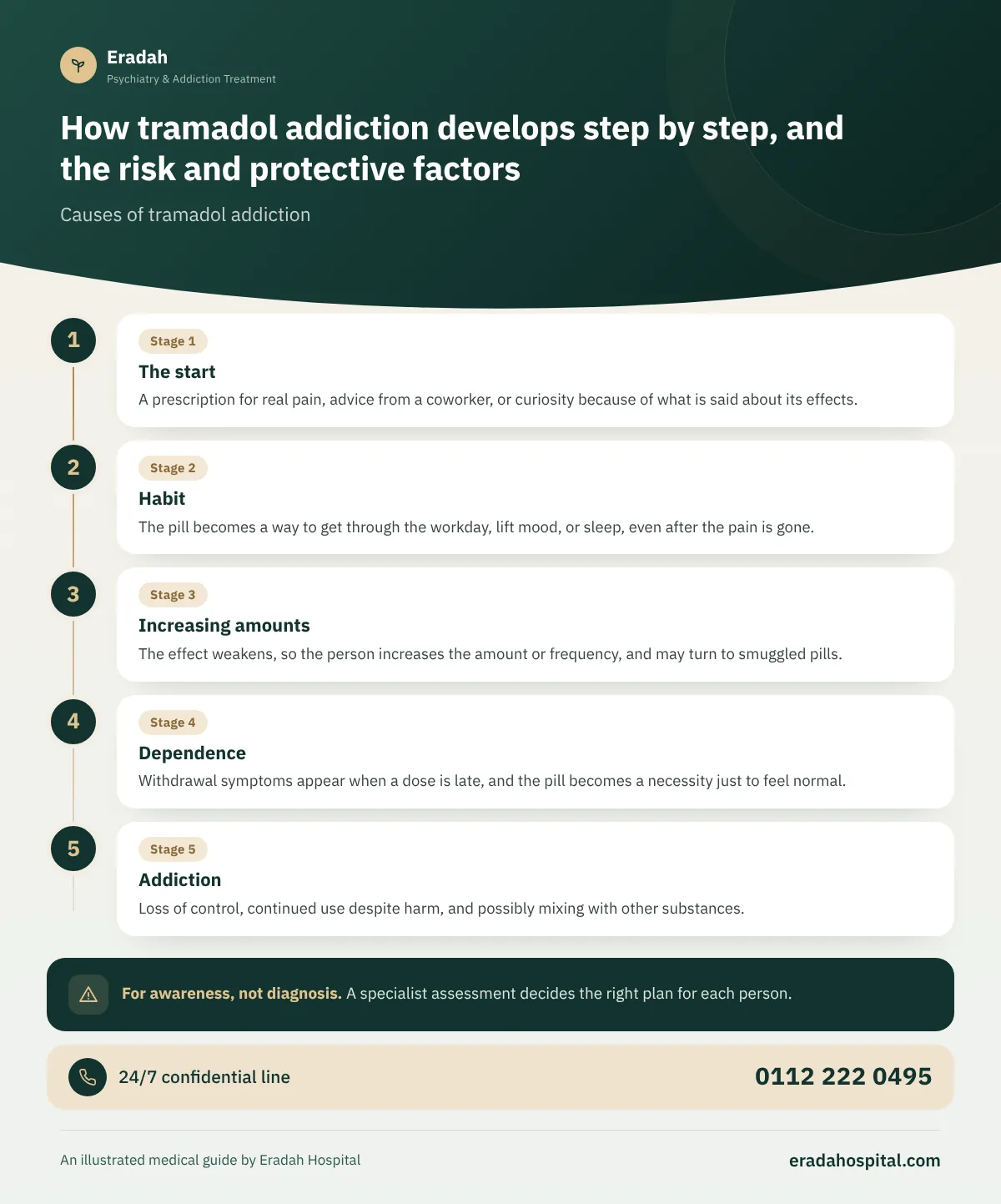
How does tramadol addiction develop?
- Stage 1The start
A prescription for real pain, advice from a coworker, or curiosity because of what is said about its effects.
- Stage 2Habit
The pill becomes a way to get through the workday, lift mood, or sleep, even after the pain is gone.
- Stage 3Increasing amounts
The effect weakens, so the person increases the amount or frequency, and may turn to smuggled pills.
- Stage 4Dependence
Withdrawal symptoms appear when a dose is late, and the pill becomes a necessity just to feel normal.
- Stage 5Addiction
Loss of control, continued use despite harm, and possibly mixing with other substances.
False beliefs that drive tramadol use (“tamol”)
In Egypt in particular, common beliefs have played a large role in the spread of tramadol, and many of them are untrue or only half true:
| Common belief | The truth |
|---|---|
| It is just a painkiller and does not cause addiction | It is an opioid that causes tolerance, dependence, and addiction with repeated use. |
| It increases the ability to do hard work | Any effect is temporary and is followed by exhaustion and dependence, and it raises the risk of accidents and seizures. |
| It improves sexual performance | Long-term use lowers testosterone and weakens desire and erections. |
| It is safe because it is sold in pharmacies | A licensed medicine is relatively safe only under medical supervision, and smuggled pills have an unknown strength. |
Work pressure and physical exhaustion
Tamol is common among people in physically demanding jobs and long working hours, such as drivers, construction workers, workshop workers, and night-shift workers. The person is looking for a way to endure physical pain and exhaustion and keep working, and finds in the pill a quick fix. Over time, work becomes tied to the pill, and it is hard to imagine a day without it.
From chronic pain to dependence
Some patients need opioid painkillers for long periods because of chronic pain such as back, joint, and nerve pain. Here two things must be told apart:
A natural adaptation of the body to a medicine, which can happen in any patient who takes it for a while, and which is managed by gradual tapering under a doctor's supervision.
Loss of control, raising the amount on one's own, using it for reasons other than pain, and continuing despite harm.
For this reason, a patient with chronic pain should not stop their medicine or change the dose on their own, but should see their doctor at any concern, since there may be alternatives better suited to their condition.
Mental health conditions and dual diagnosis
Because tramadol lifts mood temporarily, some patients find in it relief from psychological suffering that has not yet been diagnosed. Among the disorders most associated with its misuse:
- Depression and anxiety disorders.
- Post-traumatic stress disorder (PTSD).
- Untreated attention-deficit/hyperactivity disorder (ADHD).
- Chronic insomnia.
Genetic and biological factors
Genetics explains an important part of susceptibility to addiction in general, and the risk is higher in people with a family history of addiction. With tramadol specifically, the activity of the liver enzymes that convert it into its active compound differs genetically from person to person, so each person feels its effect differently and has a different risk of toxicity.
Environment and social factors
- Easy access: the spread of smuggled pills and their circulation among friends and coworkers.
- Social acceptance: seeing it as a “painkiller” rather than a “drug” lowers the sense of risk.
- Starting use at an early age: The adolescent brain is more vulnerable to addiction.
- Financial and family pressures and unemployment: and the search for a quick escape from stress.
Why do teenagers and young people try tramadol?
Some young people start tamol at an early age out of curiosity, imitating friends, wanting to stay up late or study, or because of what is said about it in conversations among young people. At this stage the brain is more vulnerable to addiction, because the areas for planning and impulse control are not yet fully developed.
A young person may also not realize that a single pill of unknown origin can cause a seizure, or that mixing it with pregabalin or hashish multiplies the risk. That is why early, frank conversation within the family, without exaggeration, is one of the strongest forms of prevention.
Risk factors and protective factors
| Area | Risk factor | Protective factor |
|---|---|---|
| Medicine | Long-term use without follow-up, or smuggled pills | A prescription for a set period with regular medical follow-up |
| Mental health | Untreated depression, anxiety or trauma | Early diagnosis and treatment, and skills for handling stress |
| Work | Long hours and physically demanding jobs without rest | A healthy work environment and real treatment for pain and exhaustion |
| Family | No dialogue, or addiction in the family | Open communication, emotional support, and clear boundaries |
How do you protect yourself and your family?
- Take tramadol only with a prescription, and do not share it with anyone.
- Ask your doctor about non-opioid alternatives for pain whenever possible.
- Do not use any painkiller to get through exhaustion or work pressure.
- Seek early help for depression, anxiety, and insomnia.
- Dispose of leftover pills after treatment ends in the way your pharmacist advises.