How does tramadol change inside the body?
In the liver, tramadol is converted into several products, the most important being an active product known scientifically as O-desmethyltramadol, abbreviated M1, which is responsible for a large part of the opioid effect. The body then eliminates the drug and its products through the kidneys in the urine.
Its half-life in the blood is about six hours according to the official leaflet, and it lengthens slightly with repeated use.
It stays for a similar period to tramadol or slightly longer, and some confirmatory tests look for it.
The activity of the CYP2D6 enzyme differs genetically, so how much of the drug is converted, and how quickly, differs from person to person.
How long tramadol stays, by type of test
Urine
Blood
Saliva
Hair
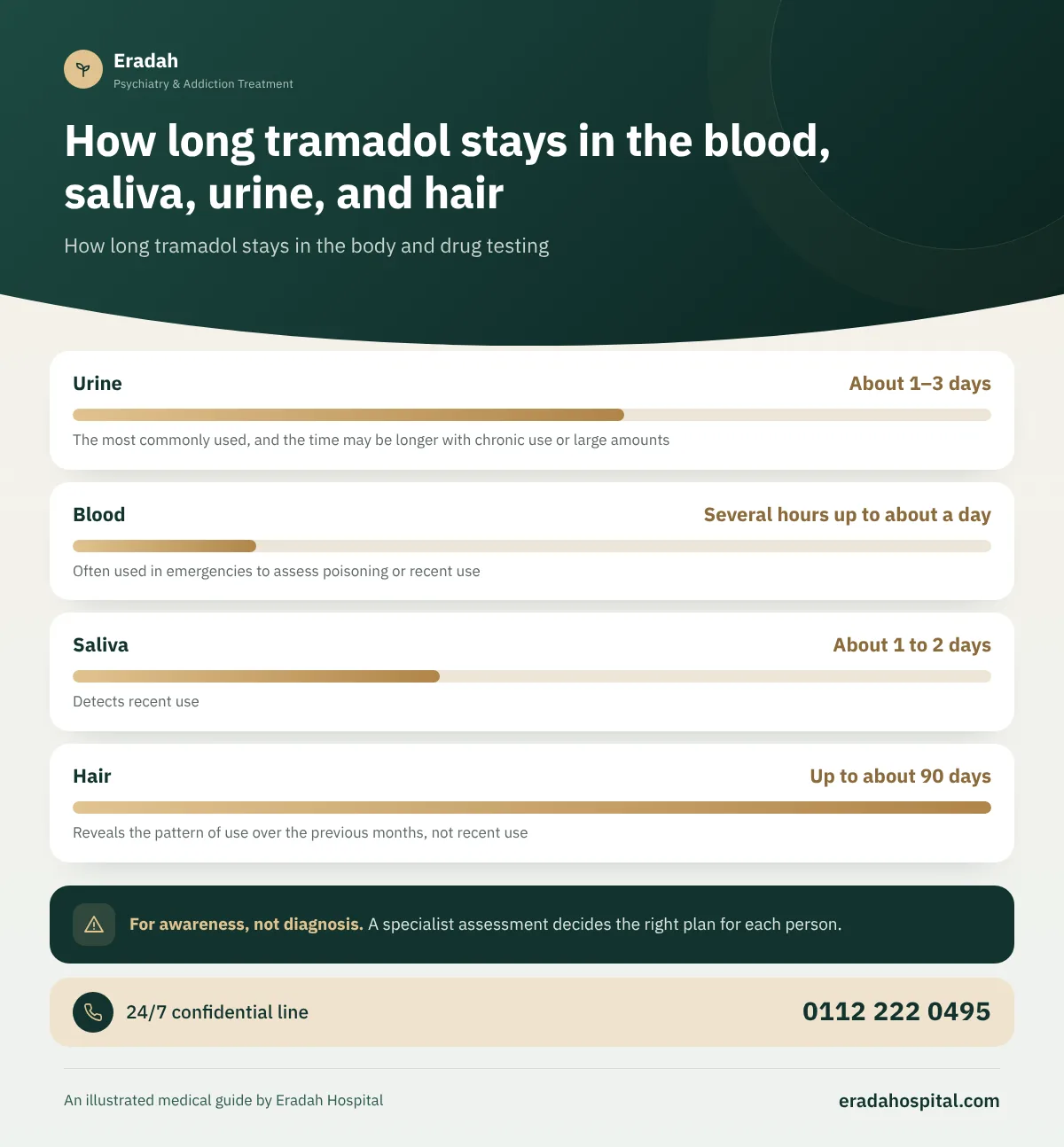
These time frames are approximate and vary with the laboratory, the sensitivity of the test and the cutoff level used. For an accurate interpretation of a specific result, consult a doctor or the laboratory.
Does tramadol show up on a standard drug test?
Not always. The usual rapid “opiate” test is designed mainly to detect morphine, codeine, and heroin, and often does not detect synthetic opioids such as tramadol. For this reason laboratories need a strip or test specific to tramadol, or an expanded opiate panel.
Factors that affect how long tramadol stays
- Frequency and duration of use: Chronic use lengthens the detection window compared with a single use.
- Type of tablets: Extended-release tablets stay longer than regular ones.
- Amount: larger amounts take longer to clear.
- Liver and kidney function: When they are weak, clearance of the drug and its products slows markedly.
- Age: Clearance usually slows with age, especially after age 75.
- Other medicines and genetics: Some medicines slow liver enzymes, and enzyme activity differs genetically.
The difference between a screening test and a confirmatory test
| Type of test | What it does | Limitations |
|---|---|---|
| Rapid initial screening test | Detects the presence of tramadol or its products above a certain threshold within minutes | May give a false positive or false negative |
| Confirmatory test | Identifies the substance precisely using specialized laboratory equipment | More accurate, but slower and more expensive |
For this reason, a positive result on a preliminary test, especially an unexpected one, must be confirmed with a confirmatory test before relying on it for a medical or legal decision.
Can the result be positive without taking tramadol?
Rarely, but it is possible. False positive results on the preliminary tramadol test have been reported in patients taking the allergy medicine fexofenadine, and the result disappeared on the confirmatory test. This is why you should tell the laboratory about all the medicines you take before testing.
If you take tramadol with a prescription and are asked to be tested
If you are a patient taking tramadol on a proper medical prescription, a positive result is expected and does not mean addiction. What matters is that the prescription is recent and clear, that you tell the party responsible for the test in advance, and that you stick to the dose the doctor set without increasing it. Do not stop your medicine suddenly before a test out of fear of the result; discuss it with your doctor instead.
Liver and kidney patients and older adults
The body clears tramadol and its products through the liver and kidneys, so it stays longer in people with liver and kidney disease and in older adults. This not only lengthens the detection window but also raises the risk of the drug building up and causing toxicity, which is why the doctor adjusts the treatment plan carefully for these patients.
On the other hand, the detection window cannot be relied on to determine exactly when a person took tramadol or how much, since the test usually tells you the substance is present above a certain threshold, not the details of use.
When are tramadol tests requested?
- In the emergency room for a seizure, unexplained loss of consciousness, or suspected poisoning.
- When starting an addiction treatment program, and during it to follow adherence.
- In people with chronic pain, to monitor adherence to the prescribed medicine.
- In some job, licensing, or legal procedures.
Tramadol testing in the emergency room
When a person arrives at the emergency room with a seizure or loss of consciousness, doctors do not wait for the test result to begin emergency care; they deal with breathing and seizures immediately. The test is then useful for identifying the substances responsible, especially when mixing tramadol with pregabalin, sedatives, or other substances is suspected. That is why telling the emergency team what you know about what the person took matters more than any test.
Why don’t we mention ways to get around the test?
Because testing in a treatment setting is a way to protect the patient and follow their recovery, not a way to punish. Attempts to quickly “flush” the body with large amounts of fluids or unknown substances can be dangerous, especially with a drug that may lower blood sodium. If you truly want to stop, the safe route is withdrawal under medical supervision.