Are there really different types of tramadol?
“Is this regular tramadol or the extended kind? Is the red one different from the white one?” People ask these questions as if tramadol came in varieties of different strength. In fact, the active ingredient is the same in every licensed type of tramadol. What differs is the dosage form: how fast it reaches the blood, how long it lasts, and whether it comes alone or with another painkiller.
Tramadol is an opioid painkiller that acts on opioid receptors and on serotonin and norepinephrine pathways; the tramadol guide explains how it works. Understanding its types helps patients who take it on prescription use it safely, helps families make sense of what they find at home, and matters for anyone who believes that one type is “milder” or “safer” to misuse.
Licensed types of tramadol by dosage form
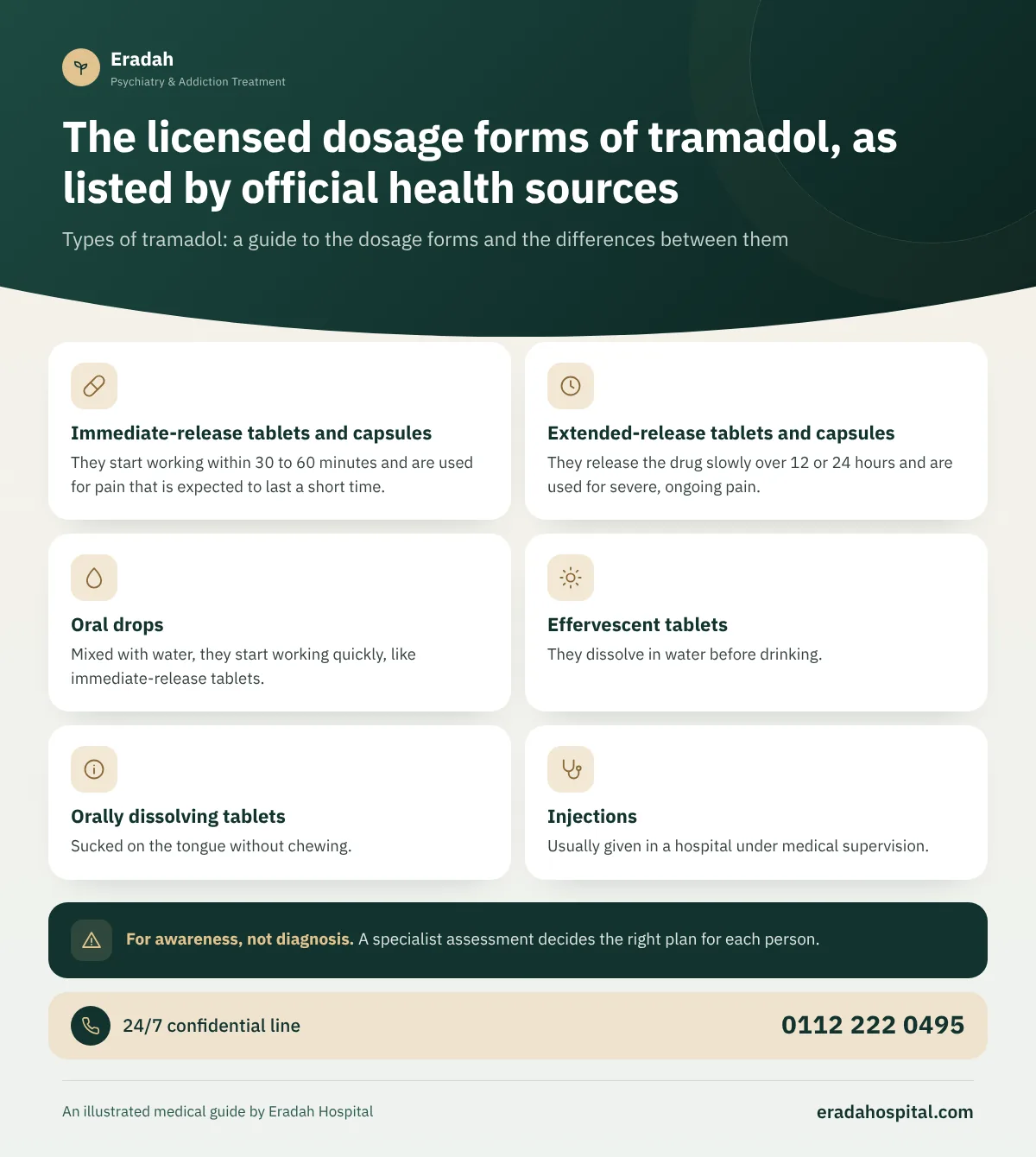
The UK National Health Service (NHS) notes that tramadol comes in several forms, each with a different use:
They start working within 30 to 60 minutes and are used for pain that is expected to last a short time.
They release the drug slowly over 12 or 24 hours and are used for severe, ongoing pain.
Mixed with water, they start working quickly, like immediate-release tablets.
They dissolve in water before drinking.
Sucked on the tongue without chewing.
Usually given in a hospital under medical supervision.
The doctor decides the type, strength and dose based on the kind of pain, the patient's age, and liver and kidney function. We do not give any doses here, because that is a medical decision for an individual patient.
The difference between immediate-release and extended-release tramadol
The two types differ in the timing of the effect, not in its nature:
| Immediate-release | Extended-release | |
|---|---|---|
| Onset of effect | Within 30 to 60 minutes | Slower at first |
| Duration of effect | A few hours, repeated through the day | Over 12 or 24 hours |
| Usual use | Short-term acute pain | Severe ongoing pain |
| Particular risk | Rapid repeat dosing and taking more | Breaking or chewing releases the whole amount at once |
Tramadol combined with other painkillers
Tramadol sometimes comes in a single tablet with a non-opioid painkiller, most commonly paracetamol. MedlinePlus, the US National Library of Medicine, notes that tramadol is available on its own and combined with acetaminophen, the American name for paracetamol.
The problem with combinations is that a person who takes more to get the tramadol effect also takes more paracetamol without noticing, and large amounts of paracetamol can cause serious liver damage. That is why patients need to know everything their medicine contains, and should not combine it with other painkillers containing paracetamol without asking a doctor or pharmacist.
Smuggled tablets: the most dangerous kind of tramadol
Outside pharmacies, the street trade circulates tablets with different numbers and colors, which people call “tamol” or refer to by numbers such as 225. In 2018, Egypt reported to the United Nations Office on Drugs and Crime large seizures of these tablets, along with analyses showing that their contents differed from what was printed on them. The page on tramadol 225 and red tramadol explains these types in detail.
The bottom line for you: a smuggled tablet is not a “type” of tramadol in the pharmaceutical sense. It is an unknown product that may contain less or more than what is written on it, or a different substance altogether. No one can work out a “safe dose” for it.
Medicines mistaken for a type of tramadol
Many people confuse tramadol with medicines that have similar names or effects, but these are actually different substances:
- Tapentadol: another opioid painkiller with a similar mechanism, but a different substance with its own risks.
- Codeine: a natural opioid found in some painkillers and cough medicines.
- Pregabalin: not an opioid, but it is often taken together with tramadol, and that combination is dangerous.
Is there a type of tramadol that is less addictive?
No. The official US Food and Drug Administration label for tramadol warns of the risk of addiction and misuse, slowed breathing, seizures, and serotonin syndrome when it is combined with certain medicines. These warnings apply to the substance itself in all its forms. The difference is that immediate-release tablets are easier to repeat and to take in larger amounts, extended-release tablets are more dangerous if broken, and injections outside a hospital have no place.
The page on tramadol addiction symptoms explains how to tell when use has become addiction, whatever the type.
If any type of tramadol has become dependence
Do not stop suddenly after regular use, because severe withdrawal symptoms can appear. The safe route is a medical assessment followed by a gradual tapering plan, which you will find in tramadol addiction treatment. At Eradah, the first consultation is free and confidential. Never start or stop any medicine without a doctor.
Danger signs after tramadol use: call an ambulance (123) right away
- Seizures, even in people who do not have epilepsy.
- Deep drowsiness or no response when called.
- Slow or irregular breathing, or bluish lips.
- Agitation, fever, sweating and tremor, which are possible signs of serotonin syndrome.
Call ambulance (123) immediately. If the person is unconscious but breathing, place them on their side so they do not choke on vomit. Stay with them and do not leave them alone. Do not give them food or drink, and tell the paramedics everything they took or used, and the amount and time if you know them.
Call the ambulance 123