What is tramadol 225?
“Just take half a 225, it won't do anything.” It sounds simple, but it rests on two wrong assumptions: that the number printed on the pill is real, and that there is a “guaranteed” amount of a substance that causes seizures and addiction. This page explains what lies behind high-strength pills, and why we cannot, and no one can, give you a “safe dose” for recreational use.
Tramadol is a licensed opioid painkiller that doctors prescribe for moderate to severe pain, dispensed in set medicinal strengths. What is known on the street as “tramadol 225” or “tamol 225” is smuggled pills. In a presentation Egypt gave to the United Nations Office on Drugs and Crime in 2018, large seizures of “tamol 225 mg” pills were reported, including about 25 million pills at East Port Said port.
The same presentation also discussed analysis of seized types, including “T-Dol 225” and “tramadol 225” and other high-strength pills, some with packaging marked “for export only.” A study published in 2019 on falsified tramadol in Egypt and West Africa also reports that 225 mg pills are sold in informal markets at very low prices, and that much of what circulates outside medical facilities is falsified or substandard.
What is red tramadol?
“Red tramadol” is a popular term for smuggled pills colored red or close to it. According to the Egyptian presentation to the United Nations, analysis of one of these types, a high-strength red pill, revealed tramadol together with a dye not approved as a food or drug additive, but approved for use in paints. An analysis by the Forensic Medicine Authority of the Ministry of Justice in 2018 of some seized pills also revealed impurities in place of tramadol, including gypsum, bicarbonate, and starch.
Is there a safe dose of tramadol?
In medical use, the doctor sets the dose for each patient according to the type and severity of pain, age, kidney and liver function, and other medicines they take, then follows up and adjusts it. For this reason we do not list any doses here. Outside medical use there is no safe dose, because:
- The contents of a smuggled pill are unknown.
- Tramadol causes tolerance, so the user needs more over time.
- The risk of seizures and respiratory depression differs from person to person and cannot be predicted.
- Mixing with other substances, which is common, changes the risk completely.
Why are high doses of tramadol dangerous?
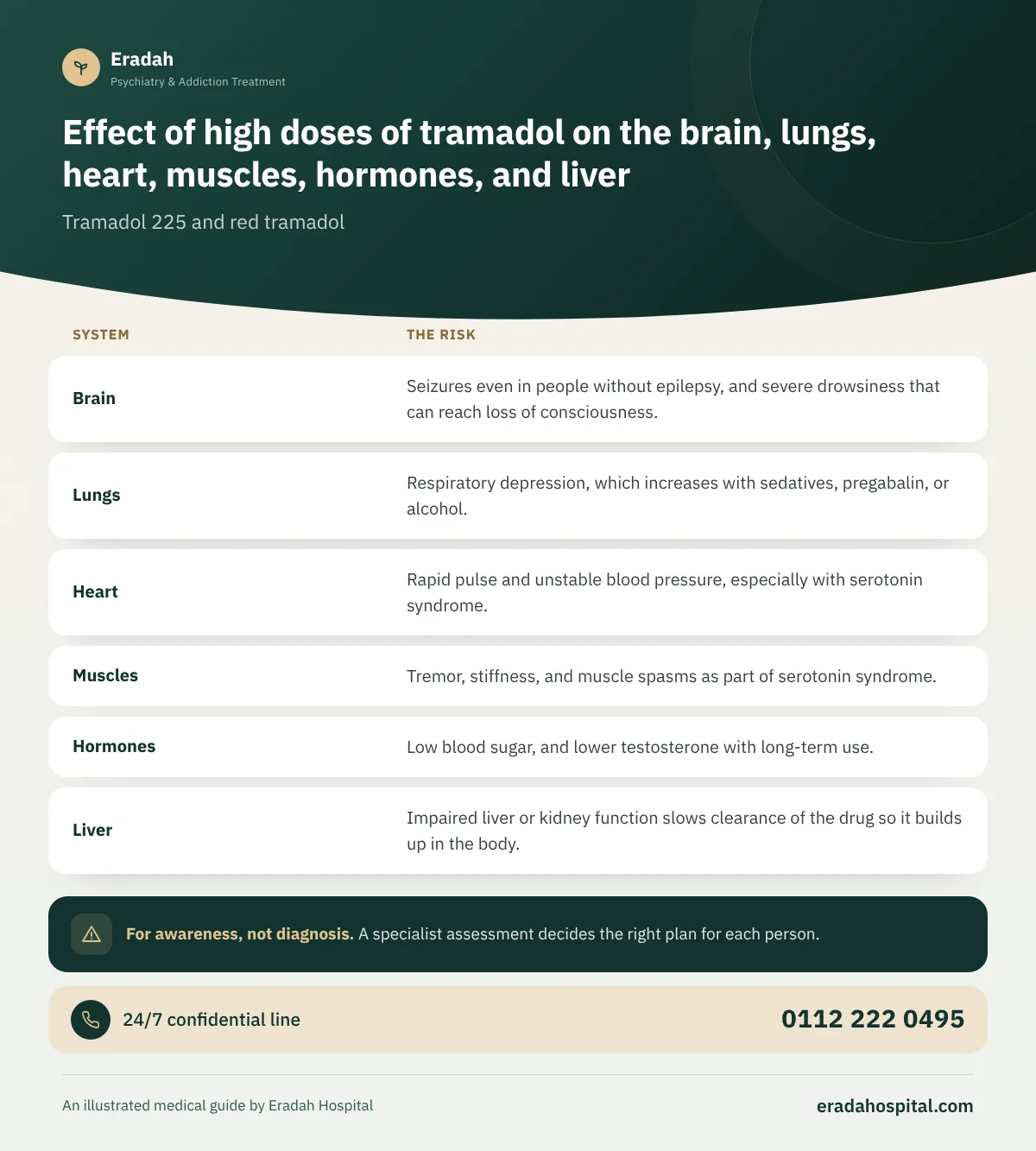
Tramadol works in two ways: it activates opioid receptors, and it raises serotonin and norepinephrine. With high doses, the risks of both appear together:
| System | The risk |
|---|---|
| Brain | Seizures even in people without epilepsy, and severe drowsiness that can reach loss of consciousness. |
| Lungs | Respiratory depression, which increases with sedatives, pregabalin, or alcohol. |
| Heart | Rapid pulse and unstable blood pressure, especially with serotonin syndrome. |
| Muscles | Tremor, stiffness, and muscle spasms as part of serotonin syndrome. |
| Hormones | Low blood sugar, and lower testosterone with long-term use. |
| Liver | Impaired liver or kidney function slows clearance of the drug so it builds up in the body. |
Egyptian figures confirm this risk. In a study of 71 patients hospitalized in Egypt for a tramadol overdose, published in 2023, seizures occurred in 38% of them and serotonin syndrome appeared in 41%, and both were linked to a high concentration of tramadol in the blood. Another study covering 11,281 cases of poisoning by substances at the Ain Shams University poison control center between 2015 and 2019 found that tramadol was the most common substance causing acute poisoning in most age groups.
Mixing tramadol with other substances
The most dangerous thing about high doses is that they rarely come alone. Mixing tramadol with pregabalin, sedatives, or alcohol multiplies the suppression of breathing and consciousness, and mixing it with some antidepressants or stimulants raises the risk of serotonin syndrome and seizures. The page on the harms of tramadol details these interactions.
High doses and addiction
The higher the amount, the greater the tolerance, and the greater the tolerance, the higher the amount, in a cycle that often ends in dependence. According to the Egyptian presentation to the United Nations, the 2015 national survey estimated the prevalence of tramadol dependence at about 2.4% of participants, making it the second most common substance of dependence in Egypt after cannabis. Anyone who reaches this stage goes through withdrawal symptoms on stopping, explained in the guide to tramadol withdrawal symptoms.
Signs of an overdose and what to do
- Seizures or involuntary movements.
- Severe drowsiness or being unable to wake up.
- Slow, weak, or irregular breathing.
- Very small pupils and bluish lips.
- Agitation, high temperature, sweating, and tremor, which are signs that may point to serotonin syndrome.
If you are taking high doses and want to stop
Do not stop suddenly on your own, and do not try to cut down using smuggled pills of unknown strength. Start by consulting a doctor, because stopping safely may need supervised detox, followed by a tramadol addiction treatment plan that includes psychological therapy and relapse prevention. Do not start or stop any medicine without a doctor.