First, understand: why do they hold on to tramadol?
“Without the pill I can't finish the shift.” This sentence sums up the story of many people addicted to tramadol in Egypt: a man working long hours in hard labor who started with a pill that gave him energy or eased his back, and then the pill became a condition for starting his day.
A study published in 2020 of 900 workers in an industrial city in the central Delta confirms that this picture is real; 92.3% of construction workers, 53% of microbus drivers, and 25.3% of textile workers had taken tramadol before. The first source was friends at 45.4%, and the main reasons were improving mood (54.3%), followed by relieving pain and being able to keep working (37.3%).
Knowing the reason changes how you talk. Someone who started because of work needs to hear that there is another way to get through their day, someone who started for real pain needs pain treatment, and someone who started for reasons related to the marital relationship will find the page on tramadol and sex useful. The signs of use themselves are in symptoms of tramadol addiction.
If it started with real pain
Some people addicted to tramadol did not buy it from the street the first time; they started with a prescription after an injury or surgery. Here families go wrong when they treat the pain as an excuse; the pain can be real and the dependence real at the same time. It helps more to say: “I believe you're hurting, let's go to a doctor who treats the pain itself.” The page on tramadol alternatives for treating pain sets out the options a doctor may discuss.
If they take it by prescription but raise the amount on their own, buy extra pills, or ask for it from more than one doctor, these are signs the treating doctor should know about. Go with them if they agree, and do not make any changes to their medicine without going back to the doctor.
How do you talk to him without him shutting the door?
With tramadol in particular, an endless debate keeps recurring: “it's a painkiller from the pharmacy, not a drug.” Do not enter that argument, and move the conversation to what you see with your own eyes:
| Instead of saying | Try saying |
|---|---|
| “You've become an addict like the heroin people.” | “I've noticed you get edgy in the morning until you take the pill, and that worries me.” |
| “Work doesn't need pills, you're fooling yourself.” | “I know your job is exhausting. I want us to find a way to help you without hurting you.” |
| “If you don't quit, I'll tell your family and your boss.” | “I'm with you, and we just want to hear a doctor's opinion once.” |
| “You're the reason for all the problems at home.” | “The house needs you clear-headed and focused, and I'm ready to help you.” |
Choose a time when they are calm, not at the peak of the drug's effect and not when they are irritable because they are late for their pill. The full steps of the evidence-based CRAFT approach are in how to persuade a person with addiction to seek treatment, so we do not repeat them here.
The danger of seizures: what should the family know?
Seizures are among the most serious features that set tramadol apart from other opioid painkillers, and its official leaflet from the US Food and Drug Administration states that they can occur even within prescribed doses, and the risk rises with higher amounts and with certain antidepressants. In a study from the epilepsy clinic at Kasr Al Ainy Hospital published in 2020, tramadol-induced seizures accounted for 7% of cases (103 of 1,480 patients), all of those affected were men, and the most common occupation among them was driving.
That is why a driver who uses tramadol is a danger to himself and his passengers. If a seizure happens in front of you:
- Move hard and sharp objects away from them, and put something soft under their head.
- Do not put anything in their mouth, and do not try to hold their movement still by force.
- Time the seizure if you can.
- Once the movement stops, place them on their side and make sure they are breathing.
- Call an ambulance (123); a first seizure, or a seizure after use, always needs medical assessment.
Tramadol with pregabalin or sedatives: the most dangerous mix in the home
Many people combine tramadol with pregabalin looking for a stronger effect or to ease withdrawal symptoms. The official pregabalin leaflet reports life-threatening or fatal respiratory depression in people who took it with opioids or other central nervous system depressants, and the tramadol leaflet likewise warns against combining it with sedatives, sleeping pills, and alcohol. The page on the harms of pregabalin explains this mix in detail.
The family's role here is practical: do not leave sedatives or sleeping pills within their reach, do not give them a “pill to make them sleep” when they are irritable or cannot sleep, and be alert if you find them deeply asleep with unusual snoring or difficult to wake; this is not “heavy sleep” but a danger sign that calls for an ambulance.
Why not make them stop suddenly at home?
Some families decide to lock their son in a room until the “tramadol leaves his body.” But the official tramadol leaflet warns that abrupt discontinuation in someone who has become physically dependent can cause severe withdrawal symptoms and unbearable pain, has been linked to suicides, and may push the person to seek other opioids, including heroin. The leaflet lists common withdrawal symptoms: restlessness, sweating, chills, muscle aches, insomnia, nausea, vomiting and diarrhea, and anxiety and nervousness.
It becomes more dangerous if they mix it with pregabalin or sedatives, because each has a different withdrawal that can include seizures. The safe place to stop is detox under medical supervision, and the page on tramadol withdrawal symptoms shows what happens at each stage.
After stopping: why does relapse become more dangerous?
The US National Library of Medicine (MedlinePlus) states that most opioid overdose deaths occur in people who have recently finished detox, because withdrawal lowers the body's tolerance, so a smaller amount than they were used to can cause an overdose. This applies to tramadol as an opioid, with the added risk of seizures.
So if they go back to tramadol days or weeks after stopping, do not settle for sadness or anger; watch for danger signs in the hours that follow, and get in touch with the treatment team. Relapse does not mean treatment failed, and the page on relapse in addiction explains how to deal with it.
Practical boundaries: money, driving, and work
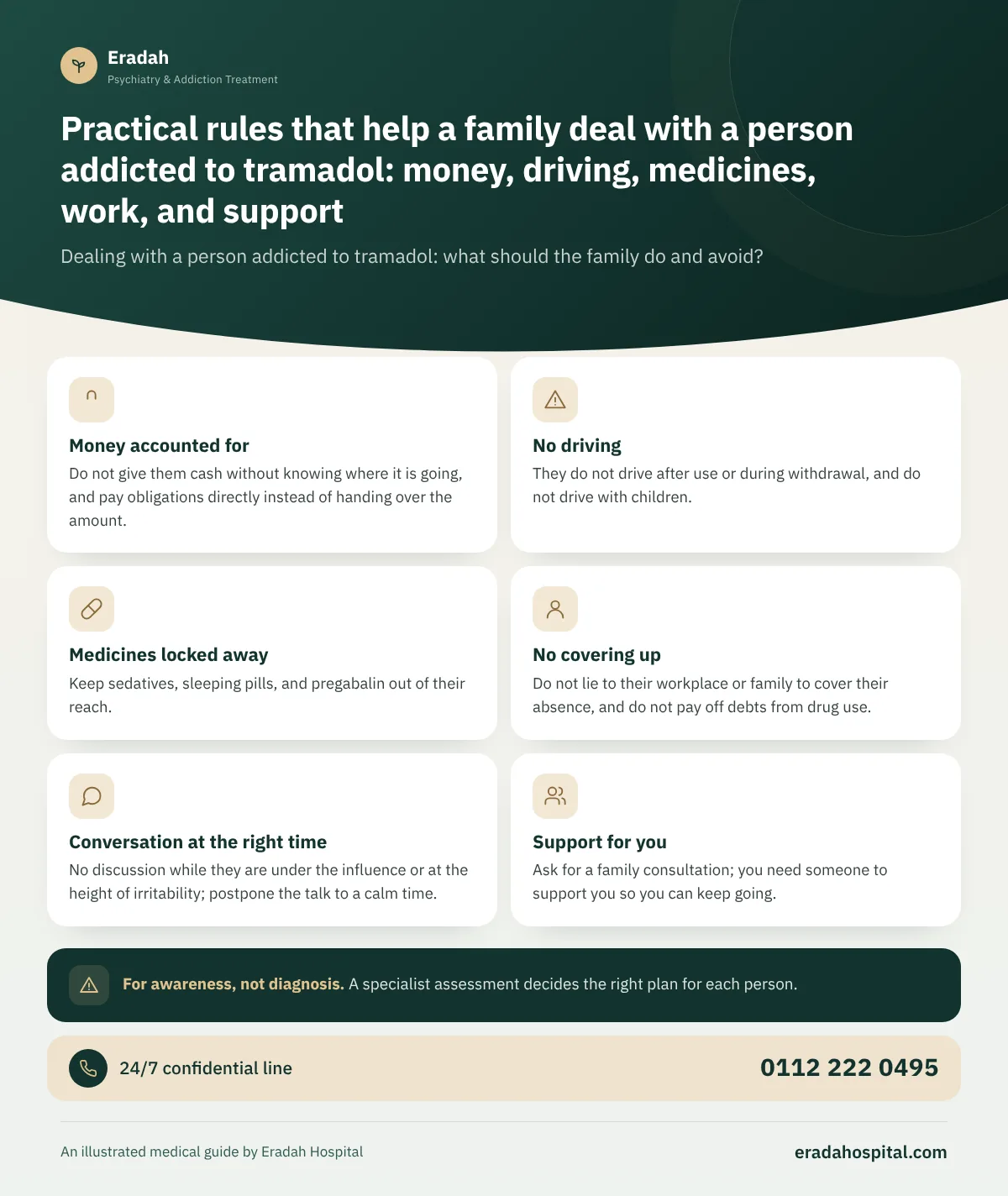
Clear boundaries protect the family without turning into daily battles. These are rules that suit tramadol addiction in particular:
Do not give them cash without knowing where it is going, and pay obligations directly instead of handing over the amount.
They do not drive after use or during withdrawal, and do not drive with children.
Keep sedatives, sleeping pills, and pregabalin out of their reach.
Do not lie to their workplace or family to cover their absence, and do not pay off debts from drug use.
No discussion while they are under the influence or at the height of irritability; postpone the talk to a calm time.
Ask for a family consultation; you need someone to support you so you can keep going.
If you are the wife of a man addicted to tramadol, the guide on dealing with an addicted husband covers protecting yourself and your children in more detail.
When should you seek specialist help?
Do not wait for them to be “completely convinced.” The family can start alone with a consultation in which they learn how to encourage them, and it helps to offer them a small step such as a medical assessment, not “a rehab for months.” The assessment determines the appropriate level of treatment, and you will find the stages and duration in tramadol addiction treatment, while Eradah's family treatment program offers sessions for relatives alone and together with the patient. The first consultation is free and confidential.
Danger signs after tramadol use: call an ambulance (123) right away
- Seizures or an epileptic fit, even in someone without epilepsy.
- Very slow or irregular breathing, or unusual snoring during sleep.
- Severe drowsiness and no response to calling or touch.
- Very small pupils with bluish lips.
- Agitation, high temperature, sweating, tremor, and muscle stiffness.
Call ambulance (123) immediately. If the person is unconscious but breathing, place them on their side so they do not choke on vomit. Stay with them and do not leave them alone. Do not give them food or drink, and tell the paramedics everything they took or used, and the amount and time if you know them.
Call the ambulance 123