“Why me? My siblings grew up in the same house and nothing like this happened to them.” Many patients and families ask this question, and it sometimes turns into blame: blaming oneself, blaming the parents, or blaming “the evil eye.” Science offers a calmer and more accurate answer: the causes of mental illness are a network of factors, not a single culprit.
Why is there no single cause of mental illness?
The World Health Organization explains that a wide range of individual, family, community, and structural factors can come together at any time to protect mental health or undermine it, and that many risk and protective factors act through changes in the structure or function of the brain. The US National Institute of Mental Health (NIMH) explains that common disorders such as depression and anxiety most likely result from a combination of life experiences, environment, and genetic differences. This is why two people can go through the same circumstances and one becomes ill while the other does not.
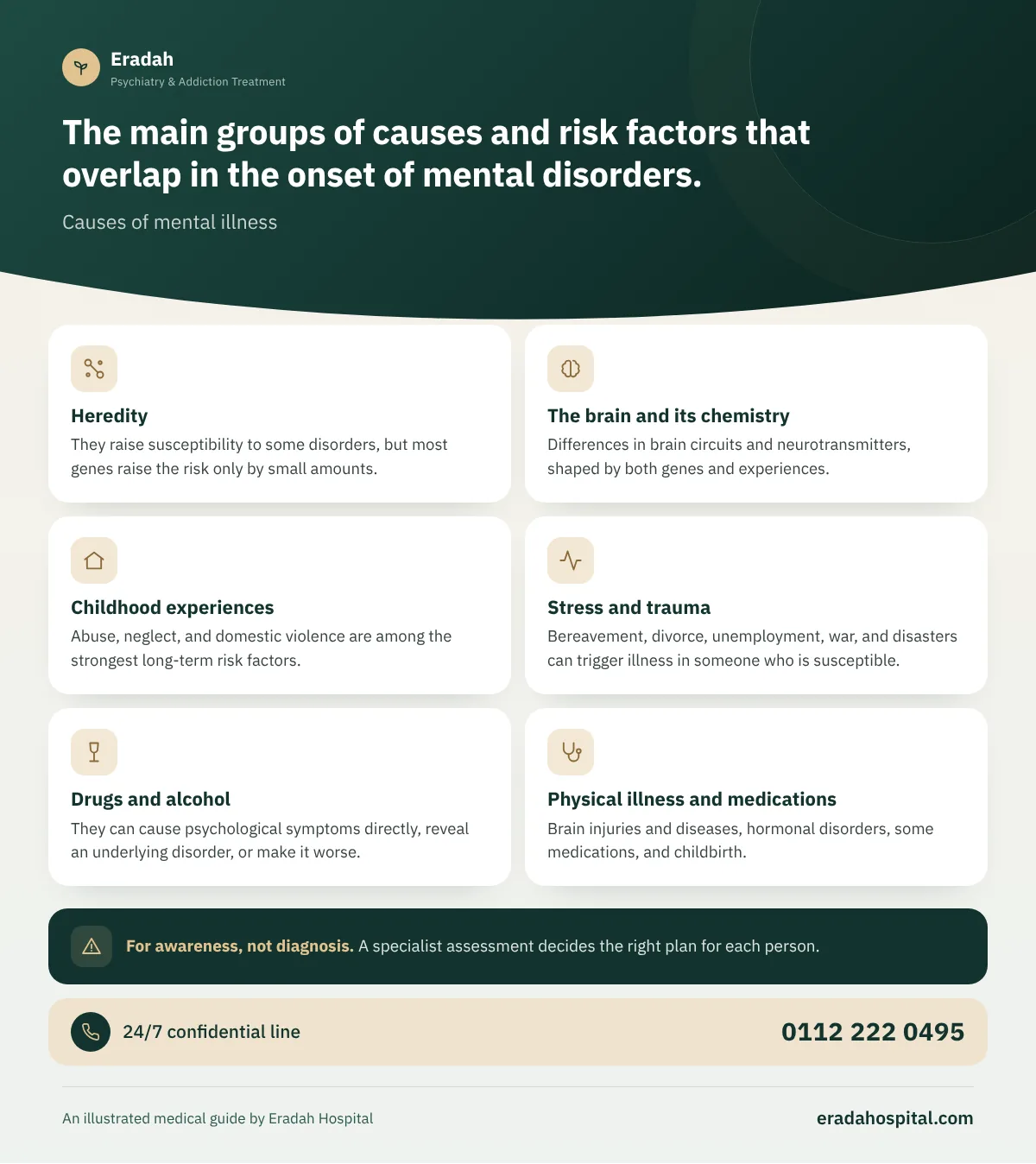
The main causes and risk factors of mental illness
They raise susceptibility to some disorders, but most genes raise the risk only by small amounts.
Differences in brain circuits and neurotransmitters, shaped by both genes and experiences.
Abuse, neglect, and domestic violence are among the strongest long-term risk factors.
Bereavement, divorce, unemployment, war, and disasters can trigger illness in someone who is susceptible.
They can cause psychological symptoms directly, reveal an underlying disorder, or make it worse.
Brain injuries and diseases, hormonal disorders, some medications, and childbirth.
Genetics: susceptibility, not destiny
NIMH says that most genetic differences do not directly cause mental disorders, that the genes linked to them raise the risk by very small amounts in most cases, and that having an affected first-degree relative may mean a higher risk but does not mean you will inevitably develop the condition. For this reason, genetic tests cannot currently predict accurately your risk of developing a mental disorder. You can find the details for each disorder on its causes page, such as causes of depression, causes of schizophrenia, and causes of bipolar disorder.
The brain and its chemistry
Thoughts and feelings run through networks of nerve cells that communicate using chemical messengers such as serotonin, dopamine, and GABA. How these networks work differs from person to person because of genes and experiences together; chronic stress, for example, raises the hormone cortisol and affects sleep and mood. But the phrase “a chemical deficiency in the brain” is a misleading oversimplification, since the brain changes with psychotherapy just as it does with medication.
Difficult childhood experiences
In a pooled analysis published in The Lancet Public Health in 2017, covering 37 studies and more than 250,000 participants, people who had gone through four or more difficult childhood experiences, such as maltreatment or witnessing domestic violence, were more likely to have every health outcome studied than those who had gone through none. The association was strong with poor mental health and heavy alcohol use (odds ratios between 3 and 6), and strongest with harmful drug use and violence toward others or oneself (more than 7). This does not mean everyone with a difficult childhood will become ill; it means prevention starts at home.
Stress, trauma, and life circumstances
The World Health Organization notes that people exposed to adverse conditions such as poverty, violence, disability, and inequality are more likely to develop mental disorders. Illness often follows a major event such as the death of a loved one, a breakup, or losing a job, in which case the event is the spark, not the only cause. You can find the difference between ordinary tension and illness on the stress and post-traumatic stress disorder pages.
Drugs and alcohol: both cause and consequence
The US National Institute on Drug Abuse (NIDA) says that many people who develop substance use disorders are also diagnosed with other mental disorders, and the reverse, and that according to the 2023 US national survey, 35% of adults with a mental disorder also had a substance use disorder. It explains that the two share risk factors such as genes, trauma, and stress. The NHS notes that using drugs and alcohol can trigger psychosis, including drug-induced psychosis. When the two occur together, the appropriate treatment is dual diagnosis care, which treats both together.
Physical illnesses and medications that can cause psychological symptoms
The NHS notes that psychosis can be triggered by a physical illness such as a brain tumor or dementia, by a head injury, by the side effects of some prescribed medications, or by childbirth. This is why a good psychiatrist begins with the necessary examination and tests before concluding that symptoms are purely psychological, especially if they appear suddenly later in life.
What is not a cause of mental illness
- Weak faith: A believer can become mentally ill just as they can become physically ill; faith is a support in recovery, not a substitute for treatment.
- Weak character or being spoiled: A mental disorder is a health condition with causes, not a flaw in character.
- A single cause in upbringing: Parents' mistakes may be a risk factor, but they rarely explain the illness on their own, and blaming the family does not help treatment.
- Laziness: Low energy and motivation are often a symptom of depression, not a cause of it.
Protective factors: what strengthens mental health?
The World Health Organization stresses that most people are able to stay resilient despite difficult circumstances, and that emotional skills are among the individual protective factors. In practice: supportive relationships, regular sleep, physical activity, staying away from drugs and alcohol, and seeking help early. At Eradah you can start with a free, confidential consultation to assess your situation, with outpatient treatment or residential care at Eradah Psychiatric Hospital for men when the case requires it.