Why does a person develop depression?
Doctors today explain depression through what is known as the biopsychosocial model: each person has a degree of vulnerability set by genetics, makeup and early experiences, and when this vulnerability meets enough stress, an episode of depression may begin.
That is why two people can go through the same hard circumstance, and one gets past it after a period of sadness while the other falls into depression. The reason is that the combination of factors in the second person is different, not that they are weaker. It is also why someone with a "stable life" can develop depression, to the surprise of those around them, even though the cause may be mainly biological.
What is the role of brain chemistry in depression?
For many years the idea spread that depression is simply a "serotonin deficiency." In truth, neurotransmitters such as serotonin, norepinephrine and dopamine, along with glutamate and GABA, take part in regulating mood, but depression cannot be reduced to a shortage of a single substance.
Recent research suggests the problem has more to do with how the brain networks for emotion, reward and thinking communicate, and with the ability of nerve cells to adapt and build new connections, an ability affected by chronic stress and improved with recovery. Areas studied include the prefrontal cortex, the hippocampus and the amygdala.
Is depression hereditary?
Genetics plays a clear role but is not inevitable. Having a first-degree relative (a parent or sibling) with depression raises the likelihood, and twin studies estimate that genetic factors explain roughly a third to 40% of the vulnerability to major depression, while the environment and experiences explain the rest.
There is no "depression gene," but hundreds of genes with small effects that make a person more sensitive to stress. So heredity does not mean that the children of an affected person will definitely become ill; it means early attention, a supportive environment and healthy skills for coping with stress matter.
How do hormones, chronic stress and inflammation play a part?
- The stress axis: under continuous pressure the body releases cortisol for long periods, and the regulation of this axis may be disturbed in many people with depression, affecting sleep, appetite and memory.
- Female hormones: hormonal changes before the period, after childbirth and around menopause may increase vulnerability in some women.
- The thyroid: an underactive thyroid can cause symptoms that look exactly like depression.
- Inflammation: raised inflammatory markers have been found in a share of people with depression, which may partly explain its link to chronic illness.
- Sleep and circadian rhythm: a disrupted body clock and low light in winter are linked to some forms of depression.
What psychological factors and thinking patterns pave the way for depression?
How we interpret what happens to us affects how we feel. Some patterns make a person more prone to depression when stress intensifies:
Going over problems and mistakes again and again without reaching a solution, as if the mind were running in circles.
Impossible perfectionist standards, and blaming yourself for everything that goes wrong.
Always expecting the worst and generalizing failure: "I failed once, so I'm a failure at everything."
A feeling that your personal worth depends on other people's approval or on achievement.
Not expressing sadness or anger, and putting up with everything in silence.
These patterns are mental habits, usually formed from past experiences, not flaws of character, and they can be learned and changed, which is exactly what cognitive behavioral therapy targets.
Do childhood trauma and painful experiences cause depression?
Painful childhood experiences, such as emotional neglect, abuse, losing a parent, or living in a home marked by violence or addiction, are among the strongest factors linked to depression later in life. Severe early stress can change how the body and brain respond to tension for life.
In adulthood, a trauma, an accident or an experience of violence may come before a depressive episode, and depression may occur together with post-traumatic stress disorder (PTSD). But having experienced trauma does not mean illness is inevitable, and safe relationships and early support make a big difference.
What life stresses and social factors are linked to depression?
- The death of a loved one, divorce, or the end of an important relationship.
- Job loss, unemployment, financial pressure and debt.
- Loneliness and isolation, and a weak social support network.
- Ongoing marital and family conflict.
- Bullying at school or work, discrimination and stigma.
- Caring for a chronically ill person for long periods without support.
- Migration, living abroad, and major changes in lifestyle.
Depression can sometimes come after seemingly happy events, such as a promotion, a move or childbirth, because they bring major pressures and changes.
Do physical illnesses and medications cause depression?
Yes, and this is an aspect many overlook. Some illnesses are linked to depression either through a direct effect on the brain and hormones or because of the burden of the illness itself:
| Category | Examples |
|---|---|
| Endocrine and metabolic diseases | Underactive thyroid, diabetes, adrenal gland disorders |
| Heart and blood vessel disease | Heart attacks, heart failure and stroke |
| Nervous system diseases | Parkinson's disease, multiple sclerosis, epilepsy, head injuries |
| Pain and chronic illness | Chronic back pain, rheumatic disease, cancer |
| Deficiency of certain nutrients | Anemia, vitamin B12 or folic acid deficiency; the link with vitamin D is being studied |
| Some medications | Such as cortisone when used for long periods, and other medications the doctor may review |
Do alcohol and drugs cause depression?
Alcohol, hashish, sedatives and opioids such as tramadol, and also the crash after stimulants, can all cause depressive symptoms or reveal hidden depression and deepen it. The relationship runs in both directions: depression drives substance use, and substance use deepens depression. Details are on the depression and addiction page.
What is the difference between a trigger and a cause?
A trigger is an event that sets off the episode, such as losing a job or a major argument, while the cause is the set of factors that made the person vulnerable in the first place. That is why "solving the problem" is not enough to end depression: the crisis may be resolved and the depression remain, because the vulnerability is still there. With repeated episodes, later episodes may need smaller triggers to begin, which explains why relapse prevention matters.
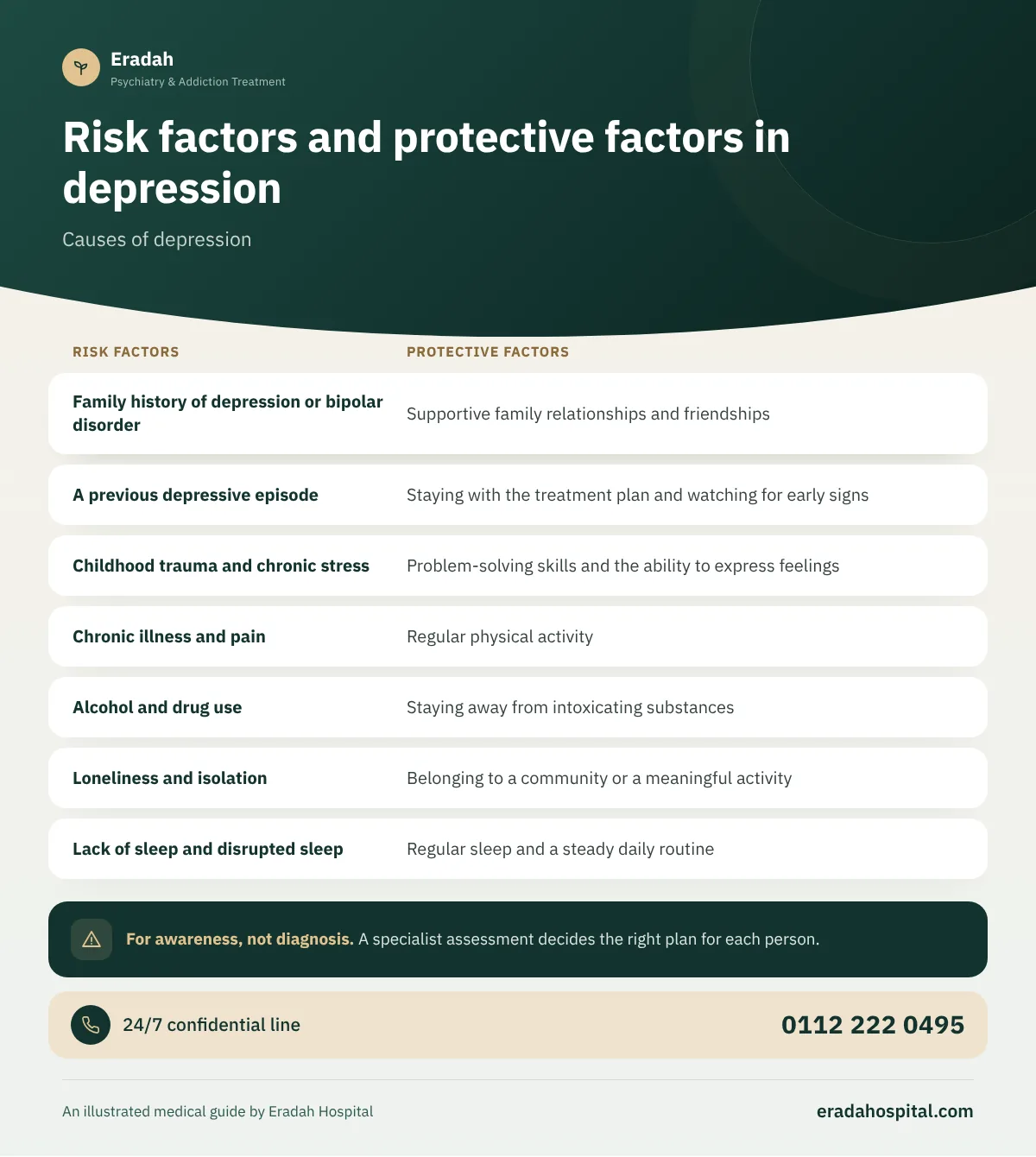
What are the risk factors and protective factors for depression?
| Risk factors | Protective factors |
|---|---|
| Family history of depression or bipolar disorder | Supportive family relationships and friendships |
| A previous depressive episode | Staying with the treatment plan and watching for early signs |
| Childhood trauma and chronic stress | Problem-solving skills and the ability to express feelings |
| Chronic illness and pain | Regular physical activity |
| Alcohol and drug use | Staying away from intoxicating substances |
| Loneliness and isolation | Belonging to a community or a meaningful activity |
| Lack of sleep and disrupted sleep | Regular sleep and a steady daily routine |
Why does vulnerability to depression rise at certain ages?
In adolescence, hormonal changes and brain development combine with school pressure, the search for identity and peer relationships, and bullying, long hours in front of screens and lack of sleep may add to vulnerability. That is why many people have their first episode between late adolescence and the mid-twenties.
After childbirth, a sharp drop in hormones combines with lack of sleep, the demands of caring for a newborn and changing roles. In old age, chronic illness, pain, the loss of a spouse and friends, retirement and loneliness build up, along with changes in the brain's small blood vessels that may be linked to what researchers call "vascular depression."
Common myths about the causes of depression
- "Depression is caused by weak faith": depression affects religious people and others, and faith can be a source of support and meaning but it is not a substitute treatment, and illness does not mean spiritual failure.
- "It's caused by idleness and being spoiled": depression affects busy and successful people, and idleness may be a result of depression, not its cause.
- "It's caused by envy or the evil eye": these are culturally widespread explanations, but they delay diagnosis and effective treatment if they take its place.
- "It's caused by poor parenting": the environment matters, but depression also affects children of loving, supportive families, and blaming parents helps no one.