What is contamination OCD?
“I wash my hands knowing they're clean, and I count to twenty, and if someone touches me afterward I start over. My hands have cracked and I can't stop.” This is how many people describe contamination OCD. The problem is not a lack of awareness; the person often knows their fear is exaggerated, but cannot tolerate the feeling of being contaminated.
Contamination OCD is one of the best-known themes of obsessive-compulsive disorder. The International OCD Foundation (IOCDF) lists these contamination fears: body fluids such as urine and feces, germs and illness, environmental contaminants, household cleaners and chemicals, and dirt. The types of OCD page explains where it sits among the other types, while here we look at it on its own.
Is contamination OCD common?
The IOCDF estimates that about 1 in 40 adults currently has OCD. In Egypt specifically, a study by a team from Ain Shams University of 90 OCD patients in Cairo, published in 1994, found that religious and contamination obsessions were the most common, at 60%. The two often overlap, as with someone who fears impurity and prolongs washing before prayer; we explain this form in religious OCD.
What is the difference between liking cleanliness and contamination OCD?
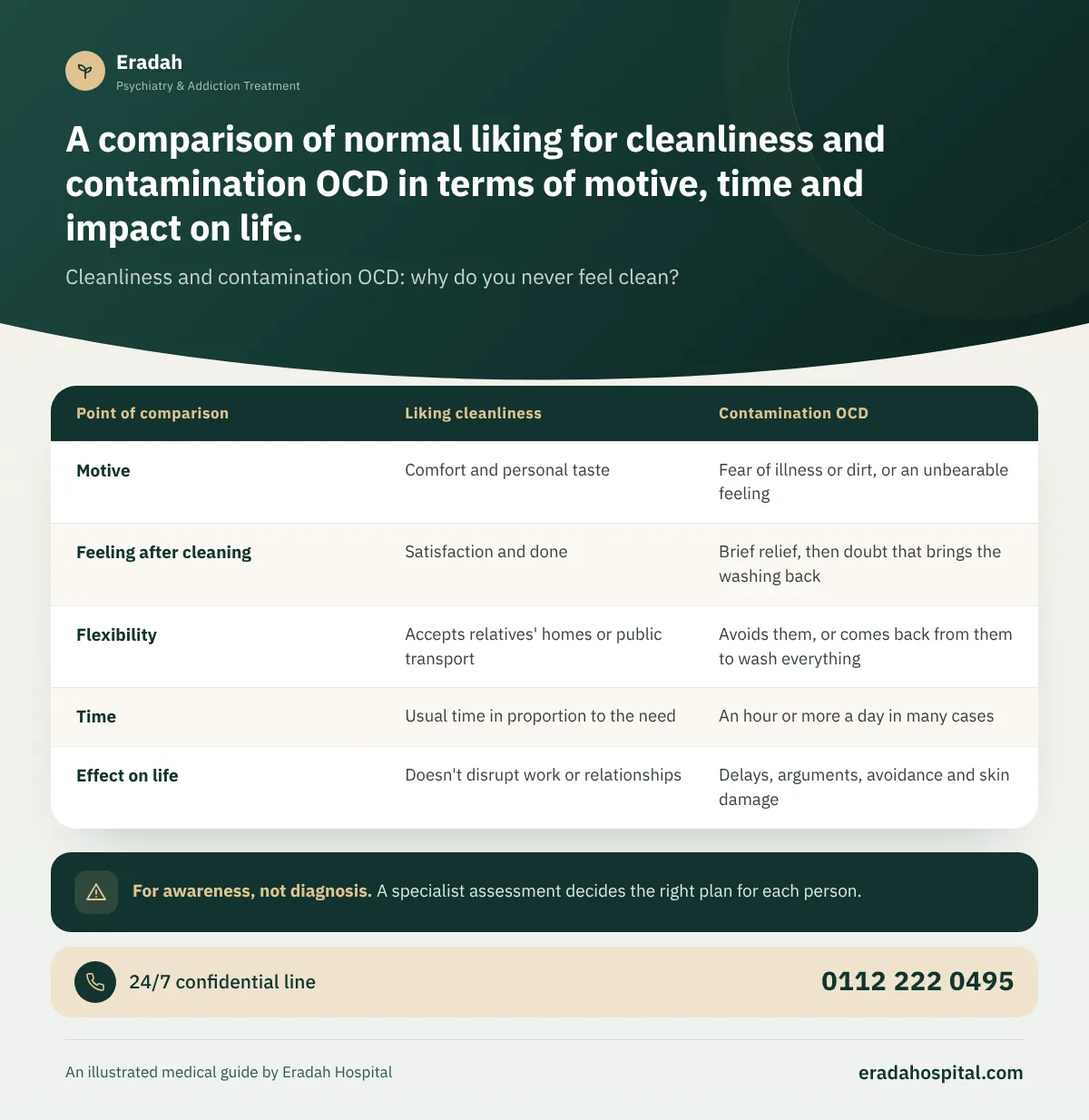
Many people jokingly say “I'm a cleanliness freak” because they like a tidy home. But the real difference is in the motive and the impact, not in how clean things are:
| Point of comparison | Liking cleanliness | Contamination OCD |
|---|---|---|
| Motive | Comfort and personal taste | Fear of illness or dirt, or an unbearable feeling |
| Feeling after cleaning | Satisfaction and done | Brief relief, then doubt that brings the washing back |
| Flexibility | Accepts relatives' homes or public transport | Avoids them, or comes back from them to wash everything |
| Time | Usual time in proportion to the need | An hour or more a day in many cases |
| Effect on life | Doesn't disrupt work or relationships | Delays, arguments, avoidance and skin damage |
Paradoxically, some people with contamination OCD live in messy rooms, because they avoid touching “contaminated” things in the first place. The OCD is about fear, not about order.
What are the visible and hidden forms of contamination OCD?
Washing the hands a set number of times or in a fixed order, and long showers that are repeated if a step “fails.”
Dividing the home into places that cannot be entered in outdoor clothes, and imposing rules on the family.
Refusing handshakes, opening doors with an elbow or a tissue, and avoiding public places.
Excessive use of alcohol, bleach and sanitizers, even on skin and food.
A feeling of being contaminated after a memory or a particular person without touching anything, which IOCDF calls “emotional contamination.”
Asking the family again and again: “Are your hands clean?” “Was this food washed well?”
Mental contamination is less well known but painful: the person feels “dirty inside” after a situation or a thought, so they wash their body even though they touched nothing, or fear that the traits of someone they dislike will “transfer” to them. This confirms that washing does not solve the problem, because its source is not the hand but the feeling.
What does contamination OCD do to the skin and the home?
Repeated washing and strong disinfectants cause dry, cracked and inflamed hands, and the patient may even avoid treating the skin for fear that creams are “contaminated.” At home, the rules gradually become a system that everyone lives by: taking off clothes at the door, washing groceries, and keeping guests away. The details of these complications are in the harms of OCD.
How is contamination OCD treated?
The UK NICE guidelines recommend cognitive behavioral therapy that includes exposure and response prevention as the main treatment for OCD, with a selective serotonin reuptake inhibitor (SSRI) medication when needed or in more severe cases. In contamination OCD, treatment usually goes through these stages:
- 1Mapping the fears
Identifying what triggers the feeling of contamination, what the patient does to get rid of it, and how long this takes each day.
- 2A graded ladder
Ranking situations from easiest to hardest, such as touching the room's door handle, then the apartment door, then public transport.
- 3Exposure with washing prevented
Touching the trigger and delaying washing until the anxiety settles on its own, so the brain learns the danger is not real.
- 4Reducing household rules
Canceling forbidden zones and reducing reassurance gradually, in cooperation with the family.
- 5Normal washing and relapse prevention
Reaching ordinary cleanliness like everyone else, and dealing quickly with any ritual that returns under stress.
Only the doctor decides the medication, its type and dose, and you should not start or stop any medication without a doctor. You can find a detailed example of an exposure ladder and medication options in OCD treatment.
When should you ask for help?
- If washing or cleaning takes an hour or more a day.
- If your hands are cracked or you have wounds and infections from washing and disinfectants.
- If you have started avoiding work, visits or public transport for fear of contamination.
- If your family changes their life to avoid upsetting you.
- If the OCD comes with deep sadness or despair.
At Eradah you can get a free, confidential first consultation and an assessment with a psychiatrist and a behavioral therapist in outpatient clinics, with an exposure plan suited to your situation and pace.
Severe despair or suicidal thoughts because of OCD? Get help now
- Talking about death or saying that life with OCD is “unbearable”
- Giving up eating, sleeping or going out altogether because of rituals or fear
- Severe skin wounds or infections from washing or disinfectants
- Hurting or punishing oneself because of thoughts they did not choose
- Saying goodbye to family, or a sudden strange calm after intense suffering
Stay with the person and listen calmly without blame or mockery, and reassure them that what they are going through is a treatable illness. Keep medications and dangerous objects out of their reach. Call an ambulance (123) or go to the nearest emergency room if the danger is imminent, and contact the mental health support line (16328), available around the clock.
Ambulance 123 Mental health support line 16328