What is doubting OCD?
“I locked the door and pulled the handle three times, went down the stairs, and then came back to make sure. At work I review an email ten times before I send it.” This is doubting OCD as many people live it: not ignorance of what happened, but an inability to feel that the matter is finished.
In everyday usage in Egypt, the phrase “doubting OCD” can mean two completely different things: the first is doubt about oneself, one's memory and one's actions, a well-known theme in obsessive-compulsive disorder. The second is suspicion about other people's intentions or a partner's faithfulness, which is closer to paranoia or pathological jealousy. This page is about the first type, with a table showing the difference between them.
What are the most common forms of doubting OCD?
The International OCD Foundation (IOCDF) lists among responsibility obsessions fear of causing something terrible such as a fire, a burglary or a car accident, and fear of harming others through lack of care. Among the checking acts it lists are making sure you have not harmed yourself or others, that nothing terrible has happened, and that you have not made a mistake. In real life it appears in forms such as:
Going back to check the door, gas, iron and windows, or photographing them with a phone.
Fear of having hit someone without noticing, and driving back to check the road.
Reviewing messages, papers and accounts many times before sending them.
Doubt that they said something hurtful or did something they don't remember, and reviewing conversations.
Constant doubt: Do I really love my partner? Are they the right person?
Repeatedly checking the body for a sign of illness, and asking doctors and family.
Constant doubt in a relationship is known as “relationship OCD,” and a review published in the journal Neuro Endocrinology Letters in 2024 describes its intrusive thoughts about the sincerity of feelings toward a partner or their suitability, and its rituals of checking, reassurance and comparison. We cover it in detail on the OCD and marriage page.
Why don't you feel reassured no matter how much you check?
This is the question that puzzles people with OCD and their families. Experiments published by two researchers from Maastricht University in the journal Behaviour Research and Therapy in 2003 gave a striking answer: healthy volunteers were asked to repeatedly check a virtual gas stove on a computer, and the accuracy of their memory stayed the same, but the vividness and detail of the memory dropped sharply, and their confidence in their memory weakened. The researchers concluded that checking feeds doubt instead of removing it.
In other words: the more you check, the more the memory of “I locked the door” becomes faint and mixed with dozens of earlier times, so your certainty falls, and you check again. It is a cycle created by the solution itself.
- 1Suspicion
“Did I turn off the gas?”
- 2Anxiety and responsibility
“If there's a fire, it will be because of me.”
- 3Checking
Going back to the kitchen, looking, touching and counting.
- 4Brief relief
The anxiety settles for a few minutes.
- 5A faint memory
The times blur together, so the doubt returns stronger and needs more checking.
What is the difference between doubting OCD and pathological suspicion of others?
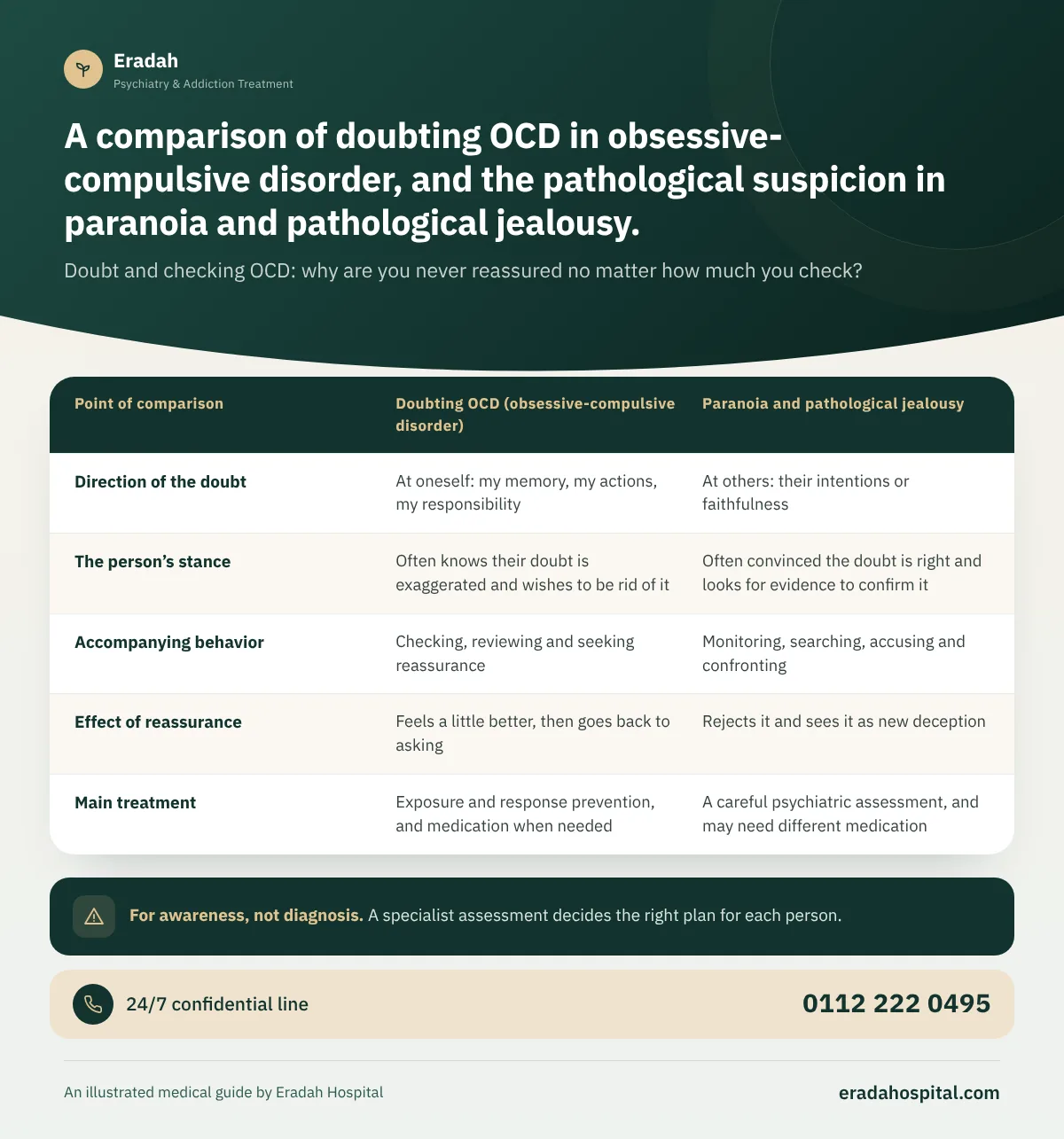
Confusing the two conditions is common and can delay the right treatment. The essential difference is in the direction of the doubt and the person's attitude toward it:
| Point of comparison | Doubting OCD (obsessive-compulsive disorder) | Paranoia and pathological jealousy |
|---|---|---|
| Direction of the doubt | At oneself: my memory, my actions, my responsibility | At others: their intentions or faithfulness |
| The person’s stance | Often knows their doubt is exaggerated and wishes to be rid of it | Often convinced the doubt is right and looks for evidence to confirm it |
| Accompanying behavior | Checking, reviewing and seeking reassurance | Monitoring, searching, accusing and confronting |
| Effect of reassurance | Feels a little better, then goes back to asking | Rejects it and sees it as new deception |
| Main treatment | Exposure and response prevention, and medication when needed | A careful psychiatric assessment, and may need different medication |
In some cases the patient's conviction in their suspicions becomes so strong that it approaches a delusional disorder, and here an assessment by a psychiatrist is decisive.
What helps and what worsens doubting OCD?
| Instead of… | Try… |
|---|---|
| You go back to check the door a second time | You check once with full attention, then walk away carrying the doubt with you |
| You ask those around you, “Are you sure I locked it?” | You tell yourself: “I may have forgotten, and I'll live with that possibility” |
| You review the message ten times | You set one review and then send |
| You try to push the doubt away with logic | You notice it and name it: “That's the OCD,” and go back to what you were doing |
These steps look simple but are painful at first, because anxiety rises before it settles. That is why they work better within a treatment plan with a therapist who goes through it with you.
How is doubting OCD treated?
The UK NICE guidelines recommend cognitive behavioral therapy that includes exposure and response prevention as the main treatment for OCD, with a selective serotonin reuptake inhibitor (SSRI) medication when needed. In doubting OCD, the patient practices situations such as leaving without going back to the door, sending a message after one review, and leaving the gas without photographing it, tolerating the doubt until it settles on its own. Cognitive therapy also works on beliefs such as excessive responsibility and the need for total certainty.
Only the doctor decides the medication, its type and dose, and you should not start or stop any medication without a doctor. The details are in OCD treatment. At Eradah you can get a free, confidential first consultation and a treatment plan in outpatient clinics with a psychiatrist and a behavioral therapist.
When does doubting OCD become a reason to see a doctor?
- If checking takes an hour or more of your day, or makes you late for work and appointments.
- If you have started avoiding responsibilities such as driving, cooking or signing, for fear of making a mistake.
- If your family members check for you or answer reassurance questions every day.
- If the doubt threatens your marriage or your job.
- If it comes with depression or despair.
Severe despair or suicidal thoughts because of OCD? Get help now
- Talking about death or saying that life with OCD is “unbearable”
- Giving up eating, sleeping or going out altogether because of rituals or fear
- Severe skin wounds or infections from washing or disinfectants
- Hurting or punishing oneself because of thoughts they did not choose
- Saying goodbye to family, or a sudden strange calm after intense suffering
Stay with the person and listen calmly without blame or mockery, and reassure them that what they are going through is a treatable illness. Keep medications and dangerous objects out of their reach. Call an ambulance (123) or go to the nearest emergency room if the danger is imminent, and contact the mental health support line (16328), available around the clock.
Ambulance 123 Mental health support line 16328