Do people with OCD get married?
“My fiancé found out I'm being treated for OCD, and I don't know how much to tell him or when. I'm afraid the OCD will ruin everything after the wedding.” Many people with OCD and their families in Egypt carry this question.
The reassuring medical answer: OCD does not prevent marriage or having children, and many patients live stable married lives, especially after treatment. But marriage itself puts OCD in the middle of daily life: a shared home, an intimate relationship, and responsibility for children. That is why it calls for preparation and openness, not concealment.
Before marriage: openness and preparation
- Start treatment or settle into it first: entering marriage with OCD at its peak doubles the pressure on both partners.
- Be clear with the other person: the name of the illness, how it affects you, and what treatment you are receiving. Concealment destroys trust when it is discovered.
- Invite them to a session with your doctor or therapist if you both wish, so they can ask and understand from a trusted source.
- Agree on realistic expectations: symptoms may return under stress, and that does not mean the treatment failed.
The UK NICE guidelines note that people with OCD often feel ashamed of their condition and find it hard to talk about, even with family, and recommend involving the family or partner in assessment and treatment when appropriate.
Relationship OCD: when the mind doubts love itself
One form of OCD that appears specifically around engagement and marriage is known as “relationship OCD.” A review published in the journal Neuro Endocrinology Letters in 2024 describes it as repeated intrusive thoughts: Do I really love my partner? Do they love me? Are they the right person? or a painful preoccupation with flaws in their looks or personality. These thoughts drive rituals such as repeatedly checking feelings, seeking reassurance, and comparing with others, so the relationship is disturbed and the anxiety continues.
The difference between it and normal hesitation is that here no answer settles the doubt, it returns stronger after each reassurance, and it causes severe distress to the person themselves. Doubting a partner's faithfulness, with searching and accusation, is closer to pathological jealousy, and you can find the difference in detail on the doubting OCD page.
How does OCD affect daily married life?
Rituals that the patient used to perform alone become, after marriage, rules that both partners live by: taking off clothes at the door, keeping guests away, checking locks before sleep, or reassurance questions every hour. Over time the partner gets tired and angry, and the patient feels guilty. You can find the details of these harms in the harms of OCD.
The intimate side may also be affected: a person with contamination OCD may avoid closeness for fear of body fluids, and someone invaded by unwanted sexual thoughts may pull away from their partner to escape them. This is not aversion to the partner, but a treatable symptom that is discussed openly with the therapist, and the sexual OCD guide explains this type. A common form in Egypt is also “divorce OCD,” meaning the fear that a passing word has caused a divorce, which we cover in religious OCD.
What does the partner do? Responses that feed the OCD and others that help
| The situation | What feeds the OCD | What often helps |
|---|---|---|
| Asks for the tenth time: “Are you sure you love me?” | Giving the same answer each time to end the conversation | “You know my answer, and that's the OCD asking. Let's do something together.” |
| Asks you to wash your hands again | Complying every time to avoid an argument | Agreeing with the therapist to reduce this gradually |
| Checks the doors several times before sleep | Checking for them so they can relax | Gently reminding them of the treatment plan and encouraging them to resist |
| Gets angry when you don't join the ritual | Responding with anger or mockery | Staying calm, acknowledging how hard the anxiety is, and sticking to the agreement |
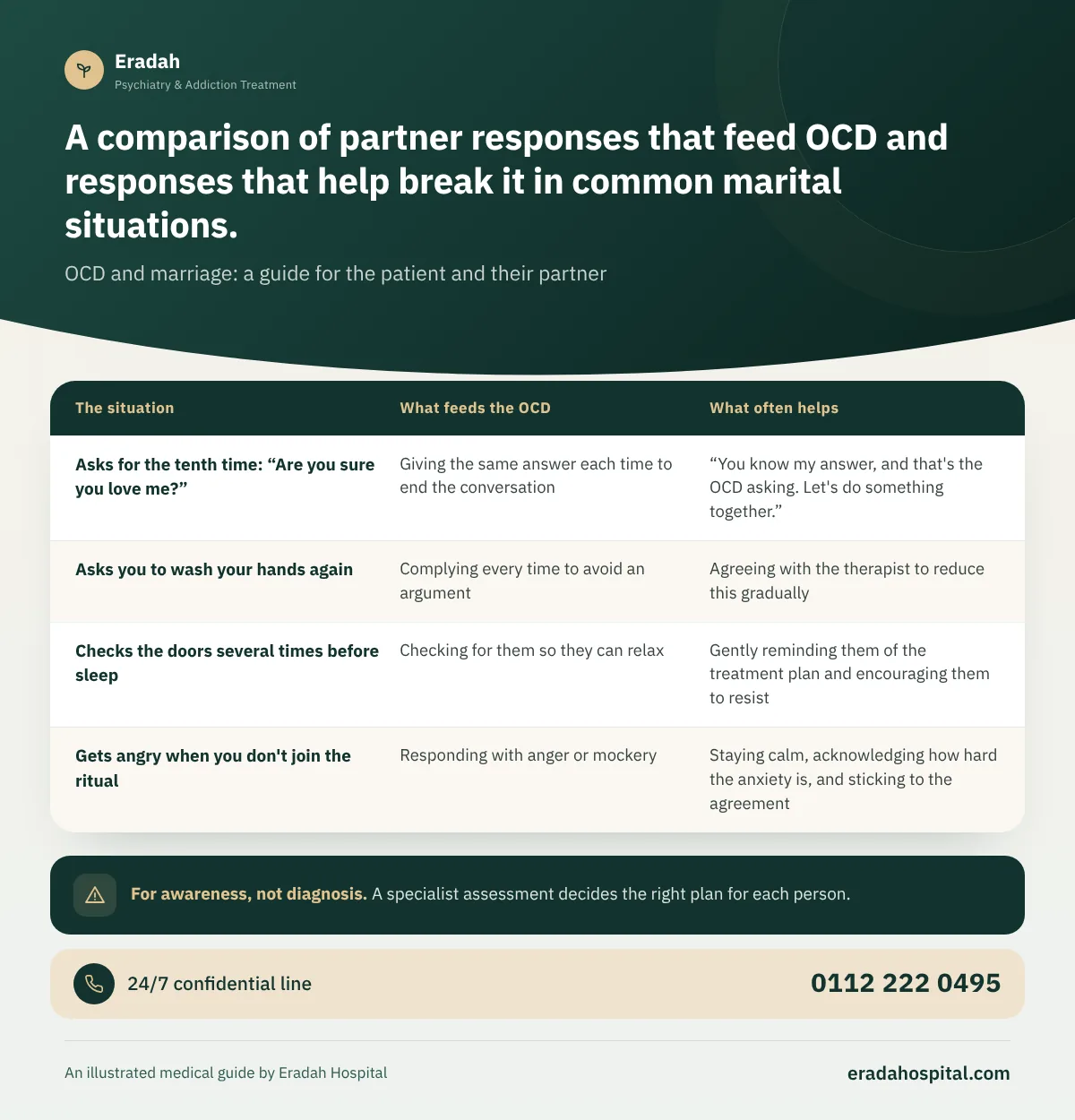
This help, called “accommodation,” looks like love, but it keeps the OCD alive. What is needed is not sudden refusal, but a gradual plan agreed with the therapist.
OCD around pregnancy and after childbirth
The UK National Health Service (NHS) notes that OCD can appear during pregnancy or after childbirth, as worry about harming the baby or about not sterilizing bottles well enough, with rituals such as repeatedly checking the infant's breathing. A pooled analysis published in the Journal of Clinical Psychiatry in 2013 found that the rate of OCD was about 1.08% in women in general, 2.07% in pregnant women, and 2.43% in mothers after childbirth.
A mother who is invaded by a thought of harming her child and is terrified by it is not a danger to the child; this is the terror of OCD, not a wish. But she needs a quick assessment and support, not blame. If she is on medication and planning a pregnancy, the decision is discussed with the doctor in advance, and she should not start or stop any medication without a doctor. If severe sadness comes with it, read about postpartum depression.
Couple-based treatment for OCD
The main treatment for OCD is exposure and response prevention, and researchers have developed a version in which the partner takes part. In an early study published in the journal Behavior Therapy in 2013, a program of 16 sessions for the patient and their partner was tested, including partner-assisted exposure exercises, work on accommodation patterns, and other relationship stresses. The researchers observed improvement in OCD symptoms, in the relationship and in depression, and the improvement in symptoms lasted up to a year.
At Eradah, couples can get a free, confidential first consultation, then a treatment plan in outpatient clinics with sessions the partner takes part in, alongside the family program. Learn about the options in OCD treatment.
Severe despair or suicidal thoughts because of OCD? Get help now
- Talking about death or saying that life with OCD is “unbearable”
- Giving up eating, sleeping or going out altogether because of rituals or fear
- Severe skin wounds or infections from washing or disinfectants
- Hurting or punishing oneself because of thoughts they did not choose
- Saying goodbye to family, or a sudden strange calm after intense suffering
Stay with the person and listen calmly without blame or mockery, and reassure them that what they are going through is a treatable illness. Keep medications and dangerous objects out of their reach. Call an ambulance (123) or go to the nearest emergency room if the danger is imminent, and contact the mental health support line (16328), available around the clock.
Ambulance 123 Mental health support line 16328