What is OCD in children?
“My son is 9, and every night he has to make sure the doors are locked and asks me the same question ten times, and if he forgets something he cries and can't sleep.” Many parents at first think it is a “habit” or “being fussy,” and then discover that their child is living with a fear he doesn't know how to put into words.
OCD in children is the same disorder that affects adults: intrusive thoughts that cause intense anxiety, and repetitive rituals that the child performs to ease that anxiety. The UK National Health Service (NHS) notes that symptoms can begin as early as age 6, though they often begin around puberty and early adulthood. AACAP estimates that it may affect as many as 1 in 200 children and teens. You can find a general explanation of the illness in the OCD guide.
How do OCD symptoms appear in children?
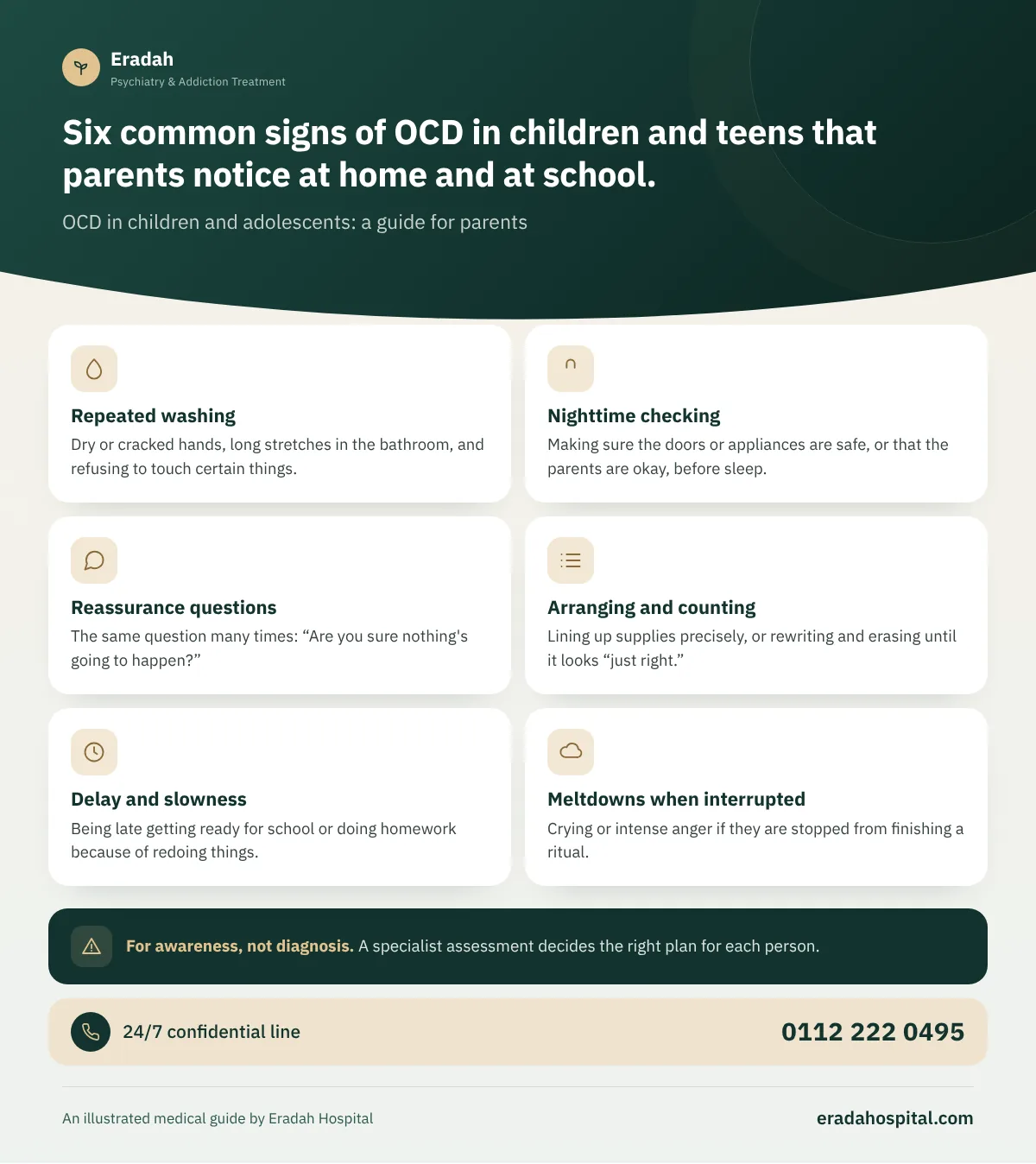
AACAP explains that the content of obsessions changes with the child's age: a younger child may fear that harm will come to them or a family member, such as a burglar entering through an unlocked door, so they check the doors and windows after their parents go to sleep. An older child or teen may fear germs, infection or contaminated food. Signs that parents notice include:
Dry or cracked hands, long stretches in the bathroom, and refusing to touch certain things.
Making sure the doors or appliances are safe, or that the parents are okay, before sleep.
The same question many times: “Are you sure nothing's going to happen?”
Lining up supplies precisely, or rewriting and erasing until it looks “just right.”
Being late getting ready for school or doing homework because of redoing things.
Crying or intense anger if they are stopped from finishing a ritual.
You can find a broader list of symptoms in adults and children on the OCD symptoms page.
Normal childhood rituals or OCD?
Many young children like repetition: the same bedtime story, the same cup, or arranging their toys a certain way. This is a normal part of development that gives them a sense of safety. The difference lies in the impact and the motive:
| Point of comparison | Normal rituals | OCD |
|---|---|---|
| Accompanying feeling | Enjoyment or comfort | Intense fear or distress if the ritual isn't completed |
| Flexibility | Accepts change with a little grumbling | Falls apart or starts everything over |
| Time | A few minutes | A long time that grows over the weeks |
| Effect | Doesn't disrupt the day | Delays school and sleep and wears out the family |
| With age | Fade gradually | Continue, increase, or change their themes |
Can OCD start suddenly after an infection?
Yes, in rare cases. The US National Institute of Mental Health (NIMH) describes two conditions called PANS and PANDAS, marked by a sudden, severe onset of OCD or a restrictive eating disorder in children before puberty, usually between age 3 and puberty. PANDAS in particular is linked to streptococcal bacterial infection such as strep throat, and the immune system is thought to mistakenly attack parts of the brain.
This may be accompanied by tics, mood swings, separation anxiety, changes in handwriting and problems with sleep and urination. If this picture appears over a few days, the right step is an assessment by a pediatrician and a child psychiatrist together, not waiting.
Why does a child hide their obsessions?
AACAP notes that children and teens often feel ashamed and embarrassed about OCD, and many fear it means they are “crazy,” so they hesitate to talk about their thoughts. Some of the thoughts themselves frighten the child, such as the idea of hurting a brother or sister, so they hide them for fear their parents will think they are bad.
- Tell them that these thoughts are “like a false alarm in the brain,” and that they do not mean the child is evil or crazy.
- Listen without shock or punishment, even if the thought disturbs you.
- Give the OCD a name separate from your child, so you talk about “the annoying OCD,” not the child's “flaws.”
- Coordinate with the school if the OCD is slowing them down with homework or exams, as the UK NICE guidelines recommend involving teachers and specialists when needed.
How can you help your child without feeding the OCD?
AACAP explains that parents often “give in” to OCD to ease their child's distress. It calls this accommodation, and notes that most parents do not realize how much of it they provide: answering the same question again and again, washing things for the child, or changing the household routine so the child avoids triggers.
| Instead of… | Try… |
|---|---|
| Answering the reassurance question for the tenth time | “I've answered you, and I'm sure you can handle the worry for a little while.” |
| Washing their toys whenever they ask | Agreeing with the therapist to cut this down gradually |
| Getting angry and suddenly forbidding the ritual | Following a gradual plan agreed with your child and the therapist |
| Blaming them for being slow | Praising every small step where they resist the OCD |
This change does not mean being harsh. It means standing with your child against the OCD, not standing with the OCD against your child.
How is OCD treated in children?
NICE recommends that psychological treatment for children be collaborative and involve the family, built on cognitive behavioral therapy with exposure and response prevention in steps suited to the child's age. In an important randomized clinical trial published in JAMA in 2004 with 112 children and teens aged 7 to 17, the clinical remission rate after 12 weeks was 53.6% with cognitive behavioral therapy combined with the medication sertraline, 39.3% with cognitive behavioral therapy alone, and 21.4% with medication alone, compared with 3.6% with a placebo. The researchers recommended starting treatment with the combination or with cognitive behavioral therapy alone.
You can learn more about sertraline, and about treatment options in general in OCD treatment.
When should you take your child to a psychiatrist?
- If the rituals take up a long time each day or increase over time.
- If they affect sleep, school, eating or friendships.
- If the child cries or falls apart when stopped from doing a ritual.
- If symptoms appear suddenly and severely, especially after an infection.
- If they talk about death or show constant sadness and hopelessness.
Eradah sees children and teens for an OCD assessment and builds a treatment plan suited to the child's age with the family's involvement, and a free, confidential first consultation helps you understand what your child is going through.
A child in danger or talking about death? Get help now
- A child or teen talking about death or saying they want to disappear
- Wounds or self-harm, or cracked skin that bleeds from washing
- Refusing to eat or drink because of fear of contamination
- Severe obsessions and tics appearing suddenly over a few days, especially after an infection
- Panic attacks or agitation that will not settle and keep them from sleeping for days
Stay with your child and listen calmly without blame or punishment, and reassure them that you are with them and that what they are going through can be treated. Keep medications and sharp objects out of their reach. Call an ambulance (123) or go to the nearest emergency room if the danger is imminent, and you can contact the mental health support line (16328), available around the clock.
Ambulance 123 Mental health support line 16328