Why are schizophrenia and bipolar disorder confused?
“One doctor said schizophrenia, another said bipolar, and we’re lost.” This confusion repeats in many families, especially when the first episode comes with hallucinations or strange ideas.
The reason is that schizophrenia and bipolar disorder can look alike at a given moment. NIMH notes that people going through severe manic or depressive episodes may show psychotic symptoms such as hallucinations and delusions, and that a person with bipolar disorder with psychosis may be misdiagnosed with schizophrenia. To avoid this, it advises looking at the course of the illness over the preceding days and weeks, not at the current symptoms alone.
What is the core of each illness?
According to the MSD Manual, schizophrenia combines hallucinations, delusions, and disorganized speech and behavior with negative symptoms such as blunted emotions and low motivation, cognitive problems in thinking, and a decline in functioning, and diagnosis requires signs of the illness to persist for at least 6 months. NIMH describes it as often continuous, and potentially severe and disabling.
Bipolar disorder, as NIMH describes it, is a disorder of mood, energy, and activity in which episodes of mania or hypomania alternate with episodes of depression, and a manic episode in type I lasts at least 7 days or is severe enough to need hospital care. The NHS notes that people usually go through stable periods without symptoms that can last weeks, months, or years.
Psychosis in the two illnesses: how does it differ?
NIMH explains that psychotic symptoms in bipolar disorder tend to match the mood: someone with psychosis during depression may wrongly believe they are bankrupt or guilty, and someone with it during mania may believe they are an important person or have special powers. As the episode settles, the psychosis usually recedes.
In schizophrenia, psychosis does not depend on mood. It may persist or leave traces even when mood is calm, and it is accompanied by negative symptoms such as withdrawal and low motivation that are not tied to a depressive episode. The page on schizophrenia symptoms explains these groups in detail.
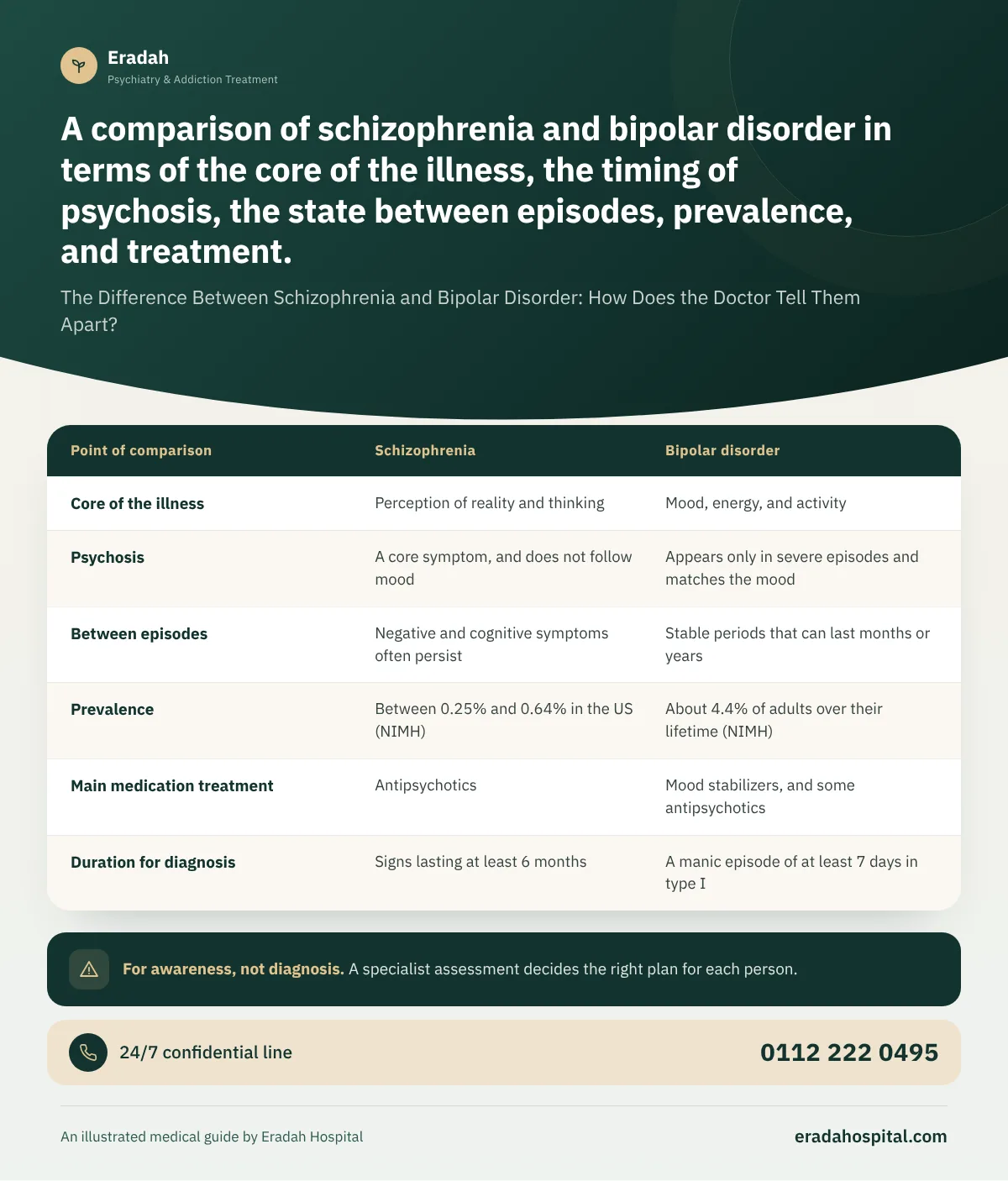
What is the difference between schizophrenia and bipolar disorder in a table?
| Point of comparison | Schizophrenia | Bipolar disorder |
|---|---|---|
| Core of the illness | Perception of reality and thinking | Mood, energy, and activity |
| Psychosis | A core symptom, and does not follow mood | Appears only in severe episodes and matches the mood |
| Between episodes | Negative and cognitive symptoms often persist | Stable periods that can last months or years |
| Prevalence | Between 0.25% and 0.64% in the US (NIMH) | About 4.4% of adults over their lifetime (NIMH) |
| Main medication treatment | Antipsychotics | Mood stabilizers, and some antipsychotics |
| Duration for diagnosis | Signs lasting at least 6 months | A manic episode of at least 7 days in type I |
Is there a genetic link between them?
Yes, and this makes the boundary between them less sharp than it appears. In a huge Swedish study published in The Lancet in 2009, researchers linked the records of more than 9 million people and estimated heritability at about 64% for schizophrenia and 59% for bipolar disorder. They found that relatives of people with bipolar disorder are also more likely to develop schizophrenia, and that 63% of the overlap between the two illnesses is attributable to genetic factors they share.
This does not mean they are one illness; the same study confirms they share part of their genetic cause and remain distinct diagnostic entities. Between the two lies a condition called schizoaffective disorder, in which persistent psychosis combines with clear mood episodes, and which the MSD Manual lists among the disorders related to schizophrenia.
How does the doctor settle the diagnosis?
- A detailed history of all episodes: when the psychosis began, and whether it came with mania or depression or apart from them.
- What happens between episodes: whether the person returns to normal or symptoms such as withdrawal and low motivation remain.
- Tracking mood and sleep over a period, as we explain in diagnosing bipolar disorder.
- The family history of both illnesses.
- Ruling out drugs and physical causes, such as thyroid disease, which NIMH notes can cause similar symptoms.
This is why the diagnosis may change after the first episode. That is not necessarily a mistake but a normal part of the picture becoming clearer over time.
Does the treatment differ?
Treatment overlaps in part and differs at its foundation. In schizophrenia, antipsychotics are the basis of medication treatment, along with psychotherapy and rehabilitation. In bipolar disorder, mood stabilizers are the basis for preventing episodes, and some antipsychotics are used in manic episodes or for prevention. Some medications are a concern in a wrong diagnosis, such as antidepressants alone in a person with bipolar disorder. Do not start or stop any medication without a doctor, who alone decides the type and dose.
You can find details in schizophrenia treatment and bipolar disorder treatment.
Outlook and risks
Both illnesses are treatable, and many patients live productive lives. But each has its own risks: NIMH reports that about 4.9% of people with schizophrenia die by suicide, and the risk is higher in the early stages of the illness. A systematic review published in the Journal of Affective Disorders in 2019 estimates suicide rates in bipolar disorder at about 20 to 30 times those of the general population. That is why any talk of death is taken seriously, and support should be sought immediately through the 16328 line or ambulance (123).
At Eradah you can get a free, confidential first consultation to assess the condition and its course, with residential treatment for men during acute episodes and outpatient follow-up afterward.
Acute psychotic episode or suicidal thoughts? Get help now
- Voices commanding him to harm himself or others
- Severe agitation or threatening those around him out of suspicion or fear
- Memory gaps, with the person found in a dangerous place without knowing how he got there
- Talk of death or suicide, or self-harm
- Refusing food and drink, or severe neglect that threatens his health
Speak calmly in short sentences, do not argue with him or mock what he says, and remove sharp objects and medications without confrontation. Call ambulance (123) or go to the nearest emergency department if the danger is imminent. If he talks about death, do not leave him alone, and contact the mental health support line 16328, available around the clock.
Ambulance 123 Mental health support line 16328