What are the three groups of schizophrenia symptoms?
Doctors divide schizophrenia symptoms into groups that help in understanding and monitoring them. The word “positive” here does not mean good; it means experiences that are “added” to ordinary perception, while “negative” means abilities or feelings that are “missing.”
| Group | What it means | Examples |
|---|---|---|
| Positive (psychotic) symptoms | Experiences and thoughts added to normal perception | Hallucinations, delusions, disorganized speech, strange or disorganized behavior |
| Negative symptoms | A reduction in motivation, expression, and engagement | Low motivation, little speech, social withdrawal, flattened emotions, loss of pleasure |
| Cognitive symptoms | Difficulties with thinking functions | Poor attention and working memory, slowed thinking, difficulty planning and making decisions |
Not all of these symptoms need to be present in one person. The picture varies greatly from patient to patient, and it can change in the same patient from one stage to another.
What are hallucinations in schizophrenia?
A hallucination is perceiving something that is not there through one of the senses, and the person experiences it as completely real. The best known in schizophrenia are auditory hallucinations: voices that speak to the person or about him or her, comment on what he or she is doing, or talk among themselves, and that may be friendly or critical and insulting.
- Auditory: voices of people the person knows or strangers, or whispers and unclear sounds.
- Visual: seeing people, shapes, or lights that are not there. These are less common in schizophrenia than in substance-induced psychosis.
- Tactile or bodily: a sensation of something touching the body or moving inside it.
- Smell or taste: strange smells or tastes. These are rare and call for ruling out physical causes.
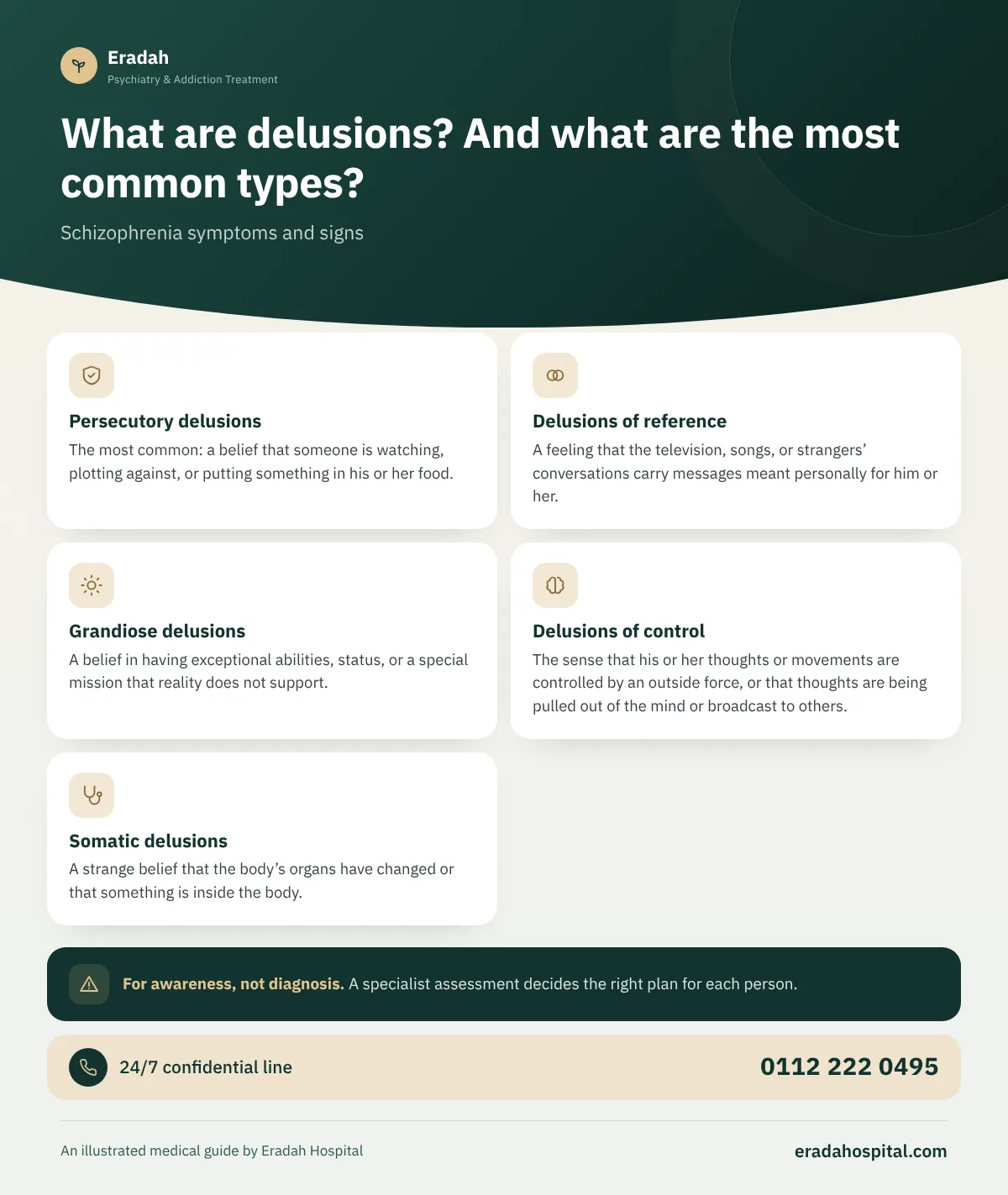
What are delusions? And what are the most common types?
A delusion is a fixed, false belief that does not change with evidence or discussion and is not shared by others in the person’s culture. What matters here is that a delusion is a strange, individual idea the person clings to despite all the evidence, whereas belief in shared religious or cultural matters is not a delusion.
The most common: a belief that someone is watching, plotting against, or putting something in his or her food.
A feeling that the television, songs, or strangers’ conversations carry messages meant personally for him or her.
A belief in having exceptional abilities, status, or a special mission that reality does not support.
The sense that his or her thoughts or movements are controlled by an outside force, or that thoughts are being pulled out of the mind or broadcast to others.
A strange belief that the body’s organs have changed or that something is inside the body.
How do disordered thinking, speech, and behavior appear?
Disordered thinking shows up in speech: the person moves from one idea to another with no connection, gives an answer far from the question, or stops suddenly in the middle of a sentence, and in severe cases the speech becomes unintelligible. He or she may also use invented words or private meanings for ordinary words.
Disorganized behavior may appear as clothing unsuited to the weather, laughing in a sad situation, unpredictable actions, or difficulty completing a simple task such as preparing a meal. Less commonly, catatonic symptoms appear: staying frozen in one position for a long time, complete silence, or repetitive purposeless movements. This is a condition that needs urgent medical care.
What are the negative symptoms of schizophrenia?
These are the quiet side of the illness, and they are often wrongly mistaken for laziness or rudeness. They may precede hallucinations by years and continue after the hallucinations improve, and they are what most hinders study and work:
- Loss of motivation: difficulty starting any activity or keeping it up, even showering or tidying the room.
- Flattened emotions: a face with little expression and a monotone voice, although the person may feel more inside than he or she shows.
- Little speech: very short answers and difficulty keeping a conversation going.
- Loss of pleasure: no longer enjoying what he or she used to love.
- Social withdrawal: avoiding friends and relatives and staying in the room for long hours.
Some of these symptoms resemble depression or the side effects of certain medications, which is why the doctor carefully tells them apart before any treatment decision.
How do cognitive symptoms affect daily life?
Many patients struggle to concentrate for long periods, to remember information and use it at the same time, to organize the steps of a task, and to understand other people’s feelings and facial expressions. These difficulties cannot be seen, but they explain why a student struggles to study or an employee stumbles over tasks he or she used to do easily.
What early signs come before the first episode?
Before the first psychotic episode, most cases go through a stage called the prodromal phase, which can last weeks, months, or years. Catching its signs early is a valuable chance for assessment before the full picture develops:
- Prodromal phaseGradual change
Isolation and declining performance at school or work, disturbed sleep, anxiety or depression, neglecting appearance, a sudden interest in strange or obscure ideas.
- Onset of psychosisSuspicions and strange experiences
A feeling that people are talking about him or her, hearing fleeting voices, unusual interpretations of events, growing difficulty organizing thoughts.
- The acute episodeClear symptoms
Fixed hallucinations and delusions, disorganized speech or behavior, and he or she may stop eating or sleeping or become a danger to themselves.
- After the meltdownGradual improvement
With treatment, positive symptoms usually settle, and some negative or cognitive symptoms may remain that need rehabilitation.
Not everyone who shows prodromal signs will develop schizophrenia; these signs can accompany depression, anxiety, or drug use. But they always deserve an assessment by a psychiatrist.
Do schizophrenia symptoms differ between men, women, teenagers, and older adults?
| Category | What often characterizes the picture |
|---|---|
| Men | An earlier onset in late adolescence and the early twenties, and more pronounced negative symptoms in many cases. |
| Women | A somewhat later onset, a possible second peak after midlife, and sometimes accompanying mood symptoms. |
| Teenagers | Often begins with declining school performance, isolation, and a change in friends, and is hard to tell apart from the ups and downs of adolescence or substance use. |
| Children | Schizophrenia before the age of 13 is very rare, and any psychotic symptoms in a child need a specialist child psychiatry assessment. |
| Older adults | Hallucinations or delusions appearing for the first time late in life first call for ruling out dementia, brain disease, and medication effects. |
What do schizophrenia symptoms look like to the family?
Families usually do not see the “hallucinations” directly; they see their results: a son who closes the windows because he feels watched, or whispers to himself, or refuses the family’s food for fear it is poisoned, or suddenly gets angry at ordinary words. He may stay up late, drop out of school, and spend the day in his room.
- Talks or laughs alone, or turns as if someone were calling him.
- Suspects the neighbors or relatives, or believes his phone is being monitored with no evidence.
- His speech is hard to follow, or he jumps between unrelated topics.
- Has neglected his hygiene and appearance and stopped his usual activities.
- His facial expressions have changed and he has become dull and unresponsive.
These questions are for awareness only and are not a diagnostic test. Having one or more of them means an assessment by a psychiatrist is a sensible step, not that the person definitely has schizophrenia.
How do you talk with someone showing these symptoms?
- Choose a quiet time and a safe place, and speak in short, clear sentences in a low voice.
- Do not argue about whether the voices or beliefs are real, and do not agree with them either; say, for example: “I don’t hear what you hear, but I can see it frightens you.”
- Focus on what bothers him, such as poor sleep or tension, and suggest seeing the doctor for help with that.
- Give him space and do not corner him, and avoid sudden touch or group confrontation.
- If there is danger to himself or others, safety comes first: call an ambulance.
Once the need for an assessment is clear, the page on schizophrenia treatment explains what happens next.
Acute psychotic episode or suicidal thoughts? Get help now
- Hearing voices that command the person to harm themselves or others, or acting on them
- Severe agitation, threats, or behavior that puts them or those around them in danger
- Stopping eating, drinking or sleeping for days, or severe neglect that threatens their health
- Talking about wanting to die or end their life, or saying goodbye and giving away their belongings
- Stiffness, rigidity and no response to speech, or sudden confusion and severe disorientation with fever
Stay with the person and don't leave them alone, speak in a calm voice and short sentences, and don't argue with the voices or ideas or mock them. Move dangerous objects out of reach as far as possible without confronting them, and call an ambulance on 123 or go to the nearest emergency room. You can call the mental health support line on 16328 around the clock for advice.
Ambulance 123 Mental health support line 16328