Can a person with schizophrenia marry?
“Our son has been stable on treatment for two years and he’s working, and he wants to get married. Is that right? Should we tell the bride’s family?” This is one of the most sensitive questions in the homes of people with schizophrenia, and it mixes hope, fear, and embarrassment.
Medically, schizophrenia is a chronic but treatable illness, and the World Health Organization reports that at least a third of patients reach full remission of symptoms. The UK’s NHS confirms that many people recover even if they go through periods of relapse, and that the illness does not mean a “split personality” and does not usually make a person violent. So the right question is not “Can a person with schizophrenia marry?” but “Is he ready now? And what does the marriage need in order to succeed?”
Does marriage cure schizophrenia?
This is one of the most common beliefs in Egypt: “Marry him off and he’ll come to his senses.” In fact, schizophrenia is a disorder of the brain and of how reality is perceived. Marriage does not treat it, and neither does a change of environment alone. Marriage actually brings new pressures: financial responsibilities, communication problems, and sleepless nights with children. The NHS notes that stressful situations can trigger the illness in people who are predisposed to it.
That is why marrying off a person who is in an active episode or has stopped treatment, in the hope that he will settle, can harm him, his partner, and later the children. Marriage after genuine stability and with a treatment plan in place, however, can be a source of support and steadiness.
When is marriage a suitable step for a person with schizophrenia?
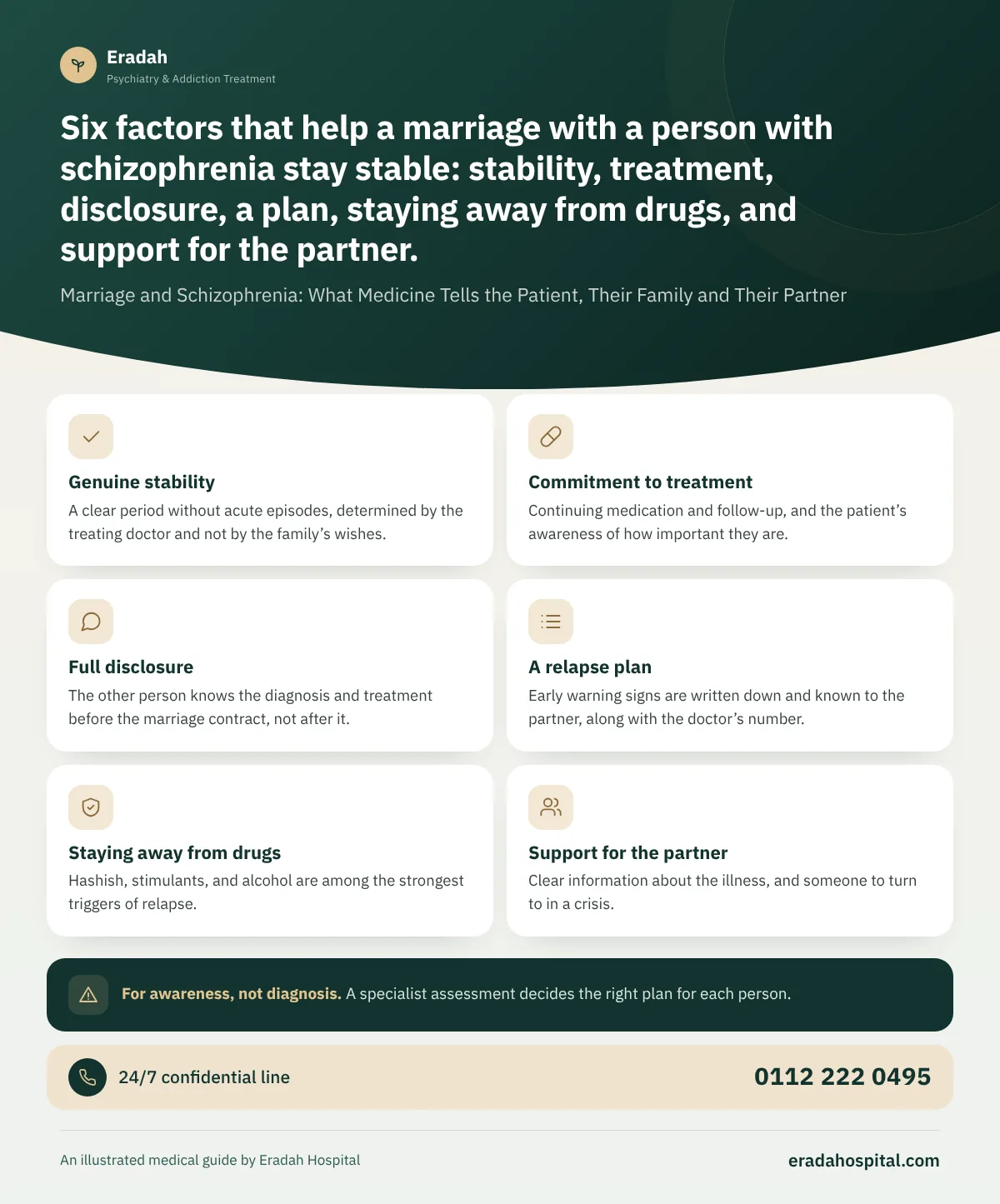
A clear period without acute episodes, determined by the treating doctor and not by the family’s wishes.
Continuing medication and follow-up, and the patient’s awareness of how important they are.
The other person knows the diagnosis and treatment before the marriage contract, not after it.
Early warning signs are written down and known to the partner, along with the doctor’s number.
Hashish, stimulants, and alcohol are among the strongest triggers of relapse.
Clear information about the illness, and someone to turn to in a crisis.
On the other hand, it is better to postpone if symptoms are active, if the patient refuses treatment or uses drugs, or if he has previously acted violently during episodes.
Why is disclosure before marriage essential?
Some families resort to concealment out of fear of rejection or stigma. That stigma is real, and the World Health Organization points to it when it notes that discrimination and violations of the rights of people with schizophrenia are common. But concealment turns the illness from a shared health issue into a secret that is discovered at the first relapse, trust collapses, and the crisis becomes a dispute between two families.
- Explain the illness in simple language: what it is, how it shows up in the patient, and what the treatment is.
- Offer the other person a meeting with the treating doctor so he or she can ask freely.
- Be honest about the medications and their effects, such as drowsiness, weight gain, or sexual side effects.
- Do not over-reassure or over-frighten; the goal is an informed decision by both sides.
Is schizophrenia passed on to children?
Schizophrenia has a genetic component, but it is not inevitable. In a huge Danish population study published in Archives of General Psychiatry in 2010, covering about 2.7 million people, the rate of schizophrenia up to age 52 was:
That means about 93% of the children of one affected parent did not develop schizophrenia in this study. The risk rises clearly when both partners are affected, which is important information in pre-marriage counseling. Genetics is not the whole story; environment and cannabis use in adolescence also play a role, as we explain in the causes of schizophrenia.
Pregnancy, medication, and childbirth
If the wife is the one with schizophrenia, pregnancy needs advance planning with the doctor. The UK’s NICE guidance on mental health in pregnancy and after birth recommends that the doctor discuss with the woman the risks and benefits of treatment and the risks of leaving the illness untreated. It notes that changing or stopping medication and the stresses of pregnancy may raise the risk of relapse, and recommends psychological therapy or family intervention when needed.
The NHS notes that the risk of postpartum disorders, including postpartum psychosis, is higher in women with a previous diagnosis of schizophrenia. This is why the first days and weeks after birth need close follow-up. Do not start or stop any medication without a doctor; stopping suddenly on learning of a pregnancy is one of the most common causes of relapse.
Daily life: how can the partner protect stability?
An informed partner is one of the strongest protective factors. NICE recommends offering family intervention to those who live with the patient, so they can learn to understand the illness, solve problems, and plan for crises. Practical steps include:
- A fixed routine for sleep, meals, and medication, and fewer late nights.
- Watching for early warning signs such as isolation, suspicion, and reduced sleep, and contacting the doctor early.
- Speaking openly with the doctor about any side effect that strains the relationship, instead of secretly stopping the medication.
- Sharing responsibilities in line with what the patient can manage, without overprotecting him or her or loading more than he or she can bear.
- The partner looking after themselves and asking for support when they feel exhausted.
Eradah’s Family Program offers sessions for the partner and family, with a free, confidential first consultation and residential treatment for men during acute episodes. You can find guidance on daily life with the patient in Caring for a person with schizophrenia.
An acute psychotic episode or danger at home? Ask for help now
- Voices commanding him or her to harm themselves, their partner, or the children
- Intense suspicion that the partner is poisoning or plotting against him or her, with threats
- A mother a few days after giving birth who shows strange ideas, agitation, or confusion
- Refusing food and drink, or severe neglect of themselves or the children
- Talk about death or suicide
Stay calm and do not argue about the ideas. Move the children to a safe place with an adult, and put away sharp objects without confrontation. Call ambulance (123) or go to the nearest emergency department, and contact the mental health support line 16328, available around the clock. Do not stay alone in a closed space with someone who is agitated.
Ambulance 123 Mental health support line 16328