What is Lexotanil (bromazepam)?
“The doctor prescribed me Lexotanil two years ago for my nerves, and since then I can’t sleep without it.” This story is heard often in psychiatric clinics, and it sums up the problem with this medicine: it starts as a solution to a temporary crisis, then stays in the person’s life far longer than it should.
Bromazepam is a medicinal substance from the benzodiazepines, the same family that includes Xanax, Rivotril and Valium. It is sold in Egypt under the brand name Lexotanil, and people sometimes know it by close pronunciations such as “Lexotan” or “Lexotonil.” Ashton’s guide notes that its brand names worldwide include Lexotan and Lexomil.
One thing many people do not know is that bromazepam is not approved for marketing in the United States, according to the US National Institutes of Health’s LactMed database, but it is available by prescription in other countries, including Egypt and Australia, which approves its leaflet under the name Lexotan.
Medical uses of Lexotanil
The approved Australian medicine leaflet summarizes its indications as “short-term symptomatic relief of tension, anxiety and agitation,” and adds an important note: anxiety and tension associated with the stresses of everyday life do not usually require an anti-anxiety medicine. In other words, Lexotanil is not meant to be a sedative for every difficult day.
Calming episodes of acute anxiety and tension when they disrupt life, as a temporary bridge until long-term treatment begins.
Relieving agitation that accompanies acute psychological crises, under medical supervision.
Such as palpitations and muscle tension when their source is anxiety, after physical causes have been ruled out.
The doctor sets the dose and duration, and in principle it should not become open-ended daily use.
The main treatment for persistent anxiety is usually medicines that do not cause dependence, such as some antidepressants, along with cognitive behavioral therapy. You will find the details in the guide to generalized anxiety disorder treatment.
How does Lexotanil work in the brain?
Like the other benzodiazepines, bromazepam acts on GABA-A receptors, increasing the effect of GABA, the neurotransmitter that “turns down the volume” of nerve cells. According to a StatPearls review, these medicines increase how often chloride channels open in the presence of GABA, so cell activity falls and calm, drowsiness and muscle relaxation appear.
With daily use the brain adapts and becomes less sensitive to GABA, so the same dose has a weaker effect, which is tolerance. When the medicine is suddenly stopped, the brain finds itself without enough “brakes,” and withdrawal symptoms appear. This is why, since 2020, the US Food and Drug Administration has required a boxed warning on all medicines in this family, stating the risk of misuse, physical dependence and withdrawal reactions.
Side effects of Lexotanil
- Drowsiness and slowed reactions, which makes driving and operating machinery risky in the first days of treatment.
- Dizziness and unsteadiness, and the risk of falls is higher in older adults.
- Poor concentration and forgetfulness, especially forgetting what happened shortly after taking the medicine.
- Rare paradoxical reactions such as agitation, aggression or insomnia instead of calm, which call for a visit to the doctor.
- Depressed breathing when combined with alcohol, opioids or other sedatives.
Ashton’s guide states that the half-life of bromazepam is between 10 and 20 hours, which means it stays longer than Xanax and shorter than Valium. With daily repetition its effect may build up in some people, so they wake up drowsy or with a heavy head.
Lexotanil compared with other sedatives
| Lexotanil (bromazepam) | Xanax (alprazolam) | Rivotril (clonazepam) | |
|---|---|---|---|
| Approximate half-life | 10 to 20 hours | 6 to 12 hours | 18 to 50 hours |
| Best-known use | Anxiety and tension | Anxiety and panic attacks | Epilepsy and panic attacks |
| Common classification by duration of action | Intermediate-acting | Short-acting | Long-acting |
| Dependence risk | Present with daily use | Present, and may be faster | Present with daily use |
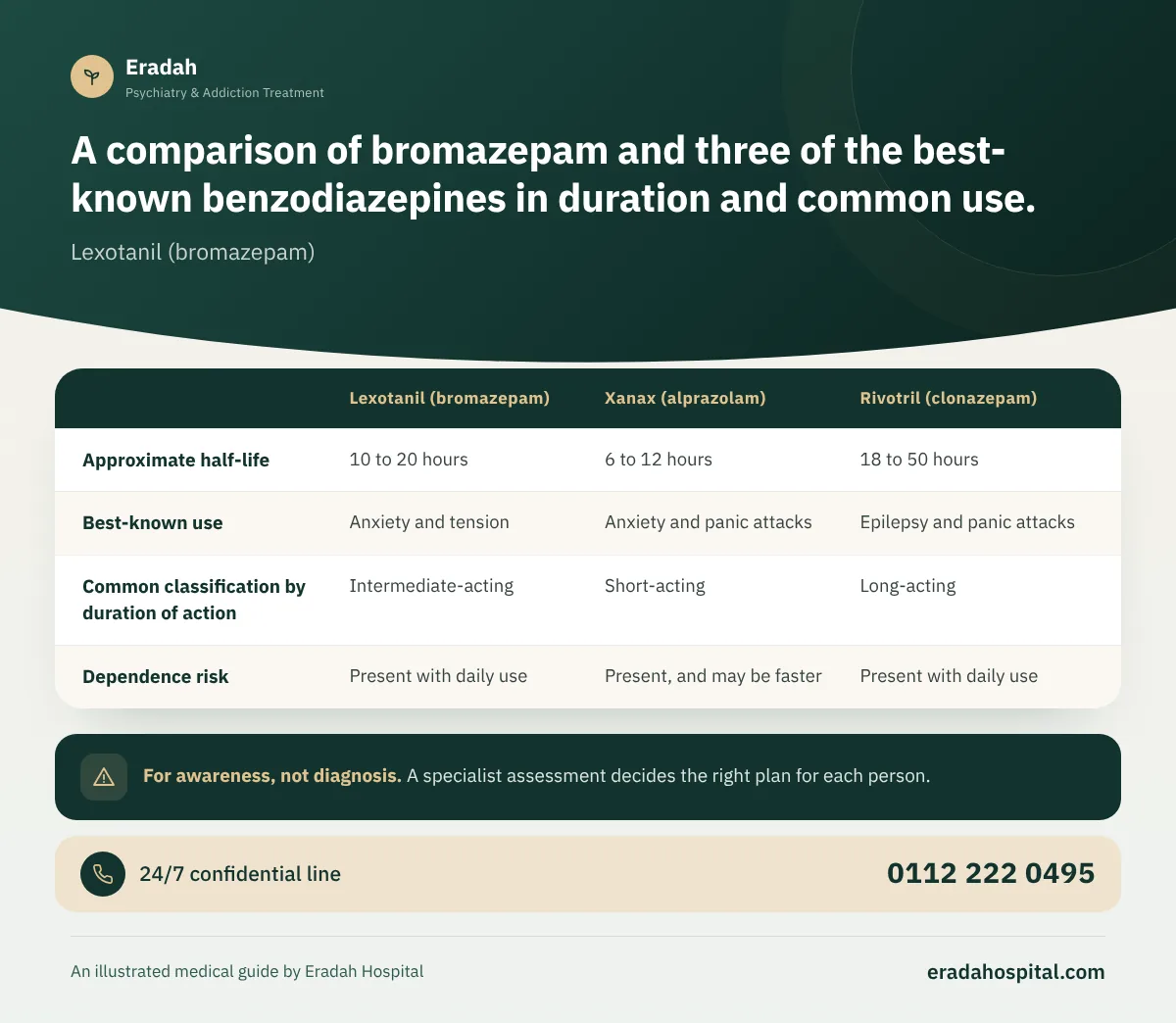
Half-lives are from the first table in Ashton’s guide; they are approximate and vary between people. Valium is longer than all of them, with a half-life ranging from 20 to 100 hours.
Why is Lexotanil misused?
- Staying on it for months or years after the crisis it was prescribed for has ended.
- Raising the dose on one’s own when the effect weakens with tolerance.
- Using it every night to sleep without follow-up.
- Mixing it with tramadol, pregabalin or alcohol seeking a stronger effect.
- Getting it from a friend or from more than one pharmacy without a prescription.
The real danger is in mixing. Tramadol, alcohol and some painkillers depress the breathing center just as bromazepam does, and together they may stop breathing during sleep. The page on harms of benzodiazepines explains these risks in detail.
Lexotanil in pregnancy, breastfeeding and older adults
In pregnancy the doctor weighs benefit against risk for each case, and a pregnant woman should not start or stop the medicine on her own. In breastfeeding, the LactMed database notes that three infants who were partially breastfed were not clearly affected, but it points to a report of the death of a newborn whose mother was taking bromazepam, and it prefers an alternative medicine because of the long half-life, especially with newborns and premature infants.
Older adults are more sensitive to drowsiness, unsteadiness and forgetfulness, so they need closer follow-up. All of these are decisions for the doctor, so do not start or stop the medicine without consulting them.
The legal status of Lexotanil in Egypt
Bromazepam is a prescription-only medicine, and dispensing or trading in it outside a medical setting is an offense. We do not cite a specific legal schedule here, but a broader presentation of the legal status of the sedative family can be found in the benzodiazepines guide. Anyone who needs help can call the hotline of the Fund for Drug Control and Treatment of Addiction, 16023.
Lexotanil in brief: harms, symptoms, withdrawal and treatment
Harms: Daytime drowsiness, slowed reactions, forgetfulness and falls in older adults, and a fatal risk if mixed with opioids or alcohol.
Signs of dependence: Needing a larger dose, anxiety before the time for the next tablet, being unable to sleep without it, and getting it without a prescription.
Withdrawal: Anxiety, insomnia, tremor and sensitivity to light and sound, and it may reach seizures with sudden stopping after long use. The details are in benzodiazepine withdrawal symptoms.
Treatment: A gradual reduction plan set by the doctor, with treatment of the underlying anxiety through psychotherapy and medicines that do not cause dependence, as in benzodiazepine addiction treatment.
Lexotanil Guide: Everything You Need to Know
We have gathered everything about Lexotanil into 5 pages, each answering one question in detail. Choose what you are looking for:
Harms of benzodiazepines to the body and mind
Harms of benzodiazepines: drowsiness, memory impairment and falls, the danger of mixing them with opioids and alcohol, the dementia debate, their effect on older adults and pregnancy, and what improves after stopping.
Symptoms of benzodiazepine addiction: signs families overlook
Symptoms of benzodiazepine addiction: the physical, behavioral and psychological signs, the difference between the dependence expected with a prescription and addiction, and danger signs that call for an ambulance.
Benzodiazepine withdrawal symptoms and how long they last
Benzodiazepine withdrawal symptoms: when they start and how long they last, the difference between acute and protracted withdrawal, the risk of seizures, and why gradual reduction under medical supervision is necessary.
Benzodiazepine addiction treatment
Benzodiazepine addiction treatment step by step: assessment, individualized gradual reduction, cognitive behavioral therapy, treatment of anxiety and insomnia, when residential care is needed, and how to prevent relapse.
How long benzodiazepines stay in the body
How long benzodiazepines stay in the body: how long they remain in urine, blood and hair, why a rapid test sometimes misses Rivotril and lorazepam, and medicines that give a false positive.
Tips for families: when does Lexotanil become a problem?
- Ask calmly: who prescribed the medicine? Since when? Is the doctor still following up?
- Keep the tablets locked away, and watch for unexplained shortages.
- Watch for daytime drowsiness, slurred speech and forgetfulness, or severe anxiety if the time for the tablet is delayed.
- If mixing with tramadol or alcohol appears, that is a danger sign that calls for a quick assessment.
- Do not encourage them to stop suddenly; the safe path is a doctor who sets a reduction plan, and you can start with the Family Guide.
Danger signs after using Lexotanil: call ambulance (123) immediately
- Deep sleep from which the person cannot be woken by calling or shaking.
- Slow or shallow breathing, or bluish lips.
- Severe slurred speech and unsteadiness after taking it with alcohol, tramadol or an opioid painkiller.
- Seizures, hallucinations or severe confusion within days of stopping it suddenly after long use.
- Swallowing a large number of tablets, deliberately or by mistake, especially by a child.
Call ambulance (123) immediately and do not wait for them to “sleep it off.” If the person is unconscious but breathing, place them on their side in the recovery position, stay with them and watch their breathing until the paramedics arrive, and do not give them any sedative, stimulant or food. Tell the paramedics what they took, the approximate amount and the time, bring the medicine box if you find it, and tell them if the person also drank alcohol or took an opioid painkiller.
Call the ambulance 123