What happens if bipolar disorder is left without follow-up?
Bipolar disorder is an illness of episodes, and every episode that passes untreated may leave behind losses that are hard to make up, whether a debt, a job or a relationship. As episodes repeat, the gaps between them may shrink and they become harder to control.
This does not mean every patient will go through these complications. They become more likely the longer diagnosis is delayed, treatment is interrupted, or the illness coexists with substance use, and they become much less likely with regular follow-up.
What do manic episodes do to money and reputation?
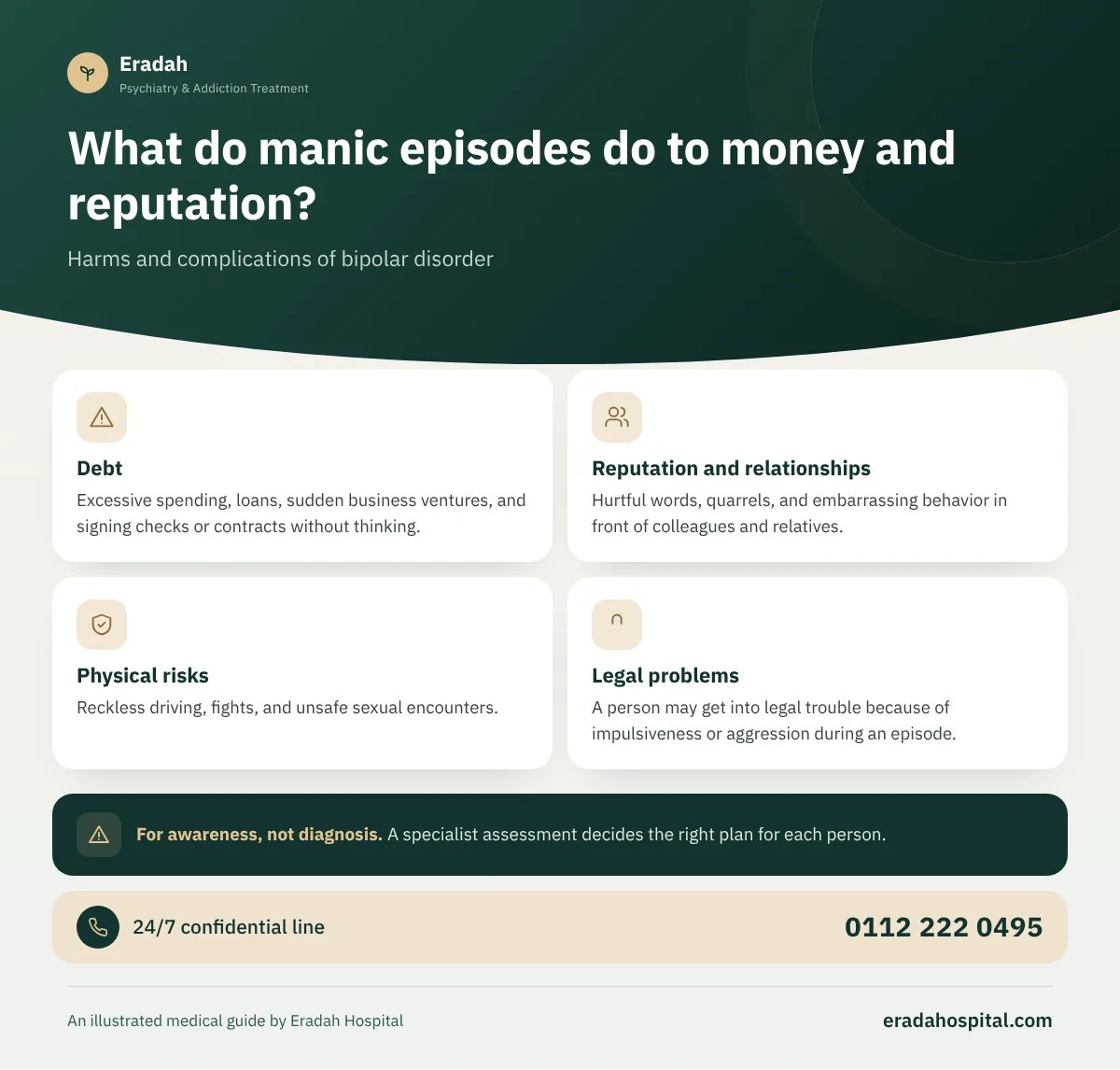
In mania, judgment weakens and the sense of one’s own ability becomes inflated, so a person makes decisions they would not make in their normal state, and often discovers the consequences only after the episode ends:
Excessive spending, loans, sudden business ventures, and signing checks or contracts without thinking.
Hurtful words, quarrels, and embarrassing behavior in front of colleagues and relatives.
Reckless driving, fights, and unsafe sexual encounters.
A person may get into legal trouble because of impulsiveness or aggression during an episode.
How does prolonged depression affect life?
Depressive episodes in bipolar disorder are often longer than manic ones, and without treatment a patient may spend more time depressed than manic. During them, the ability to work and study breaks down, self-care and health care decline, and the person feels isolation and guilt that can make things worse.
Does bipolar disorder affect physical health?
Yes, and this side is often forgotten. The illness is linked to a higher risk of a number of physical problems, because of disrupted sleep, chronic stress, unhealthy lifestyle patterns during episodes, and some medication side effects:
| Aspect | What may happen |
|---|---|
| Heart and blood vessels | A higher risk of heart disease and high blood pressure compared with the general population. |
| Metabolism | Weight gain, insulin resistance, diabetes and high blood fats, which is why the doctor orders regular checks. |
| Sleep | Severe insomnia in mania, and excessive or broken sleep in depression; both exhaust the body. |
| Smoking and substances | Higher rates of smoking and of alcohol and drug use, with all their harms. |
| Neglected health | Putting off doctor visits and neglecting chronic illnesses during episodes. |
For this reason, medical guidelines, including the UK’s NICE guidelines, recommend regularly monitoring the patient’s physical health alongside their mental health.
Does it affect thinking and memory?
Some patients notice difficulty with concentration, memory and planning, especially during episodes, and some of it may persist between episodes in people who have had repeated episodes. Stable mood, regular sleep and staying away from substances help protect these functions.
Effects on work and study
- Frequent absence from work or study during depressive episodes.
- Hasty career decisions in mania, such as sudden resignation or entering into poorly considered ventures.
- Clashes with managers and colleagues because of irritability.
- A drop in school performance among teenagers, which may be wrongly read as carelessness.
With stability, many return to their previous level of performance, and some even succeed remarkably, especially with organized working hours and avoiding night shifts where possible.
How does it affect marriage, family and children?
The family carries a heavy burden. A partner may live with constant worry about the next episode and exhaustion from debts or conflicts, and children may be confused by a parent’s sudden change. Some relationships end because of what happened in an episode that was not understood as an illness.
Family education changes the picture a great deal: when the family understands the illness and its early signs, conflicts decrease and early intervention becomes easier. It is important to explain to children in simple language that their parent is “ill and being treated” and that what is happening is not their fault.
Why does the risk of substance misuse rise?
Some patients turn to alcohol or drugs to calm mania or escape depression, or are driven to them by recklessness during mania. The result is often more frequent and more severe episodes and a poorer response to treatment. The page on bipolar disorder and addiction explains this relationship in detail.
Why does suicide risk rise? And how do we protect those we love?
Medical reviews indicate that the risk of suicide among people with bipolar disorder is much higher than in the general population, and it rises further during depressive and mixed episodes, with alcohol and drug use, and right after leaving the hospital.
But this risk can be reduced: regular treatment, follow-up and family support are very protective. Speaking openly and calmly about suicidal thoughts does not plant them in anyone’s mind; it opens the door to help.
- Watch for signs such as talk about death, hopelessness, or being a burden on others.
- Ask him directly and calmly whether he is having thoughts of harming himself, and listen without judgment.
- Do not leave him alone if he is in danger, and remove anything he could use to harm himself.
- Call the ambulance on 123 or the mental health support line 16328, or take him to the nearest emergency room.
What about pregnancy and the postpartum period?
The postpartum period is one of the highest-risk times for an episode, including postpartum psychosis, which is an emergency. Some mood-stabilizing medications also need review before pregnancy. For this reason, guidelines advise planning a pregnancy with the psychiatrist and not suddenly stopping any medication on discovering a pregnancy before consulting the doctor.
Can complications be avoided?
Yes, in most cases. Early diagnosis, sticking to the treatment plan, regular sleep, staying away from alcohol and drugs, and having a written plan for handling early signs all reduce the number and severity of episodes and the damage they leave. Learn about the available options on the treatment plan page.
Acute mania or suicidal thoughts? Get help now
- Talking about wanting to die or being a “burden” on others, or feeling complete despair
- Saying goodbye to family, giving away belongings, or sudden isolation
- No sleep for several days in a row with severe agitation or nonstop racing speech
- Hearing voices that command them to act, or fixed strange beliefs that they are being pursued or have a special mission
- Dangerous reckless behavior that puts them or others at risk of harm, or unusual aggression
Stay with the person and do not leave them alone, and listen calmly, without arguing or blaming. Call the ambulance on 123 or take them to the nearest emergency department, or call the mental health support line 16328, available around the clock, and keep anything they could hurt themselves with out of their reach.
Ambulance 123 Mental health support line 16328