Can a marriage work with bipolar disorder?
“My husband is the kindest man when he’s well, but in mania he spends the household money, doesn’t sleep and gets angry over the smallest thing, and then he sits for weeks silent and withdrawn. I don’t know how to deal with it.” This description comes up again and again from the partners of people with bipolar disorder.
Bipolar disorder does not rule out marriage, and many people with it are successful spouses and parents. The NHS notes that patients usually have symptom-free stable periods that can last weeks, months or years. But when episodes come, they put strong pressure on the relationship, and the difference between a marriage that holds and one that breaks down is often this: Has the illness been treated? Do both partners understand it? Is there a plan?
How do mania and depression affect married life?
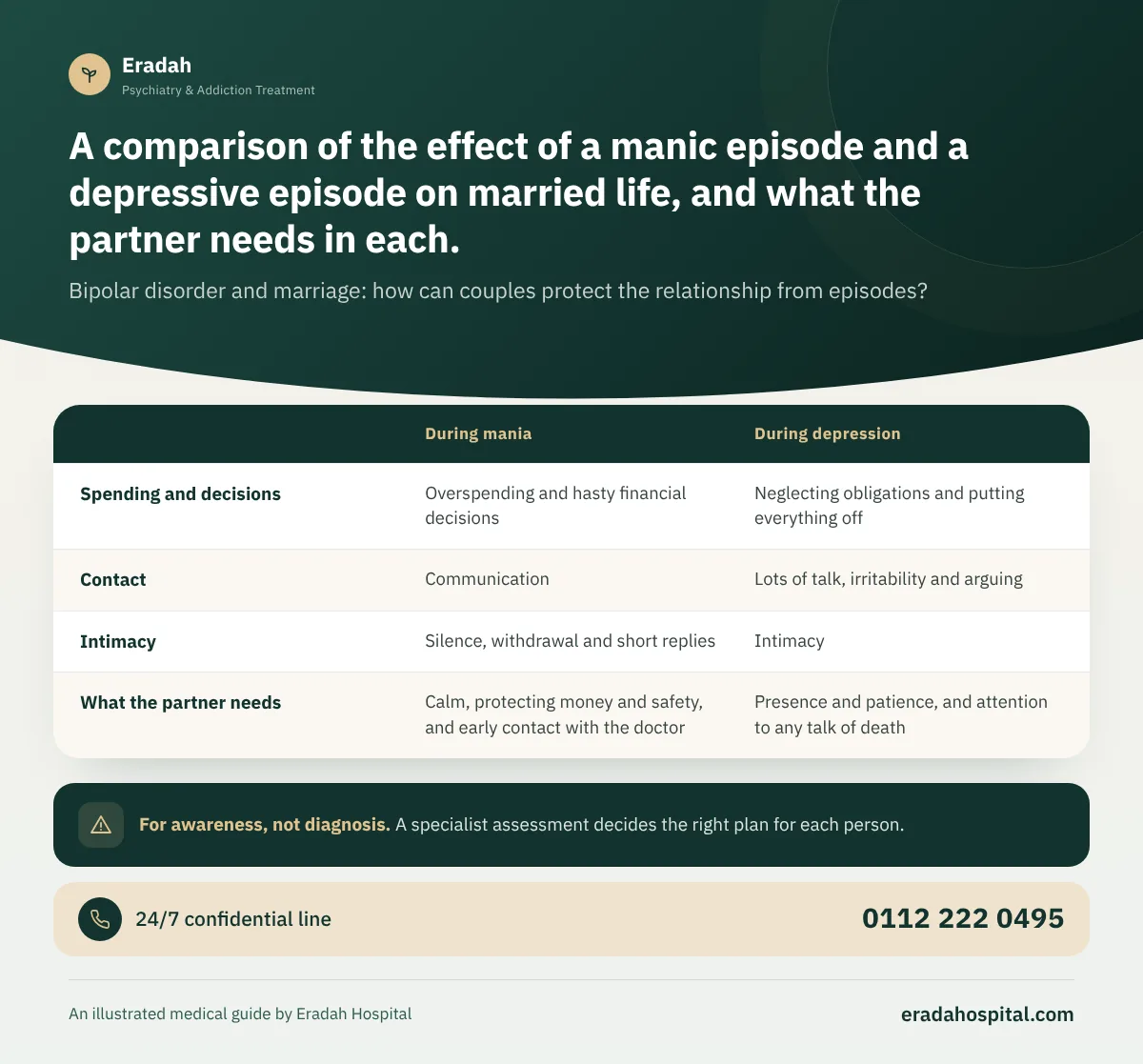
The NHS lists these among the symptoms of a high mood: irritability, lack of sleep, impulsiveness and overspending, increased sexual desire, and saying or doing unusual things. Symptoms of depression include loss of interest and energy, avoiding people, and a sense of worthlessness. Each pole leaves a different mark on the home:
| During mania | During depression | |
|---|---|---|
| Spending and decisions | Overspending and hasty financial decisions | Neglecting obligations and putting everything off |
| Contact | Communication | Lots of talk, irritability and arguing |
| Intimacy | Silence, withdrawal and short replies | Intimacy |
| What the partner needs | Calm, protecting money and safety, and early contact with the doctor | Presence and patience, and attention to any talk of death |
Among the hardest things couples face, the impulsiveness of mania can extend to relationships outside the marriage. This is no justification for infidelity, but it is a known symptom that needs treatment and honesty, and many couples benefit here from joint sessions with a therapist.
Before marriage: honesty and stability
- Full honesty: the diagnosis, the nature of the episodes, the treatment, and what happens when it is stopped.
- Stability first: entering a marriage during an episode or right after one raises the risk of a new relapse.
- Meeting the doctor: the other person can ask the treating doctor, with the patient present and consenting.
- Realistic expectations: episodes may still come despite treatment; what matters is dealing with them quickly.
Is bipolar disorder passed on to children?
The illness has a genetic component, and the NHS notes that the chance is higher for someone with a parent or sibling who has it. But the numbers are calmer than many people think: in a Danish population study published in the journal Archives of General Psychiatry in 2010, covering about 2.7 million people, the risk of developing bipolar disorder up to age 52 was:
In other words, the great majority of children of an affected parent do not develop the illness, while the risk rises clearly if both parents have it. Details of the other factors are in causes of bipolar disorder.
Pregnancy and bipolar disorder: why does it need advance planning?
The NHS warns that some bipolar medications are not safe in pregnancy, and advises anyone planning a pregnancy to talk to their doctor. The prime example is valproate: the UK medicines regulator, the MHRA, states that about 1 in 9 children (11%) whose mothers take it during pregnancy is born with a birth defect, and that it must not be prescribed to any woman or girl who could become pregnant unless a strict pregnancy prevention program is followed. NICE guidelines also advise men who take it to use effective contraception throughout treatment and for 3 months after stopping, and to discuss it with the doctor if they are planning to have children.
On the other hand, stopping medication suddenly has a price. An analysis published in the American Journal of Psychiatry in 2016 pooled data from 5,700 births and found that the risk of relapse after childbirth was 66% in women with bipolar disorder who did not take preventive medication during pregnancy, versus 23% in those who continued it. The bottom line: the decision is not made alone or at the moment of learning about the pregnancy, but beforehand with the doctor. Do not start or stop any medication without a doctor.
A shared plan that protects the home
- A written list of the patient’s own early warning signs, known to both partners.
- A money agreement made during a stable period: a withdrawal limit, and a wait before big decisions.
- A fixed sleep routine for the whole household, avoiding late nights and overnight travel as far as possible.
- The doctor’s number and the nearest psychiatric emergency service in a known place.
- A regular time to talk about the relationship, away from episodes and arguments.
You will find details of what to do in each type of episode in dealing with a person with bipolar disorder, and if there is substance use, read bipolar disorder and addiction.
The partner needs support too
NICE recommends giving caregivers clear information about the illness, recovery and the types of support available to them, and the NIMH reminds those who support a person with bipolar disorder to look after themselves too. Exhaustion, anger and sadness in the partner are natural feelings, and deserve space and treatment. At Eradah, couples can get a free, confidential first consultation and join the family program, with residential treatment for men during acute episodes and outpatient follow-up afterward.
A dangerous manic episode or depression with suicidal thoughts? Get help now
- Barely sleeping for days, with agitation or aggression in the home
- Squandering the family’s money or dangerous reckless decisions within days
- A mother in the first weeks after childbirth with severe insomnia and strange ideas or confusion
- Talk about death or being a burden on the family, or saying goodbye
- Fixed strange ideas or hearing voices
Stay close and speak calmly without arguing or blaming, remove car keys, medications and dangerous tools without confrontation, and move children to a safe place if there is agitation. Call the ambulance on 123 or go to the nearest emergency room if the danger is imminent, and contact the mental health support line 16328, available around the clock.
Ambulance 123 Mental health support line 16328