Why does living with someone who has bipolar disorder confuse the family?
“Last week he was spending everything he had, not sleeping and full of big projects, and this week he can’t get out of bed.” This swing between two poles is what bewilders the families of people with bipolar disorder: it is the same person, but what he needs from you changes completely from one phase to the next.
Bipolar disorder is marked by manic or hypomanic episodes and depressive episodes, separated by stable periods that can last weeks or years, as the NHS explains. The main page on the illness has a short table of what helps in each phase. Here we expand on the difficult situations: mania, money, depression, medication and crisis.
How do you deal with him during a manic episode?
The NHS lists these among the symptoms of a high mood: irritability or aggression, a reduced need for sleep, rapid speech, excessive confidence, impulsiveness and overspending, and saying or doing things that are inappropriate or out of character. In this state the patient often does not see that he is ill; he feels he is at his best.
- Do not challenge his big ideas: “That’s an important idea, let’s put off the decision for a week and think it over calmly” works better than “You’re talking nonsense.”
- Help him sleep: cut down late nights, visitors and screens in the evening, because lack of sleep feeds mania.
- Reduce stimulation: crowded places, arguments and stimulants such as coffee and energy drinks increase agitation.
- Protect safety: reckless driving, fights and impulsive relationships are among the most dangerous parts of an episode.
- Contact the doctor early: an adjustment to the treatment plan may be enough to avoid a full episode.
How do you protect money and big decisions?
Overspending and hasty financial decisions are among the things that leave the deepest mark after mania ends: debts, sold property and unplanned ventures. The UK’s NICE guidelines recommend that the treating team discuss with the patient and family legal arrangements for managing finances if mania or hypomania causes financial problems.
In an Egyptian household, you can agree during a stable period, with the patient’s full consent, on a few simple steps:
- A daily limit on bank card withdrawals, or keeping the card with someone he trusts during episodes.
- A “72-hour” rule before any big purchase, contract signing or resignation.
- Informing a specific family member before any loan or sale.
- Writing this agreement down, having both sides sign it, and reviewing it with the doctor.
The idea here is not to take away the patient’s right to run his own life, but to protect him from decisions he himself will regret once the episode is over.
In a depressive episode: be present and watch for danger
After mania, mood can drop sharply, and the patient loses energy and interest and feels guilt or worthlessness. This phase needs a calm presence, not lectures: sit with him, suggest small tasks, and do not say “pull yourself together.”
Most importantly, take any talk of death seriously. A systematic review of 61 studies published in the Journal of Affective Disorders in 2019 concluded that suicide rates in people with bipolar disorder are about 20 to 30 times higher than in the general population. A direct, calm question does not plant the idea; it opens the door to help, and you will find the steps on the page about suicidal thoughts.
Early warning signs: the agreement written during a stable period
The NIMH advises families to understand the patient’s triggers and watch for big mood changes. It works best when the patient himself, while stable, identifies his own signs, and then you agree on what to do when they appear. Common signs include:
Much less sleep without feeling tired, or unusually long sleep.
Many new projects and talk that does not stop.
Purchases or financial promises bigger than usual.
Anger at small things that never used to bother him.
Suddenly leaving work, friends, prayer or hobbies.
Forgetting doses or declaring that he “no longer needs it.”
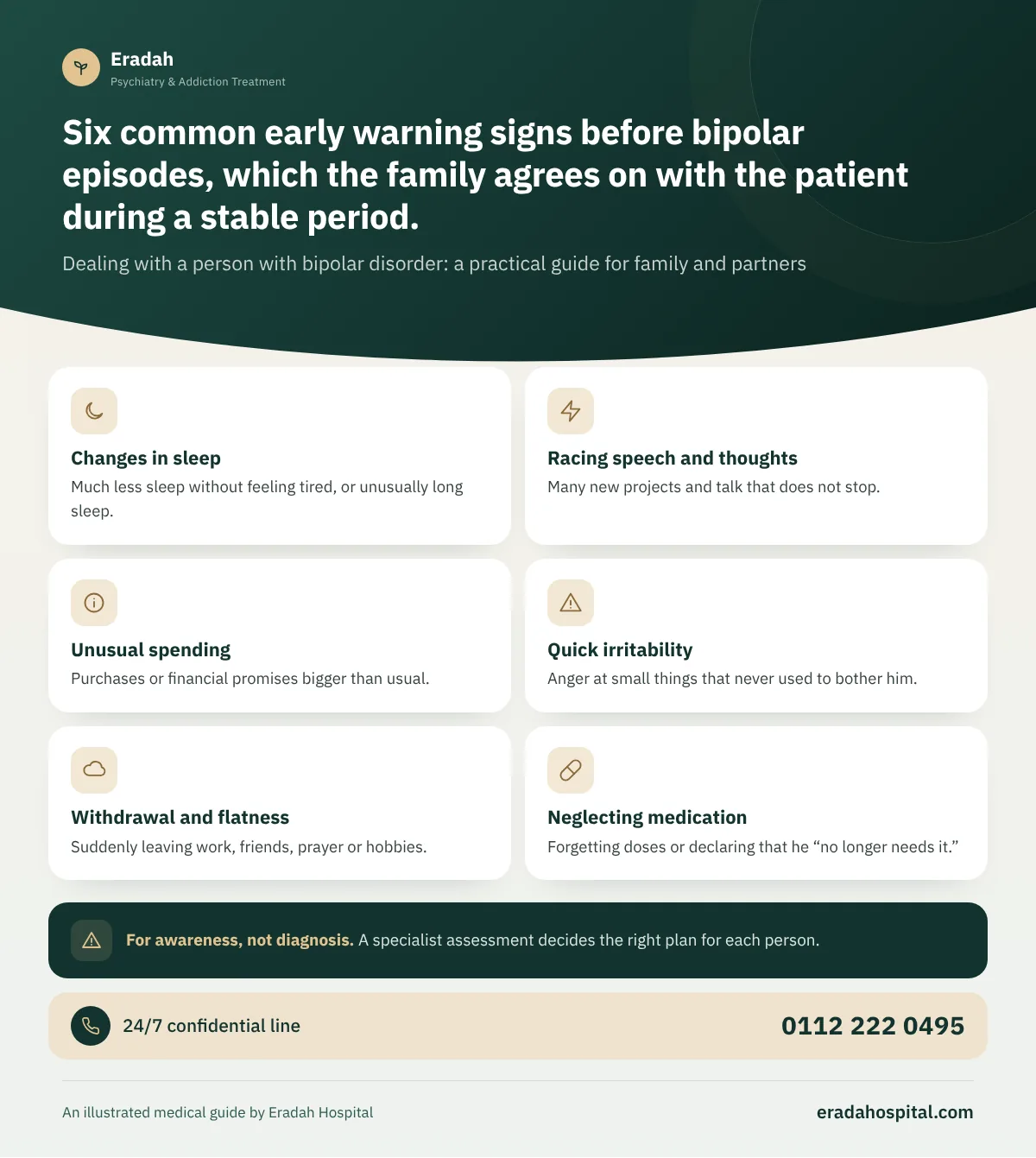
Also agree on who contacts the doctor and when, and what the patient accepts and refuses in a crisis, as he said it himself in his normal state.
Medication without daily battles
The NHS stresses that bipolar medication should not be stopped except on the doctor’s direction, even if the patient feels better. Many patients stop because they miss the energy of mania, or because of side effects such as weight gain or sluggishness. The solution is to discuss these reasons frankly with the doctor, not to turn the pills into a battleground.
Do not start or stop any medication without a doctor, since only the doctor decides the type, the dose and the tests needed. Learn about the options in treatment of bipolar disorder. If there is drug or alcohol use, it changes the whole plan, as we explain in bipolar disorder and addiction.
A routine that protects against episodes
The NHS recommends that people with bipolar disorder keep a regular routine, get enough sleep, avoid stress, stay away from drugs and excessive alcohol and caffeine, and where possible avoid shift work, very long hours and overnight travel across time zones. The family can help by organizing the household’s own schedule: dinner at a fixed time, quiet evenings, and encouragement to walk or exercise.
When should you seek urgent help? And who supports you?
Seek an urgent assessment if he has not slept for days and is agitated, or if strange ideas or voices appear, dangerous recklessness, or talk of suicide. A severe episode may need a short stay in a psychiatric hospital, which can happen without his consent in cases of serious danger under the law, as the guide to involuntary treatment explains.
NICE asks that caregivers be given clear information about the illness, recovery and the types of support available to them, and the NIMH reminds families to look after themselves too. At Eradah you can get a free, confidential first consultation and join the family program, with residential treatment for men during acute episodes.
A dangerous manic episode or suicidal thoughts? Get help now
- Barely sleeping for days, with agitation or non-stop talking
- Dangerous reckless behavior such as driving at crazy speeds, squandering money or fighting
- Fixed strange ideas or hearing voices
- Talk about death or being a burden on the family, or saying goodbye and giving away belongings
- Severe hopelessness after a manic episode or at the start of deep depression
Stay with him and do not leave him alone, and speak calmly without arguing or blaming. Remove car keys, medications and dangerous tools if you can, without confrontation. Call the ambulance on 123 or go to the nearest emergency room if the danger is imminent, and contact the mental health support line 16328, available around the clock.
Ambulance 123 Mental health support line 16328