“The doctor said I have a neurotic condition... does that mean I'm crazy?” Many people confuse neurosis and psychosis because the two words sound alike, and they mix up “neurotic” and “nervous,” so a patient may fear a simple diagnosis or underestimate a serious one. This article explains the difference between neurosis and psychosis in clear language, and when each needs a doctor.
The difference between neurosis and psychosis in one sentence
Neurosis is psychological suffering within the bounds of reality: the person worries, feels afraid or is pursued by disturbing thoughts, but realizes that their fear is exaggerated or that their thoughts are not logical. Psychosis is a disturbance in the perception of reality itself: the person sees or hears things that are not there, or firmly believes things that are untrue, and often cannot see that they are untrue.
What is neurosis, or neurotic disorders?
The word neurosis is old; its medical use is attributed to the 18th-century Scottish physician William Cullen, as documented in a historical review published in the American Journal of Psychiatry. Its original meaning was a disease of the “nerves,” and over time it came to describe psychological suffering in which the patient does not lose contact with reality.
In the World Health Organization's International Classification of Diseases, 10th revision, the category “neurotic, stress-related and somatoform disorders” (F40 to F48) groups these conditions:
- Phobic anxiety disorders such as phobias and social phobia.
- Other anxiety disorders such as panic attacks and generalized anxiety.
- Obsessive-compulsive disorder.
- Reactions to severe stress and adjustment disorders, including post-traumatic stress disorder.
- Dissociative (conversion) disorders such as hysteria.
- Somatoform disorders and other neurotic disorders.
The 11th revision, which is currently in use and on which the WHO's fact sheet on mental disorders relies, distributes these conditions into separate categories under their own names, such as anxiety and fear-related disorders and obsessive-compulsive and related disorders. For this reason the word “neurosis” is used less in diagnosis, although it remains in everyday speech and in the psychoanalytic school.
What is psychosis?
The UK's National Health Service (NHS) defines psychosis as a person losing some contact with reality, and lists three main symptoms: hallucinations, such as hearing voices or seeing things that do not exist outside the person's mind; delusions, strong beliefs that others do not share, such as believing there is a plot to harm them; and disorganized thinking and speech. Psychosis may be part of schizophrenia, bipolar disorder or severe depression, and it may be triggered by drugs, alcohol, trauma or physical illnesses such as brain tumors and dementia. Details are on the psychosis page.
Comparing neurosis and psychosis
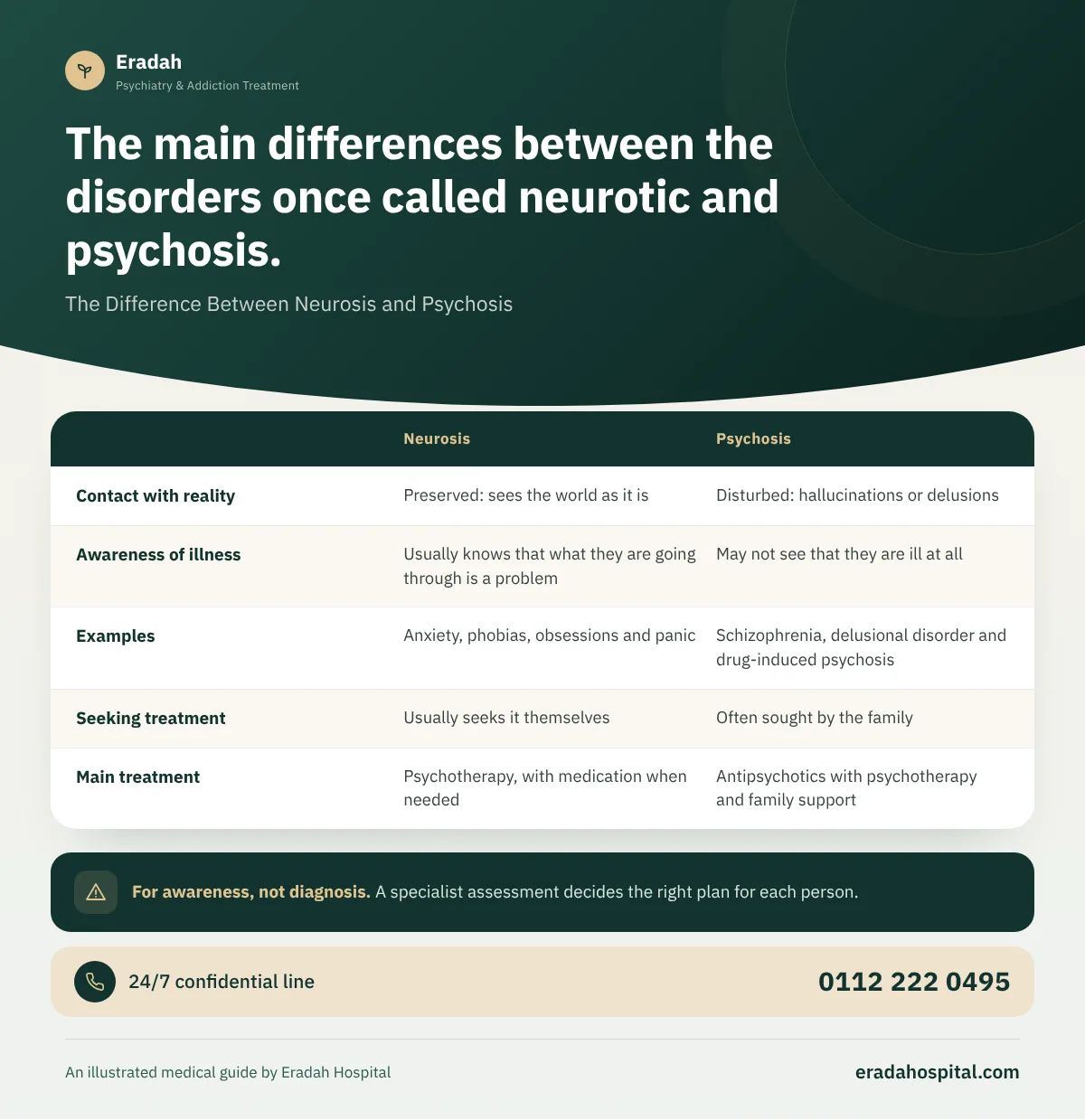
| Neurosis | Psychosis | |
|---|---|---|
| Contact with reality | Preserved: sees the world as it is | Disturbed: hallucinations or delusions |
| Awareness of illness | Usually knows that what they are going through is a problem | May not see that they are ill at all |
| Examples | Anxiety, phobias, obsessions and panic | Schizophrenia, delusional disorder and drug-induced psychosis |
| Seeking treatment | Usually seeks it themselves | Often sought by the family |
| Main treatment | Psychotherapy, with medication when needed | Antipsychotics with psychotherapy and family support |
Insight: the key difference between neurosis and psychosis
Insight is a person's awareness that they are ill. NAMI explains that a person with psychosis refusing their diagnosis is not always conscious “denial”; it can be a medical symptom called anosognosia, a lack of awareness of illness, and early studies estimated that about 30% of people with schizophrenia and 20% of people with bipolar disorder have a severe lack of awareness of their diagnosis. This is why a person with obsessions says, “I know the thought is silly but it won't leave me,” while a person with a delusion says, “I'm sure, and you don't believe me.”
Does neurosis turn into psychosis?
Anxiety and obsessions do not usually turn into psychosis; they are different patterns. But the boundaries are not always sharp: hallucinations or delusions can accompany severe depression, as the NHS notes, which is called psychotic depression, and insight may weaken in some people with OCD. Drugs, especially cannabis and stimulants, can also cause substance-induced psychosis in a person who previously had only anxiety.
Treating neurosis and psychosis: what is the difference?
Neurotic disorders are treated mainly with psychotherapy, best known being cognitive behavioral therapy, with medications such as antidepressants when the patient needs them. For psychosis, the NHS says treatment usually combines antipsychotics, cognitive behavioral therapy, family interventions and social support, and some patients may need medication for a long time. Never start or stop any medication without a doctor.
Why do words matter?
The word “neurotic” does not mean “bad-tempered,” and it does not mean “crazy.” The word “psychotic” does not mean the person is dangerous or hopeless. Wrong labels make a person with anxiety ashamed to seek treatment, and make the family of a person with psychosis delay out of fear of stigma. It is always best to ask your doctor for the name of the specific disorder and what it means for the treatment plan.
When should you ask for help?
Ask for an assessment if anxiety, fear or obsessions have affected your work and relationships for weeks, and immediately if psychotic symptoms appear. At Eradah you can start with a free, confidential consultation, and when a stay is needed, Eradah Psychiatric Hospital offers a treatment program for men, with outpatient treatment for stable cases.