Does hashish really cause addiction?
The belief that hashish is "not addictive" is one of the most widespread myths. In fact, cannabis use disorder is a recognized medical diagnosis in the DSM-5 and ICD-11, and it affects a large share of people who use it.
The US Centers for Disease Control and Prevention estimate that about three in ten people who use cannabis have cannabis use disorder. That does not mean every person who uses it will become addicted, but it does mean the risk is real, and that certain factors raise it considerably.
How does THC make the brain ask for more?
THC mimics natural substances in the body's endocannabinoid system and indirectly increases dopamine in the reward circuits, so the brain links hashish with feeling good. With repetition, the brain reduces the number and sensitivity of cannabinoid receptors, so the person needs more to feel the same, which is tolerance.
Once the brain gets used to THC being present, its absence becomes unpleasant: irritability, insomnia and loss of appetite. The person goes back to use to get rid of this discomfort, not to feel pleasure. This is where the vicious cycle that marks addiction begins.
Why has hashish potency increased the risk of addiction?
The higher the THC percentage in the product, the stronger the stimulation and the faster the brain adapts. With the potency of cannabis resin roughly doubling over the last decade in Europe, reaching dependence has become easier than it was a generation ago, even with the same apparent pattern of use. A lack of CBD in some varieties also leaves THC's effect with nothing to balance it.
Why is age of first use the most important factor?
The adolescent brain is still being built and reorganized, especially the frontal cortex responsible for controlling impulses. For this reason, a teenager's brain adapts to THC more deeply, and an experiment is more likely to turn into a fixed pattern. According to NIDA, people who start before age 18 are four to seven times more likely to develop cannabis use disorder.
Does genetics play a role in hashish addiction?
Yes. Twin and family studies show that a significant part of the risk of addiction in general is inherited, since genes affect how the brain responds to the substance and traits such as impulsivity and thrill-seeking. But heredity is a predisposition, not a destiny; many people with a family history never become addicted, especially when strong protective factors are present.
Anxiety, depression and ADHD: mistaken self-medication
Many people who become addicted to hashish started using it to calm anxiety, insomnia or sadness, or to ease the symptoms of undiagnosed attention-deficit/hyperactivity disorder (ADHD). Hashish gives temporary relief, so the brain learns that it is "the solution," while the original disorder gets worse over time.
Temporary calm followed by stronger anxiety when the effect wears off.
Faster sleep at first, then disturbed sleep quality and dependence on it.
Escaping feelings instead of facing and treating them.
An attempt to silence painful memories, a common pattern in people who have been through harsh experiences.
How do environment and society contribute to hashish addiction?
In Egypt, in some circles hashish is seen as an ordinary part of late nights and gatherings, and its image appears in songs and TV dramas in a charming or heroic light. This normalization lowers the sense of danger and makes a young person see use as natural and nothing to worry about.
- Friends: Peer pressure is among the strongest reasons for the first try and for continuing.
- Easy access: Having the substance nearby raises the chance of regular use.
- Idle time and unemployment: A lack of goals and activities leaves space that use fills.
- Family problems: Constant conflict, poor communication and a lack of caring supervision.
- A family member who uses: Makes the substance familiar and accepted from an early age.
Why does a person keep using hashish despite the harm?
With repetition, the brain links hashish with many things in daily life: particular friends, late-night places, the time after work, and even feelings such as boredom or distress. These become triggers that set off the urge automatically, so the person finds themselves using without a conscious decision.
Denial adds to this; the harms of hashish creep in slowly and do not appear as one clear crisis as with other substances, so it is easy for a person to tell themselves "I'm in control" or "it's just a mood thing." The uncomfortable withdrawal of irritability and insomnia also pushes them back quickly with every attempt to stop, so they wrongly become convinced they cannot live without it.
Do social media and songs play a part in the spread of hashish?
Content that presents hashish as a symbol of calm, intelligence, manliness or "chilling out" reaches teenagers every day through short videos and songs. This does not create addiction by itself, but it lowers the sense of danger and makes the first try easier. Family conversation about these messages, rather than only banning them, helps children think critically about them.
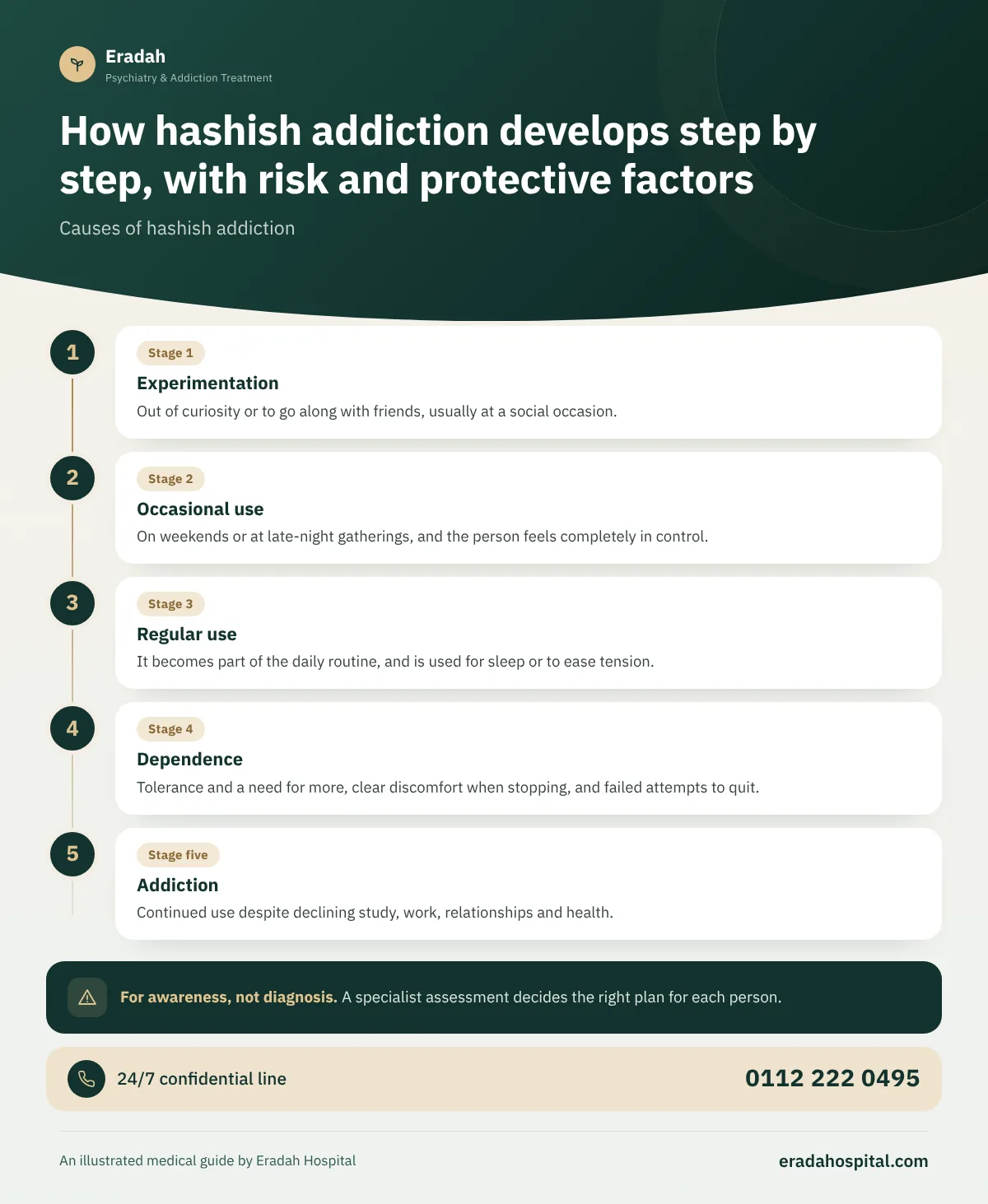
How does use turn into addiction? The stages
- Stage 1Experimentation
Out of curiosity or to go along with friends, usually at a social occasion.
- Stage 2Occasional use
On weekends or at late-night gatherings, and the person feels completely in control.
- Stage 3Regular use
It becomes part of the daily routine, and is used for sleep or to ease tension.
- Stage 4Dependence
Tolerance and a need for more, clear discomfort when stopping, and failed attempts to quit.
- Stage fiveAddiction
Continued use despite declining study, work, relationships and health.
Does hashish addiction sometimes start because of pain?
Some people turn to hashish to ease chronic pain such as back pain or headaches, after hearing about "medical cannabis." But the hashish in circulation has an unknown composition and strength, its pain relief is limited and temporary, and tolerance and dependence build over time. It is safer to treat chronic pain with a specialist doctor under a clear plan, and to tell them honestly about any use.
Risk factors versus protective factors
| Factors that raise the risk | Factors that protect against it |
|---|---|
| Starting in adolescence | Delaying any experimentation until after the brain has finished developing |
| Daily use of strong varieties | No use, or rare use |
| Untreated anxiety, depression or ADHD | Early diagnosis and treatment of mental health disorders |
| Family history of addiction | A supportive family and open communication |
| Friends who use | Sports and social activities and clear goals |
| Trauma and harsh experiences | Skills for coping with stress and psychological support |
If you notice signs that use has gone beyond the experimental stage, see the symptoms of hashish addiction and learn about the steps of treatment.