What are the signs of hashish use while under its influence?
In the hours after use, a group of physical and behavioral signs appear that the family may notice, and they are clearer in people who have used recently.
Obvious redness and slight widening of the blood vessels, and heavy eyelids.
Dry mouth and thirst, then a big appetite, especially for sweets and fast food.
Laughing for no clear reason, or slow speech, zoning out, and difficulty following a conversation.
Slowness in movement and reaction, and forgetting what was said minutes ago.
A faster heartbeat that the person sometimes notices as anxiety or palpitations.
In some people, suspicion, tension, and wary looks instead of relaxation.
Physical signs that appear with regular use
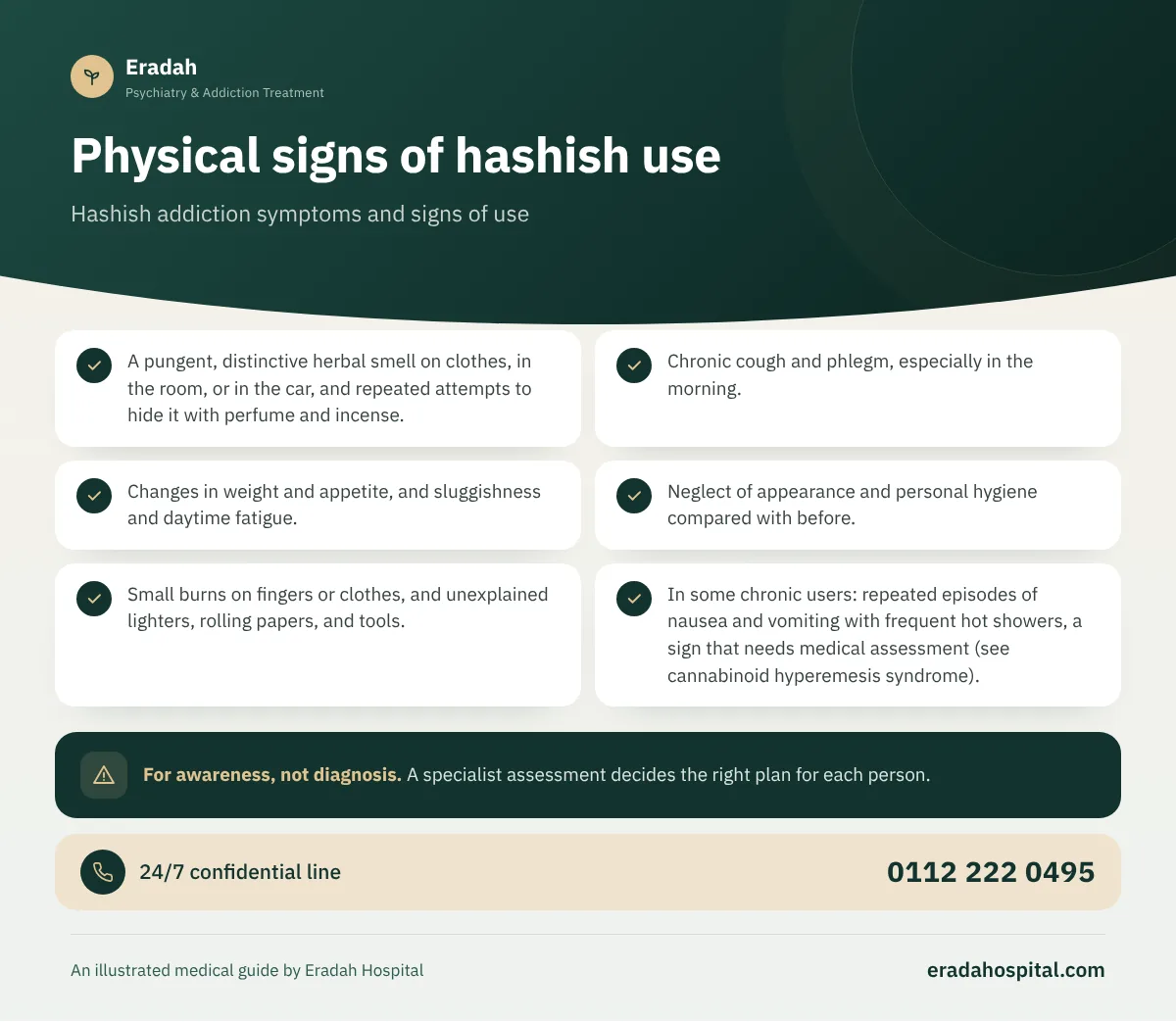
- A pungent, distinctive herbal smell on clothes, in the room, or in the car, and repeated attempts to hide it with perfume and incense.
- Chronic cough and phlegm, especially in the morning.
- Changes in weight and appetite, and sluggishness and daytime fatigue.
- Neglect of appearance and personal hygiene compared with before.
- Small burns on fingers or clothes, and unexplained lighters, rolling papers, and tools.
- In some chronic users: repeated episodes of nausea and vomiting with frequent hot showers, a sign that needs medical assessment (see cannabinoid hyperemesis syndrome).
Behavioral changes that cause concern
- Falling grades or repeated absence from school or work.
- New friends the family doesn't know, and distance from old friends.
- Staying out late and sleeping until noon.
- Asking for money often with no clear explanation, or money and things disappearing from the home.
- Isolating in the room with the door closed for long periods.
- Losing interest in hobbies and sports he used to like.
- Lying or being vague about places and people.
Psychological signs: from mood to suspicion
With regular use, mood swings appear: the person is calm and relaxed under the influence, and irritable and quick to react when not using. Families often notice a general apathy, low enthusiasm, and repeated talk of boredom.
In some people, thoughts of suspicion and paranoia appear, or strange beliefs that people are watching or talking about them, or they hear voices that aren't there. These are warning signs that call for an urgent psychiatric assessment, and if they come with agitation or aggression, it is an emergency.
When is a person diagnosed with cannabis use disorder?
Doctors rely on the criteria of the DSM-5 diagnostic manual, summarized as 11 signs within one year. Two or three signs mean a mild disorder, four or five moderate, and six or more severe. This is an awareness summary and not a self-diagnosis tool:
| Group | Signs |
|---|---|
| Impaired control | Using more or for longer than intended, failed attempts to cut down, spending a lot of time getting it or recovering from it, and strong craving |
| Social harm | Failing obligations at school, work, or home, continuing despite relationship problems, and giving up important activities |
| Risky use | Using in dangerous situations such as driving, and continuing despite knowing its psychological or physical harm |
| Pharmacological changes | Tolerance: needing more for the same effect, and withdrawal when stopping |
What happens after stopping, such as irritability, insomnia, and loss of appetite, is detailed on the page about hashish and bango withdrawal symptoms.
What is the difference between occasional use and addiction?
| Occasional use | Signs of addiction |
|---|---|
| Spaced-out times tied to an occasion | Daily or near-daily use, sometimes from the morning |
| Doesn't affect studies or work | Absence, lateness, and clear decline in performance |
| No distress when it isn't available | Irritability, insomnia, and anxiety without it, and constant searching for it |
| The amount is constant | Needs more or stronger types for the same effect |
| Can stop whenever he wants | Repeated attempts to stop that end in going back |
Note that occasional use is not safe, especially for teenagers, but it differs in risk and in the kind of intervention needed. The earlier the intervention, the easier and more successful it is.
Signs that call for urgent medical assessment
- Hearing voices or seeing things that aren't there, or severe suspicion of family and friends.
- Talk of self-harm or suicide, or severe hopelessness.
- Repeated vomiting with frequent hot showers and signs of dehydration.
- Loss of consciousness, convulsions, or violent agitation, signs that may point to a synthetic substance.
- Use together with alcohol, sedative pills, or tramadol.
How do you tell hashish use from Strox and others?
| Substance | Common signs | What sets it apart |
|---|---|---|
| Hashish and bango | Red eyes, big appetite, laughing and zoning out, herbal smell | Mostly calm and slowness |
| Strox | Stiffness or sudden loss of consciousness, agitation, vomiting, convulsions | A violent, rapid, and unpredictable effect |
| Tramadol | Pinpoint pupils, activity or drowsiness, constipation | Eyes are not red, and it may cause convulsions |
| Stimulants | Dilated pupils, staying up, rapid speech, loss of appetite | The opposite of hashish in appetite and energy |
Signs specific to teenagers and students
In adolescence the signs of use mix with the changes of the age itself, such as wanting privacy and mood swings. So focus on sudden change compared with your son's earlier nature: a sharp drop in grades, a complete change of friends, repeated late nights, and marked isolation. Several signs together over weeks are what deserve attention.
Signs that appear at work or university
At work or school you may notice repeated lateness, forgetting appointments and tasks, slowness in doing work that used to be easy, short disappearances during the day, and a distinctive smell after returning. These signs alone don't prove use, but they deserve a calm conversation that focuses on performance and health, not accusation.
How does a person who uses hide the signs of hashish?
It is useful for the family to know that the attempts to hide may themselves be a sign: using eye drops a lot, excessive perfume, incense, and air fresheners, constantly chewing gum and mints, insisting on closing the room or opening windows in the cold, and changing clothes immediately on returning. These behaviors are not conclusive proof, but they deserve attention if they come together with other changes in studies, mood, and friends.
How do you talk to someone you suspect uses hashish?
- Choose a calm time when he is in his normal state, away from others.
- Start with worry and love, not accusation: “I noticed you've been upset and not sleeping well, and I'm worried about you.”
- Mention specific situations instead of general judgments.
- Listen without interrupting, and accept that denial is a common reaction at first.
- Offer help in a practical way: an appointment for a confidential consultation or a call with a specialist.
- If he refuses, keep the door open and try again, and seek support yourselves as a family.
In the first conversation, don't expect a confession; it is enough that he knows you are on his side and that the road to treatment is open.
When does a person who uses hashish need emergency care? Call ambulance (123) immediately
- A severe panic attack that does not settle, or psychosis: hallucinations, intense suspicion, incoherent speech or aggression
- Chest pain, severe palpitations or fainting
- Repeated vomiting that does not stop, with signs of dehydration: intense thirst, passing little urine and dizziness on standing
- Seizures, loss of consciousness or sudden agitation, especially if the substance is suspected of being mixed with a synthetic drug such as Strox
- A child swallowing any product containing cannabis: extreme drowsiness, unsteadiness or difficulty breathing
Call ambulance (123) and do not leave the person alone. If they are vomiting or have lost consciousness, place them on their side (recovery position) so they do not choke, and tell the paramedics honestly what was taken so they can choose the right treatment. Do not use any home remedies.
Call the ambulance 123