“It's not an addiction”: how can you respond without arguing?
“Dad, it's hashish, not heroin. Half the country smokes it.” Most parents have heard this sentence or something like it, and most then got drawn into a long debate about the definition of addiction that ended with a closed door.
The truth is that your son is right about one small thing: not everyone who has tried hashish is addicted. But the US National Institute on Drug Abuse (NIDA) states that studies estimate 22% to 30% of people who use cannabis have a cannabis use disorder, that the strongest predictor is frequency of use, and that starting at a younger age raises the likelihood. A British study also found that frequent use of high-potency types was linked to more severe dependence, especially in younger people.
That is why you don't need to win the argument over the “name.” You might say: “It doesn't matter what we call it. What matters is that you now sleep until the afternoon and your grades have dropped.” Talking about a tangible effect is hard to deny, while talking about “drugs” triggers a ready-made defense. You can find the signs of use that you are relying on in signs of hashish addiction.
What does a person who uses hashish dislike about how their family treats them?
Many parents search for this question. The useful answer is not a list of what “annoys” him so that we avoid upsetting him, but the approaches that push him toward more secrecy:
He stops listening after the first sentence. A short sentence about your worry works better.
“Look at your cousin” adds shame, and shame fuels both drug use and hiding it.
Searching his phone and room every day turns the home into an interrogation room and teaches him to hide things.
It teaches him that your words mean nothing. Say only what you intend to do.
Confronting him in front of relatives or guests closes any door to conversation.
Describing hashish as “just like heroin” makes him doubt everything you say afterward.
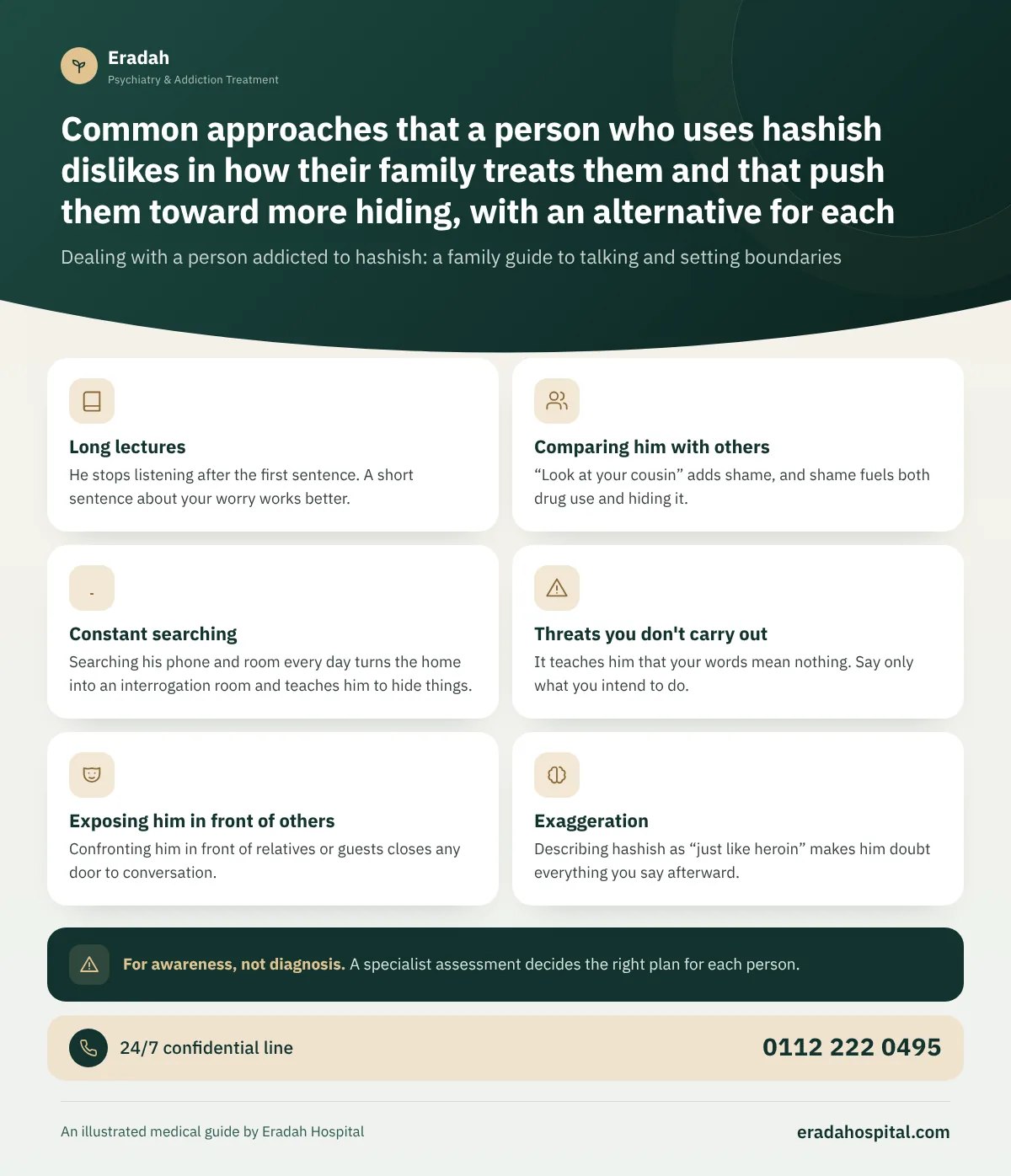
This doesn't mean being lenient. All of the alternatives carry a clear position, but they keep you as the person he will turn to when he decides to stop. You can find ready-made alternative phrases in the guide for the family of a person with addiction.
Behaviors of a person who uses hashish that confuse the family, and how to read them
Some behaviors anger parents because they interpret them as disrespect, while part of them is an effect of the substance or of its withdrawal. Understanding them doesn't excuse them, but it helps you choose a suitable response:
| Behavior | What it may mean | A more helpful response |
|---|---|---|
| Laughing for no reason and slow speech | Effect of a session | No discussion now; talk at another time |
| Sleeping until the afternoon and apathy toward everything | A regular use pattern and reduced motivation | Link the conversation to studies or work, not to laziness |
| Irritability and insomnia when he can't get hashish | Withdrawal symptoms | Calm and routine, without sleeping pills from the home |
| Suspicion of what people say or a feeling of being watched | A psychological effect of hashish, stronger with concentrated types | Don't argue, and watch whether it continues after the effect wears off |
If suspicion and paranoia appear
Suspicion is one of the best-documented psychological effects of hashish, and the section on hashish and suspicion explains why it happens. What matters for the family is how to act: don't try to convince him that his thoughts are wrong while they are at their peak. Instead, reduce the noise and the number of people around him, speak in a calm voice and short sentences, and reassure him that you are there without confirming what he says or mocking it.
It becomes more serious when the suspicion continues after the effect wears off, turns into fixed accusations of infidelity or conspiracy, or comes with hallucinations. In a large European study published in 2019, daily cannabis use was linked to about 3 times the likelihood of a psychotic disorder, rising to nearly 5 times with daily use of high-potency types. Here he needs an urgent psychiatric assessment, and the page on drug-induced psychosis explains what is happening.
Irritability and insomnia after stopping: how do you support him without giving in?
When he tries to stop, the family may be surprised that he has become “worse”: more irritable, not sleeping, with no appetite. NIDA notes that cannabis withdrawal symptoms may include anger, irritability, aggression, anxiety, restlessness, reduced appetite, depression, insomnia, and disturbing dreams. They are mostly temporary, and the page on hashish withdrawal symptoms explains how long they last.
- Don't read the irritability as failure; it is evidence that he is trying.
- Help him keep a steady sleep routine and daytime physical activity, and cut back on stimulants at night.
- Don't give him sleeping pills or sedatives from the home; this opens the door to a new dependence.
- Ease big demands for a while without giving up the rules you agreed on.
- If clear depression or hopelessness appears, that is a sign to seek a psychiatric assessment.
If the person using is a teenager
A teenager is not a small man; his brain is still developing, which is why, according to NIDA, an early start is linked to a higher risk of addiction. At the same time he is more sensitive to insults and comparisons, and more influenced by his friends. What helps with him:
- A few clear, written rules about going out, allowance, and the phone, with consequences set in advance.
- Regular time with him that isn't about hashish: a match, an outing, or a meal.
- Knowing his friends and where he goes, without daily interrogation.
- Contact with the school when needed, coordinated with him as far as possible.
- A specialist assessment if his studies clearly decline or suspicion or depression appears.
You can find more details about teenagers in the guide to teen addiction.
Clear limits without threats
Successful limits are few, enforceable, and said calmly. For example: “No hashish in the house,” “The allowance goes to known needs,” and “No driving after a session.” Most important, follow through on what you said without shouting, and reward good days with closeness and attention. This idea, making life without hashish more attractive instead of entering a fight, is the basis of the CRAFT family-training program, and you can find its steps in how to persuade a person with addiction to accept treatment.
When should you seek a specialist assessment?
Seek an assessment if use becomes daily, if he fails to stop despite trying, if his studies or work decline, or if suspicion, depression, or severe anxiety appears. Most cases are treated through outpatient treatment with cognitive behavioral therapy and family involvement, and you can find the stages in hashish addiction treatment. The family can start on their own with a free, confidential consultation at Eradah.
Warning signs after using hashish: call an ambulance (123) immediately
- Hallucinations or severe suspicion with a threat to cause harm or while holding a sharp object.
- A panic attack with chest pain, severe palpitations, or fainting.
- Repeated vomiting that won't stop, with signs of dehydration.
- Convulsions or loss of consciousness, which may point to synthetic cannabis or an adulterated substance.
- Serious talk about death or self-harm: don't leave him alone, and also call the mental health support line 16328.
Call ambulance (123) immediately. If the person is unconscious but breathing, place them on their side so they do not choke on vomit. Stay with them and do not leave them alone. Do not give them food or drink, and tell the paramedics everything they took or used, and the amount and time if you know them.
Call the ambulance 123