Why is the family confused by the behavior of people who use hashish?
“My son has become someone else: he wakes up in the afternoon, doesn't talk to us, and any question turns into a fight.” This is how a mother begins her story, not knowing whether what she sees is ordinary adolescence or something bigger. The question about the behavior of people who use hashish is one of the most searched by families, because behavior is the first thing to change, before any test.
In everyday speech, the word “hashashi” (hashish smoker) describes a person who uses hashish, and it often carries a harsh judgment. We use it here because it is what people search for, but we treat what lies behind it as symptoms with explanations. The guide to signs of hashish addiction presents the physical and psychological signs and the diagnostic criteria, while this page focuses on behavior: how a person who uses behaves at each stage, and why.
Behavior during the effect
The US National Institute on Drug Abuse (NIDA) lists these short-term effects of hashish: altered senses, altered sense of time, mood changes, impaired movement, difficulty thinking and solving problems, and impaired memory. They show up in behavior like this:
Laughing at ordinary things, or long silences and spacing out.
Slower movement and speech, and a feeling that time is passing slowly.
A strong desire for sweets and eating at odd times.
Forgets what he said minutes ago or repeats himself.
In some people, tension and a feeling that people are watching him.
Physical signs that often accompany the behavior.
Behavior in daily life
With regular use, life patterns themselves change, and among the things families notice most:
- Reversed sleep: staying up until dawn and waking late, with unrefreshing sleep.
- Apathy: less interest in studies, work, or hobbies, and putting everything off.
- Forgetfulness: appointments, tasks, and conversations that are constantly forgotten.
- A new circle of friends: distance from old friends and spending long hours outside the home.
- Unexplained spending: repeated requests for money without a convincing explanation, or small things disappearing.
- Secrecy: locking the phone and the room, short mysterious calls, and smells hidden with perfume or incense.
In a well-known New Zealand study that followed more than a thousand people from birth to age 38, those who used hashish persistently showed a decline in mental abilities, clearer in those who started in adolescence, and people close to them noticed more memory and attention problems than in others. This is what the family sees as forgetfulness and distraction.
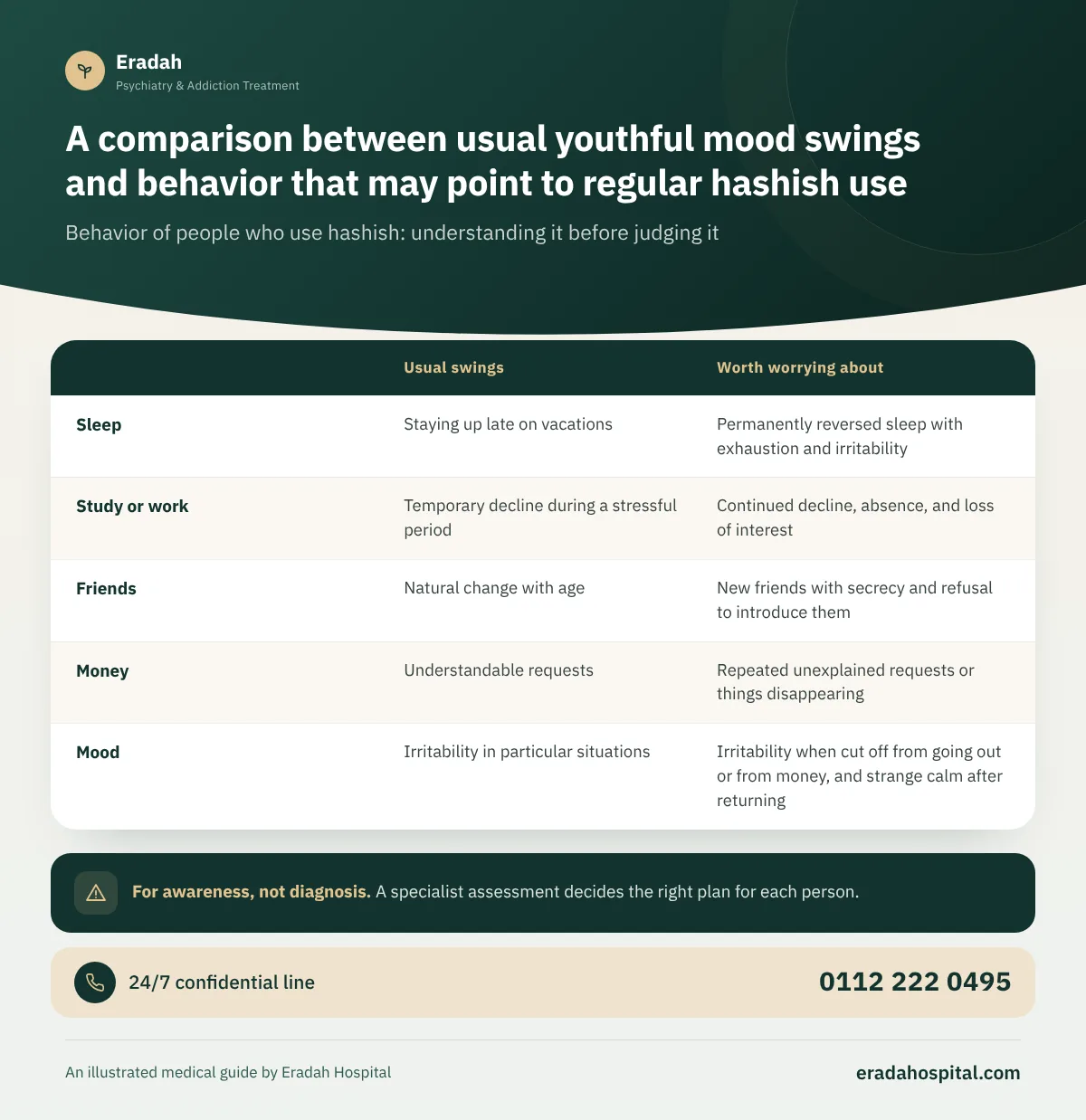
Normal mood swings or behavior worth worrying about?
| Usual swings | Worth worrying about | |
|---|---|---|
| Sleep | Staying up late on vacations | Permanently reversed sleep with exhaustion and irritability |
| Study or work | Temporary decline during a stressful period | Continued decline, absence, and loss of interest |
| Friends | Natural change with age | New friends with secrecy and refusal to introduce them |
| Money | Understandable requests | Repeated unexplained requests or things disappearing |
| Mood | Irritability in particular situations | Irritability when cut off from going out or from money, and strange calm after returning |
Behavior of people who use hashish when they are cut off from it
Much of the irritability the family sees is not “bad manners” but withdrawal symptoms. In a US study that followed regular users after stopping, irritability, anger, aggression, anxiety, insomnia, reduced appetite, and restlessness appeared, usually beginning between the first and third day, peaking between the second and sixth day, and mostly lasting 4 to 14 days. The page on hashish withdrawal symptoms explains how you can help him during these days.
Are people who use hashish violent?
The common picture is that hashish “calms,” and that is true in some people during the effect. But a systematic review published in the American Journal of Psychiatry in 2020, covering about 297,000 adolescents and young adults, found that cannabis use was linked to about double the likelihood of physical violence, and the increase was greater in heavy, persistent users, even after accounting for other factors. An association doesn't mean every person who uses is violent, but it does mean violence isn't necessarily to be explained as “just his nature.”
Suspicion and strange behavior
Some behaviors are more worrying than others: closing the curtains for fear of being watched, searching the phone for “spying,” and accusing the family or wife of conspiracy or infidelity. These may be a passing effect of hashish or the start of psychosis, and the page on hashish and suspicion explains how to tell them apart and when to seek an urgent assessment.
How do you respond to these behaviors?
Understanding does not mean justifying. What's needed is a response that keeps the dialogue open and sets limits: no discussion while he is under the effect, a calm talk about specific situations, and clear limits on money and going out, without daily searching or exposing him in front of others. The page on dealing with a person who uses hashish presents what a person who uses dislikes in how the family acts and more helpful alternatives.
If several behaviors from this page come together, the next step is a specialist assessment, and the page on hashish addiction treatment explains what happens after that. Many of these behaviors improve after stopping, as the page on the body's recovery after quitting hashish shows. At Eradah the first consultation is free and confidential.
Warning signs linked to hashish: call an ambulance (123) immediately
- Hallucinations or severe suspicion with a threat to oneself or others.
- Talk of death or self-harm.
- Chest pain, severe palpitations, or fainting.
- Repeated vomiting that won't stop, with dehydration.
- Convulsions or loss of consciousness, especially if the “hashish” is synthetic or adulterated.
Call ambulance (123) immediately. If the person is unconscious but breathing, place them on their side so they do not choke on vomit. Stay with them and do not leave them alone. Do not give them food or drink, and tell the paramedics everything they took or used, and the amount and time if you know them.
Call the ambulance 123