Why is there no approved medication for hashish addiction?
“Doctor, I want an injection or a pill that makes me quit for good.” We hear this request often, and we understand it. Quitting hashish is hard, and a drug looks like a shorter road. The honest answer to the question about medications for hashish addiction is that they are still in laboratories and trials, not on the pharmacy shelf.
The reason is that hashish acts on a complex system in the brain, the endocannabinoid system, which takes part in mood, sleep, appetite, and memory. The medications that work for opioids or alcohol depend on different receptors. The 2025 Cochrane update reviewed about 37 randomized trials involving 3,201 participants, and concluded that every medication studied is still experimental, and that the evidence for half of the important outcomes was of low or very low quality.
The page on hashish addiction treatment presents the full plan and its stages. Here we go through each medication that has been studied: what the trials found, what their limits are, and when a doctor might consider it.
The main medications that have been tried
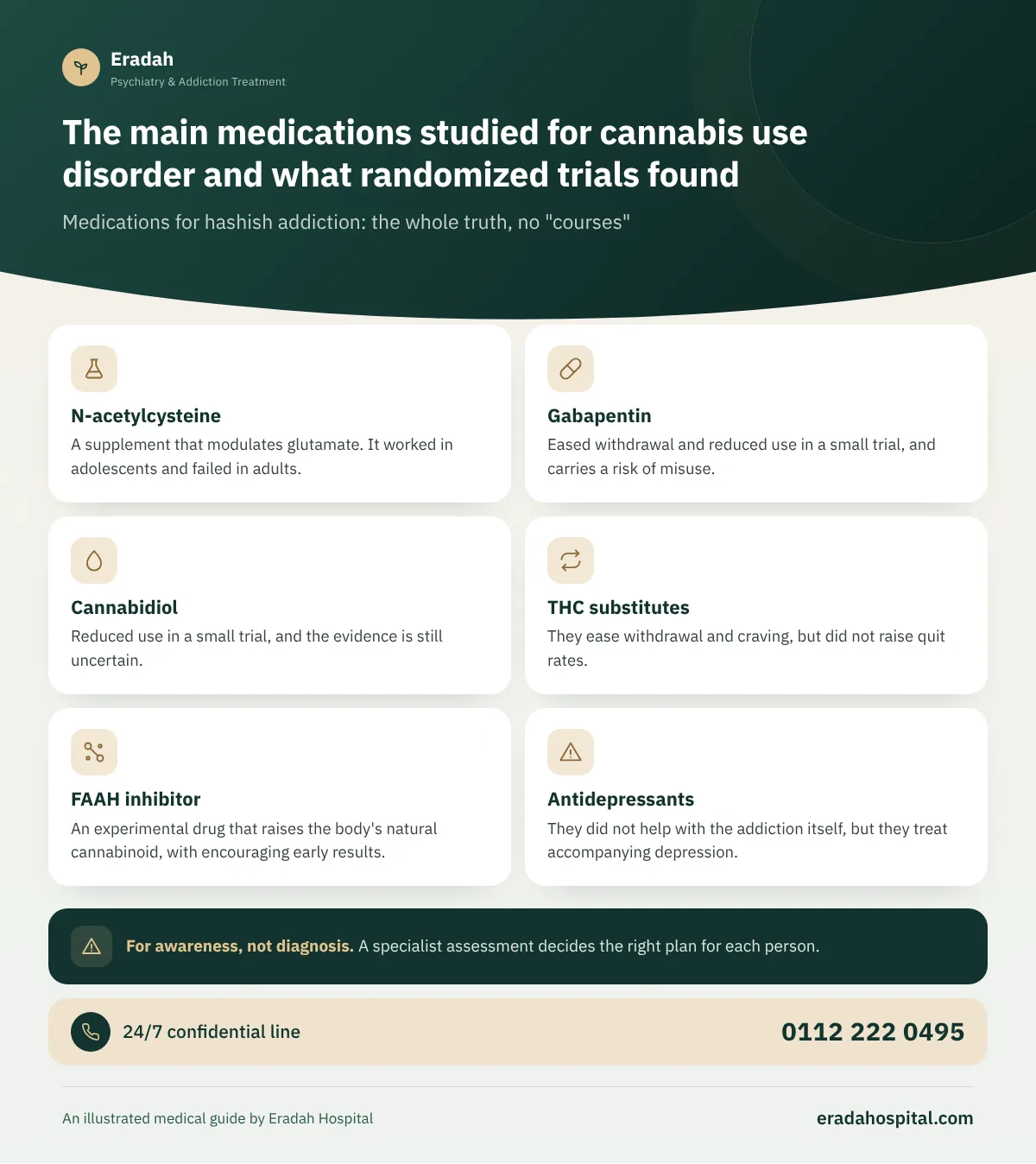
A supplement that modulates glutamate. It worked in adolescents and failed in adults.
Eased withdrawal and reduced use in a small trial, and carries a risk of misuse.
Reduced use in a small trial, and the evidence is still uncertain.
They ease withdrawal and craving, but did not raise quit rates.
An experimental drug that raises the body's natural cannabinoid, with encouraging early results.
They did not help with the addiction itself, but they treat accompanying depression.
N-acetylcysteine: success in adolescents only
It is a supplement sold without a prescription in many countries, and it is believed to rebalance the glutamate transmitter in the brain's reward centers. In a US trial published in 2012 on 116 adolescents and young adults aged 15 to 21, the chances of negative urine tests among those who took it were more than double compared with placebo, with few side effects.
But a larger trial on 302 adults published in 2017 found no difference: the share of negative tests was 22.3% with the drug and 22.4% with placebo. Researchers think differences in age, pattern of use, and adherence to the medication may explain the contradiction. For this reason N-acetylcysteine is not considered a proven treatment, and a doctor may discuss it with some adolescents as part of a psychological and behavioral plan, not instead of it.
Gabapentin: a promising result and an important warning
In a small trial published in 2012 on 50 adults over 12 weeks, gabapentin reduced use according to urine tests, eased withdrawal symptoms, and improved performance on some executive-function tests compared with placebo. But it was a small “proof of concept” trial and Cochrane reviews have not confirmed it. Most important in the Egyptian context, gabapentin is itself a drug that is misused, especially together with opioids, so it should not be used without close supervision.
Cannabidiol and THC substitutes: treating cannabis with cannabis?
The idea resembles treating opioid addiction with a regulated opioid substitute: giving a cannabis-family substance in a measured way to ease withdrawal. In an Australian trial published in 2019 on 128 patients who had failed earlier attempts, researchers used a spray containing THC and cannabidiol alongside psychological sessions for 12 weeks. Days of use were fewer in the medication group: 35 days on average versus 53 days with placebo.
As for cannabidiol (CBD) alone, a British trial published in 2020 on 82 participants found that it reduced use more than placebo and was well tolerated. Even so, the Cochrane update rated the evidence on cannabidiol as low-confidence, and THC substitutes did not raise complete quit rates when trials were pooled. These medical preparations are completely different from the “oil” products of unknown content sold online.
New medications under research
One of the most interesting directions is an experimental drug that inhibits the FAAH enzyme, raising the level of the body's natural cannabinoid in the brain instead of adding a substance from outside. In a trial published in 2019 on 70 men who used daily, the drug was linked to milder withdrawal symptoms during the in-patient period and less use after four weeks. But it is still in the early stages of research and is not available for treatment.
What does a doctor actually prescribe?
In everyday practice, a doctor uses medications to treat what surrounds the addiction, not the addiction itself:
| Problem | What the doctor may do |
|---|---|
| Severe insomnia after stopping | A behavioral sleep plan first, and sometimes a short-term, non-habit-forming medication |
| Persistent depression or anxiety | An accurate diagnosis, then suitable treatment with antidepressants or psychotherapy |
| Psychotic symptoms or severe suspicion | Urgent assessment, and an antipsychotic may be needed |
| Hyperactivity and attention problems | Diagnosis and treatment suited to a person with a history of substance use |
| Use of other substances | A withdrawal plan for each substance, since some need medical supervision |
The data on hashish withdrawal symptoms show that insomnia, irritability, and loss of appetite are among the things that most often push people to relapse in the first days, which is why the doctor pays attention to treating them early.
Why does psychological treatment remain the foundation?
Because the evidence is much stronger: cognitive behavioral therapy, motivational interviewing, and contingency management improve quit outcomes, and these same therapies were used alongside the medication in most of the earlier trials. At best, a medication helps the person get through the first weeks so they can benefit from psychological treatment. This can be done through outpatient treatment in most cases, and at Eradah the first consultation is free and confidential.