What happens to the body after quitting hashish?
“It's been a week without hashish, and I can't sleep, and I'm irritable about everything. Will I stay like this?” Almost everyone who has tried to stop asks this question. The reassuring answer is that the body's recovery after quitting hashish really does happen, that it has known stages you can expect, and that the hardest comes first.
The page on hashish withdrawal symptoms explains the first days in detail. This page looks at the bigger picture: what improves, when, and what research says about the brain, memory, sleep, mood, and lungs over weeks and months.
THC is stored in body fat and leaves slowly, so it may show up in a test for a while after stopping in people who used regularly, as the page on how long hashish stays in the body explains. But showing up in a test doesn't mean the body hasn't started to recover.
Timeline of the body's recovery after quitting hashish
- Days 1 to 3Withdrawal begins
Irritability, anxiety, insomnia, and reduced appetite usually begin in this period.
- Days 2 to 6The peak
The most intense symptoms: anger, restlessness, and disturbed sleep, and sometimes tremor and abdominal pain.
- The first weekMemory starts to improve
Verbal learning improved in young people who stopped, mostly in the first week.
- Week 2Withdrawal fades
Most withdrawal symptoms last 4 to 14 days and then ease.
- About 4 weeksBrain receptors return
The density of cannabis receptors in the cerebral cortex returned to the normal level.
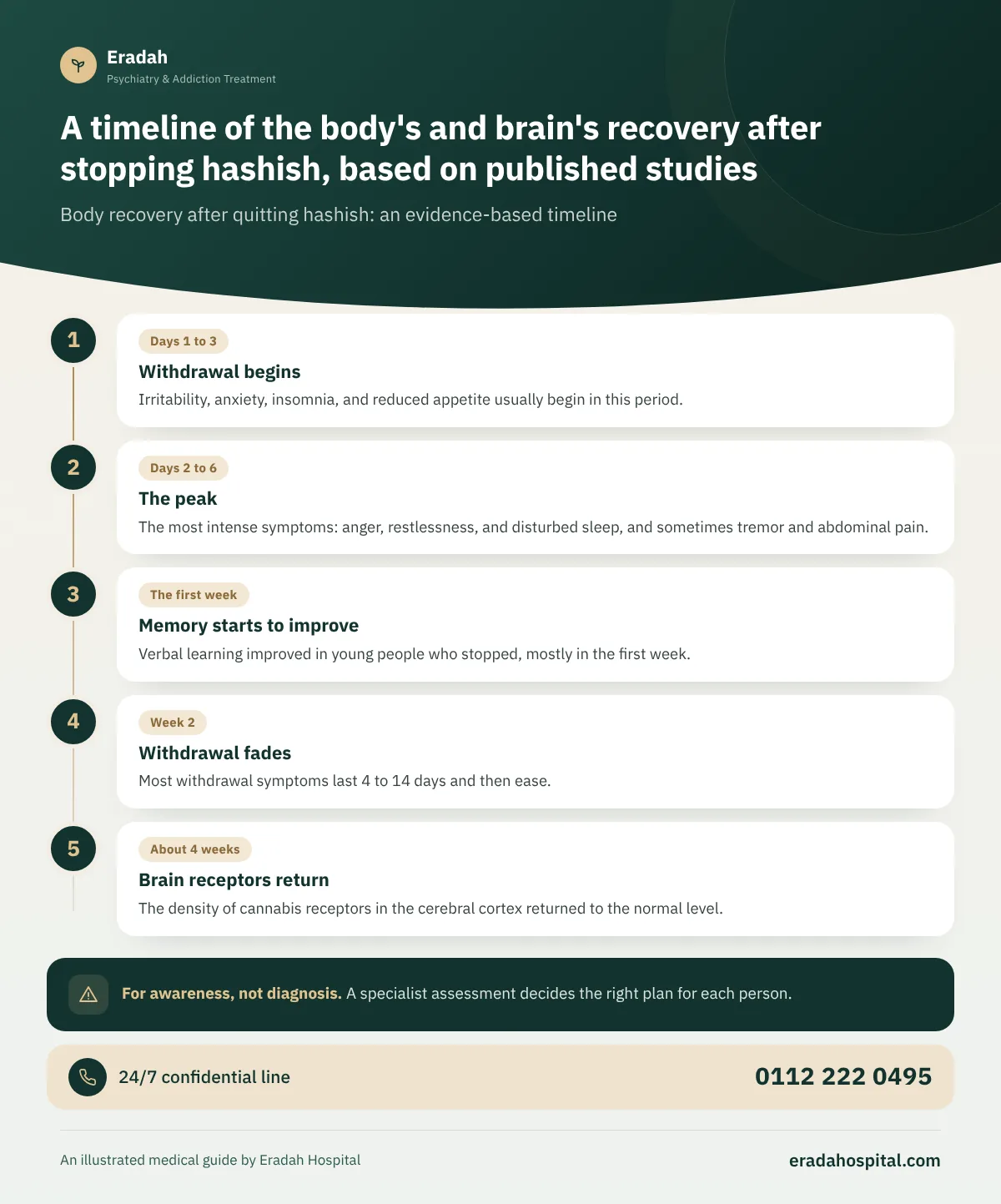
These stages are taken from published studies, and they vary from person to person depending on the duration and amount of use, the potency of the type, and the presence of psychiatric disorders or other substances.
The brain: receptors return to normal
Hashish acts on receptors called cannabinoid type 1 receptors. With daily use the brain reduces their number to adapt to the constant flooding, and this is one reason for tolerance and dependence. In a positron emission tomography imaging study published in 2012, the density of these receptors was lower in daily users, and the decrease was linked to the number of years of use. But after about 4 weeks of monitored abstinence inside a research unit, the density returned to the normal level.
This is one of the most encouraging findings: the change that creates dependence is reversible within weeks. But it doesn't mean that the craving disappears within a month, since habits, triggers, and memories need longer and psychological treatment.
Memory and concentration
In a randomized trial published in 2018 on 88 young people aged 16 to 25 who used regularly, a group was asked to stop for 4 weeks with verification by tests, and their verbal memory improved compared with those who continued, with most of the improvement happening in the first week. Attention, however, improved equally in both groups.
Sleep: the slowest to improve
Many people sleep on hashish, so sleep is among the hardest things they face after stopping. In a study published in the journal Sleep in 2008, heavy users after stopping showed shorter sleep and less deep sleep compared with non-users, and their sleep on the second night was worse than on the first. Many also describe vivid, disturbing dreams in the first weeks.
Sleep improves gradually, helped by a fixed bedtime and wake-up time, daytime movement, and less caffeine and screen time at night. Don't turn to sleeping pills or sedatives without a prescription, as they may shift the dependence to another substance. The page on insomnia and addiction explains the treatment options.
Mood and anxiety
In an analysis of data from 302 adults receiving treatment for cannabis use disorder for 12 weeks, reduced use was linked to improvements in anxiety, depression, and sleep quality over time. But the first days may bring distress and anxiety as part of withdrawal, so don't judge recovery by its first week. If depression or anxiety continues after withdrawal ends, it may be a separate disorder that deserves treatment, as the page on dual diagnosis explains.
If thoughts of death or self-harm appear at any stage, seek help immediately through the mental health support line 16328 or an ambulance (123).
The lungs, stomach, and the rest of the body
- Lungs: in a study that followed 299 people for about ten years, those who kept smoking hashish were more likely to have chronic cough and phlegm, while those who stopped did not differ from people who never smoked, meaning chronic bronchitis symptoms improved with stopping.
- Stomach: cannabinoid hyperemesis syndrome, episodes of severe repeated vomiting in some chronic users, usually resolves with complete cessation of hashish.
- Appetite and weight: appetite may drop in the first days of withdrawal, then returns gradually.
Why does relapse happen midway?
The riskiest periods are the first two weeks, when withdrawal peaks, and then the following weeks, when the person feels better and thinks he “can control it.” Research indicates that about half of regular users go through withdrawal symptoms, and these are among the reasons for going back. Psychological treatment helps with handling triggers, friends, and boredom, and the page on hashish addiction treatment presents a full plan.
At Eradah, treatment can start through outpatient treatment in most cases, with aftercare to consolidate recovery, and the first consultation is free and confidential.