What is meant by hashish and suspicion?
“Every time I smoke I feel like people in the cafe are staring at me, and that someone is monitoring my phone.” Many people who use say this sentence. Some laugh about it the next day, and some never laugh. The question of hashish and suspicion is a serious one, because the difference between a passing feeling and a lasting certainty can be the difference between a bad session and a mental illness.
Paranoia, or suspiciousness, is the belief that others intend to harm you, are watching you, or are plotting against you, without enough evidence. The British mental health charity Mind explains that paranoid thoughts range from mild suspicions that many people know to fixed beliefs that take over life. The guide to paranoia explains the condition in general.
A section in harms of hashish presents this effect briefly. Here we go deeper: how does hashish create suspicion? Who is most at risk? When does it pass? And when does it turn into something that needs treatment?
How does hashish create suspicion?
The substance responsible is THC, the main psychoactive component of hashish. In the largest trial of its kind, published in the journal Schizophrenia Bulletin in 2015, 121 people with a tendency toward paranoid thoughts took part, and suspicion was measured in real social situations and in virtual reality. The trial showed that suspicion did not arise from poor memory, but from two things combined:
- Negative feelings: anxiety, worry, and negative thoughts about oneself, which make the mind expect danger.
- Strange perceptual experiences: sounds louder than usual, and colors and sensations that seem “different,” so the mind looks for an explanation, and the nearest explanation for an anxious mind is that something suspicious is going on.
Practically, what matters is that telling participants in advance that these were effects of the substance did not protect them much from suspicion. In other words, “I know it's the hashish effect” is not always enough to stop the feeling.
Who is most at risk of suspicion with hashish?
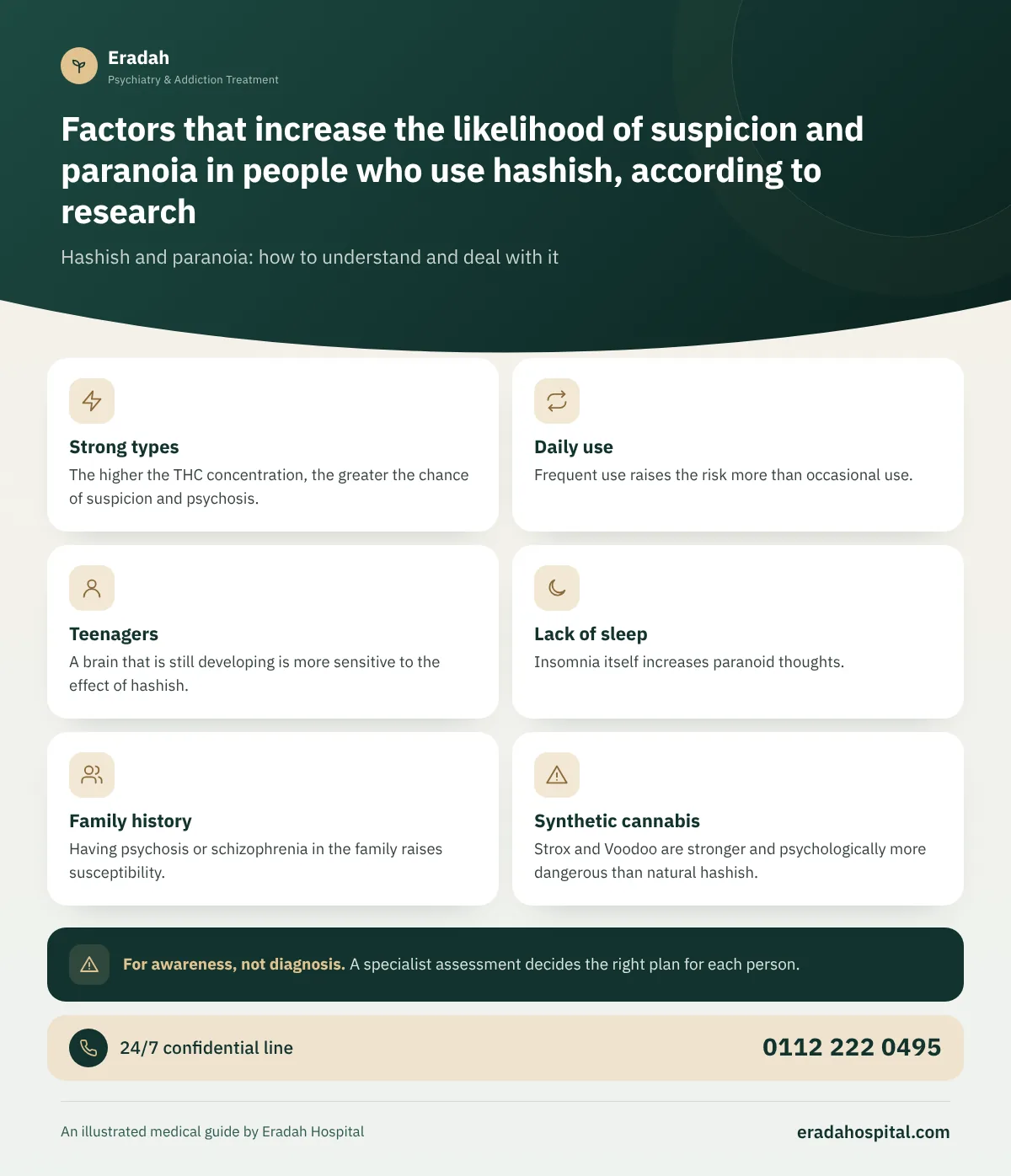
The higher the THC concentration, the greater the chance of suspicion and psychosis.
Frequent use raises the risk more than occasional use.
A brain that is still developing is more sensitive to the effect of hashish.
Insomnia itself increases paranoid thoughts.
Having psychosis or schizophrenia in the family raises susceptibility.
Strox and Voodoo are stronger and psychologically more dangerous than natural hashish.
In a large European study published in the journal Lancet Psychiatry in 2019 on 901 patients with a first episode of psychosis and 1,237 people from the general population across 11 sites, the researchers estimated that the absence of high-potency types could have prevented about 12% of new psychosis cases at those sites, and psychosis rates in each city were linked to how common daily use and strong types were there.
Passing suspicion, paranoia, or psychosis?
Not every suspicion with hashish is an illness, but there are degrees that must be told apart:
- Passing suspicion during the effect: a feeling of being watched that passes when the session ends, and the person later admits it was exaggerated.
- Recurring suspicion between sessions: excess caution, withdrawal from people, and interpreting ordinary speech as aimed against him, even without use.
- Fixed jealousy or accusations: certainty that the wife is cheating or that the family is plotting, and here the page on morbid jealousy helps.
- Psychosis: an unshakable certainty with hallucinations, disorganized speech, or strange behavior, which needs urgent assessment as the page on drug-induced psychosis explains.
In a pooled analysis published in 2020, 34% of cases of cannabis-induced psychosis later converted to schizophrenia, the highest rate among the different substances. That is why psychosis after hashish is not treated as a “side effect that will go away” without follow-up.
Does suspicion go away after quitting hashish?
Passing suspicion usually goes away when the effect ends. Recurring suspicion usually improves within weeks of stopping, but the first days may bring anxiety, irritability, and insomnia as part of hashish withdrawal symptoms, and these can temporarily increase suspicion. That is why stopping needs follow-up, not patience alone.
If the suspicion continues after weeks of stopping, or appeared even before use, there may be a separate psychiatric disorder that needs diagnosis, such as a psychotic disorder, paranoid personality disorder, or depression with psychotic features.
Why does sleep matter in treating suspicion?
Many people who use hashish sleep on hashish, then suffer insomnia when they stop. In a British trial published in the journal Lancet Psychiatry in 2017 on 3,755 university students, treating insomnia with digital cognitive behavioral therapy reduced insomnia and, with it, paranoid thoughts and hallucinations, and the improvement in sleep was what explained the improvement. This means that treating sleep is part of treating suspicion, not a luxury.
Treating hashish-related suspicion
Treatment depends on the degree:
- Stopping hashish of all types, with treatment of withdrawal and insomnia.
- Cognitive therapy for suspicion: in a British trial published in 2021 on 130 patients with persistent persecutory delusions, a tailored cognitive therapy program reduced the strength and severity of delusional conviction more than regular supportive sessions.
- Medications: if psychosis is present, the doctor prescribes antipsychotics according to the case. Don't start or stop any medication without a doctor.
- Treating the addiction itself: through a hashish addiction treatment plan, because returning to use brings the suspicion back.
The page on paranoia treatment presents the options in detail.
If your relative is suspicious of you after hashish
Don't try to prove your innocence by arguing, don't mock his thoughts, and don't confirm them to calm him. Speak in a calm voice, reduce the noise and the number of people around him, and postpone the discussion until he calms down. The page on dealing with a person who uses hashish offers practical steps for the family.
Warning signs linked to hashish: call an ambulance (123) immediately
- Hallucinations or severe suspicion with a threat to oneself or others.
- Talk of death or self-harm.
- Chest pain, severe palpitations, or fainting.
- Repeated vomiting that won't stop, with dehydration.
- Convulsions or loss of consciousness, especially if the “hashish” is synthetic or adulterated.
Call ambulance (123) immediately. If the person is unconscious but breathing, place them on their side so they do not choke on vomit. Stay with them and do not leave them alone. Do not give them food or drink, and tell the paramedics everything they took or used, and the amount and time if you know them.
Call the ambulance 123