Why do some people believe hashish improves intimacy?
“At that moment I feel like time has stopped and everything is better.” This description is common among people who use hashish when they talk about marital intimacy, and it is an honest description of how they feel in that moment. But the medical question is different: does hashish actually improve sexual function, or does it only change the sensation of it?
THC, the active substance in hashish, acts on cannabinoid receptors in the brain, changing the sense of time and easing tension in some people, while provoking anxiety in others. That is why people tell contradictory experiences, and each one believes their own. You can find the general picture of the effects of different substances in the guide to drugs and sex, while here we detail what research says about hashish specifically.
It is important to remember that much of this research was done in countries where cannabis is used in forms and potencies different from the hashish in circulation in Egypt, which is usually smoked with tobacco and may be mixed with other substances, so its results should be read with caution.
Why do research results seem contradictory?
Because each study measures something different. In a large US survey published in 2017 that included 28,176 women and 22,943 men, cannabis users reported more sexual encounters in the previous month compared with those who had never used it. But the researchers themselves noted that the answers are self-reported and represent a single point in time, and the survey cannot say that hashish is the cause; people who are more adventurous may be more inclined toward both.
| Aspect | What the person who uses reports | What studies say |
|---|---|---|
| Desire and frequency of sex | More desire and relaxation | Self-reported surveys find an association that doesn't prove cause |
| Erection | Doesn't notice a problem at first | A systematic review links it to a higher rate of erectile dysfunction |
| Hormones | Doesn't think about it | Mixed results with no clear difference in testosterone |
| Fertility | “It has nothing to do with it” | Unsettled indicators, and an effect is not ruled out |
| Mood during intimacy | Calm | Anxiety and suspicion in some users, especially with strong types |
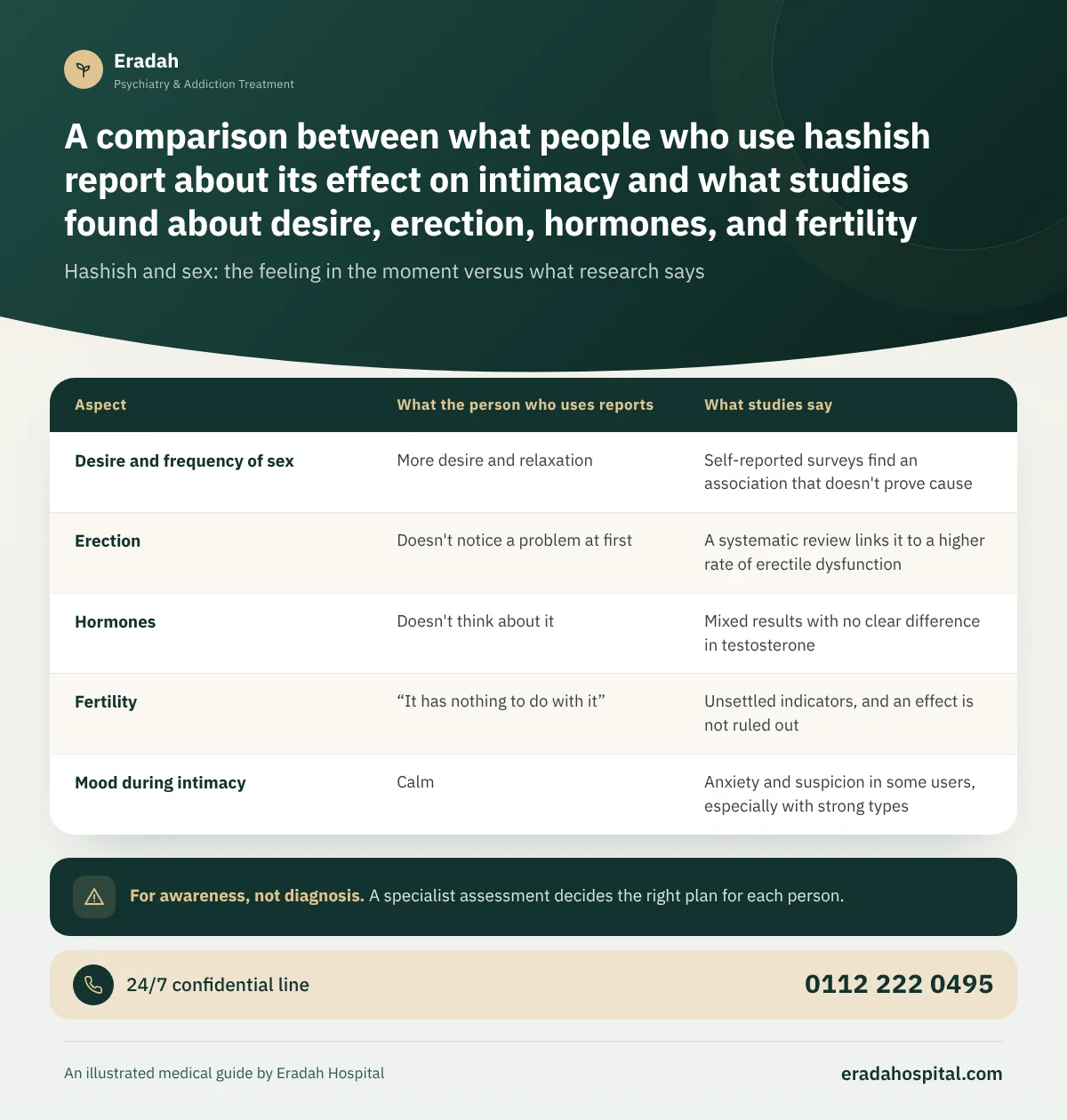
In summary, research provides no evidence that hashish improves sexual health, and what looks like an improvement in self-reported studies doesn't hold up against more careful questions.
Hashish and erection: where does the problem show up?
A systematic review published in 2019 pooled five studies and found a higher rate of erectile dysfunction in cannabis users, with a caution about large variation between studies, and the page on harms of hashish presents its numbers. What matters to us here is how this effect meets a well-known psychological factor: performance anxiety.
A man who is used to intimacy under the influence of hashish may feel tense when he tries without it, and sees the tension as proof that he “needs” hashish, so he goes back to it. Over time the substance becomes a psychological condition for intimacy, which is one form of dependence that is hard for the person to notice.
Does hashish lower the male hormone?
The question is an old one and the answer is unsettled. In an analysis of US national health survey data published in 2017 that included 1,577 men, testosterone level did not differ between those who had ever used cannabis and those who hadn't, and was in fact slightly higher in those who had used it recently, especially between ages 18 and 29. The researchers cautioned that this doesn't settle the effect of cannabis on reproductive health.
In a systematic review and pooled analysis published in 2021 that included nine studies, no significant difference in testosterone appeared between users and others, with a slight decrease in one of the pituitary hormones that regulate the testis (FSH). The researchers concluded that current evidence doesn't point to a clear clinical effect, but doesn't rule it out because the studies are limited and varied.
Hashish and fertility: what is known so far?
In the same review, the proportion with abnormal semen analysis was 44.9% among 1,158 users versus 24.5% among 2,856 non-users, but this difference was not statistically significant after pooled analysis. In other words, the raw numbers look worrying, and careful analysis doesn't settle them. The page on harms of hashish presents a Danish study that linked frequent smoking to lower sperm concentration.
Between “unsettled” and “safe” there is a big distance. Someone who is planning with his wife to have a child, or who is struggling with delay in conceiving, does best to stop hashish and tell the men's health doctor about the history of use frankly, because this information is part of the assessment.
Hashish and women's sexual health
Research on women is much scarcer. In a questionnaire conducted at one US women's clinic and published in 2019, 127 of 373 women reported having used cannabis before intimacy, and most said it increased desire and improved satisfaction. But it is a questionnaire of personal impressions from one place, which doesn't measure the medical effect and doesn't represent others.
On the other hand, hashish has an effect these questionnaires don't measure: it impairs judgment and decision-making, and may provoke anxiety or suspicion. Pregnant and breastfeeding women are advised to stop completely, and any decision related to pregnancy is discussed with the doctor.
How does hashish affect the marital relationship?
Many of hashish's problems at home have nothing to do with hormones, but with behavior and mood. The US National Institute on Drug Abuse (NIDA) states that studies estimate 22% to 30% of people who use cannabis have a cannabis use disorder, and that the strongest predictor is frequency of use. With dependence, things appear that the wife notices before anyone else:
- Emotional withdrawal and indifference, and spending more time at the “session” than at home.
- Suspicion and jealousy, especially with strong types, explained in the section on hashish and suspicion.
- Irritability and insomnia when he is late for his usual time, which are withdrawal symptoms that NIDA mentions.
- Increasing spending and arguments about money.
If you are a wife living in this situation, the guide to dealing with an addicted husband helps you protect yourself and your children, and the guide to dealing with a person who uses hashish explains how to talk to him without a clash.
Does sex life improve after quitting hashish?
There are not enough studies to determine when and how it improves after stopping. But it is known that the first weeks may bring sleeplessness, irritability, anxiety, and disturbing dreams as part of withdrawal, and all of these temporarily affect mood and the relationship. This doesn't mean that hashish was improving the relationship, but that the body and brain are resetting themselves. The page on hashish withdrawal symptoms explains how long they last and how to ease them.
If you can't stop despite wanting to, psychological treatment is the foundation, and most cases are treated without residential care through outpatient treatment. You can find the treatment stages in hashish addiction treatment, and the first consultation at Eradah is free and confidential.
Warning signs after using hashish: call an ambulance (123) immediately
- Chest pain or severe palpitations with dizziness or fainting.
- A panic attack or severe suspicion with a threat to cause harm or while holding a sharp object.
- Hallucinations, disorganized speech, or detachment from reality.
- Repeated vomiting that won't stop, with signs of dehydration.
- Convulsions or loss of consciousness, signs that may point to mixing with synthetic cannabis or another substance.
Call ambulance (123) immediately. If the person is unconscious but breathing, place them on their side so they do not choke on vomit. Stay with them and do not leave them alone. Do not give them food or drink, and tell the paramedics everything they took or used, and the amount and time if you know them.
Call the ambulance 123