Can depression really be treated without medication?
“I don't want psychiatric medication; I'm afraid of getting hooked on it.” This is one of the things patients say most often at the first visit. The good news is that treating depression without medication is a real option, supported by medical guidelines, with one important condition: it must suit the severity of the depression, and it must be structured treatment with a plan and follow-up, not scattered general advice.
The World Health Organization states that psychological treatments are the first option for treating depression, that they can be combined with antidepressants in moderate and severe cases, and that antidepressants are not needed for mild depression. The UK's NICE guideline NG222 recommends not routinely offering medication as a first option for what it calls “less severe depression,” unless that is the patient's preference after they have been informed of the options.
For the full details of treatment at every level of severity, including medication, see treating depression. Here we focus on the non-medication options: what they are, who they suit, and when they are not enough.
When is treating depression without medication appropriate?
| Severity | Role of non-medication options | Notes |
|---|---|---|
| Mild symptoms or mild depression | Often the first choice | The doctor may suggest close follow-up within two to four weeks to see whether you improve |
| Moderate depression | An essential part of the plan | Combining with medication is discussed according to symptoms and preference |
| Severe depression | Supportive; often not enough on its own | Combining psychotherapy and medication usually works better than either alone |
| Suicidal thoughts or psychotic symptoms | Not to be relied on alone | Urgent assessment and a comprehensive medical plan |
The NHS notes that in mild depression the doctor may suggest “watchful waiting,” then review the situation after two to four weeks, and that combining an antidepressant with cognitive behavioral therapy usually works better than either alone in more severe depression.
What are the options for treating depression without medication?
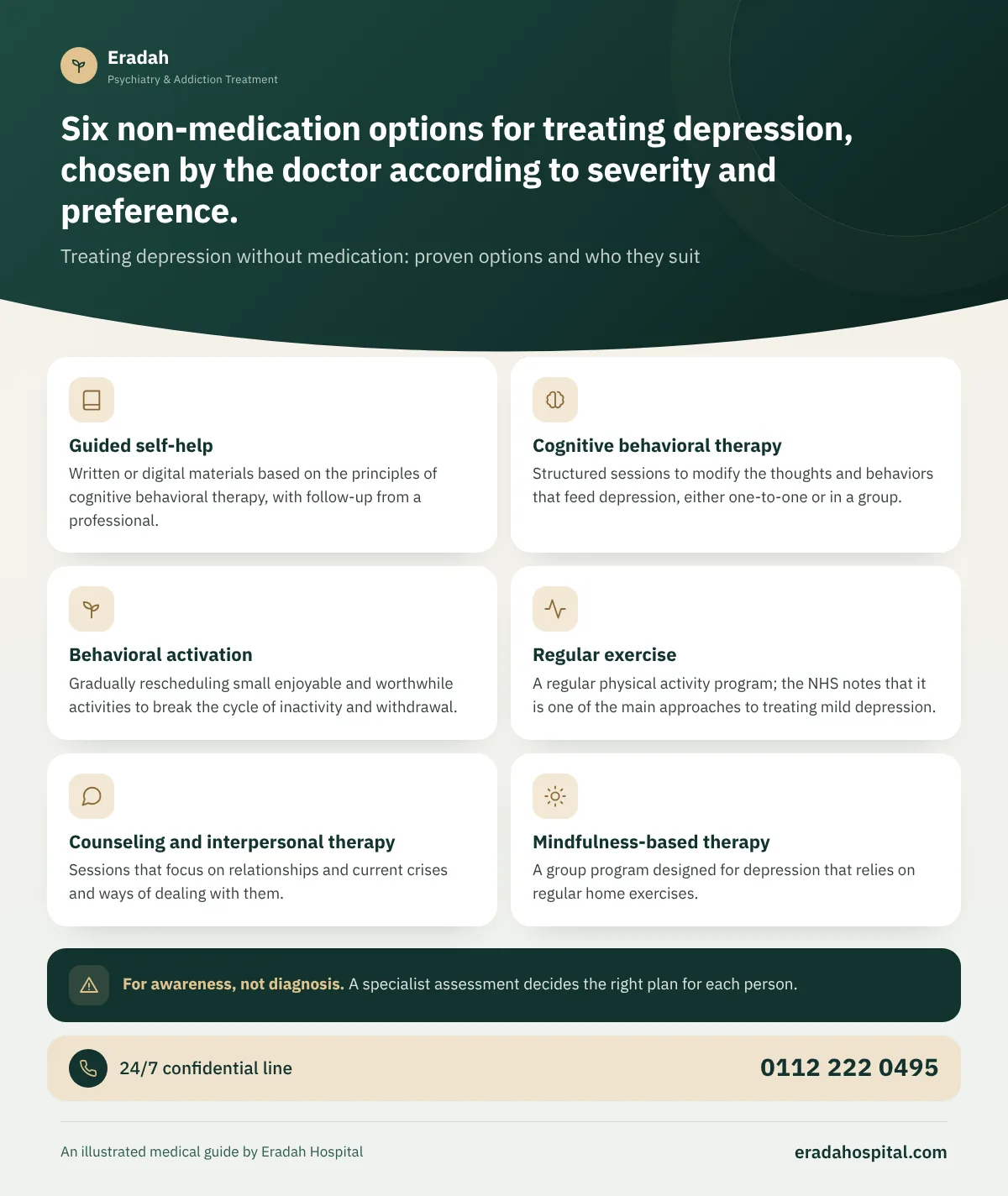
The NICE and NHS guidelines list several options, and your doctor or therapist chooses among them according to your condition and preference:
Written or digital materials based on the principles of cognitive behavioral therapy, with follow-up from a professional.
Structured sessions to modify the thoughts and behaviors that feed depression, either one-to-one or in a group.
Gradually rescheduling small enjoyable and worthwhile activities to break the cycle of inactivity and withdrawal.
A regular physical activity program; the NHS notes that it is one of the main approaches to treating mild depression.
Sessions that focus on relationships and current crises and ways of dealing with them.
A group program designed for depression that relies on regular home exercises.
According to the NHS, cognitive behavioral therapy usually involves a session every week or two. You can see the cognitive behavioral therapy page to understand what happens in the sessions.
Does exercise treat depression? What does the research say?
In a broad scientific analysis published in the British Medical Journal (BMJ) in 2024, researchers pooled 218 studies involving more than 14,000 participants, and found that walking or jogging, yoga, strength training and mixed aerobic exercise reduced depression symptoms to a moderate degree compared with usual care. The effect was greater the more intense the prescribed exercise, and strength training and yoga were the easiest to stick with.
However, the researchers themselves described their confidence in these results as low for methodological reasons, and suggested viewing exercise as one of the core treatments alongside psychotherapy and medication, not a substitute for them in every case.
What helps in daily life alongside treatment?
These habits are not a complete treatment for depression, but they support any treatment plan, and the NHS lists them among its tips for coping with low mood:
- Fixed times for going to bed and waking up, and less screen time before sleep.
- Regular meals, and cutting back on excess caffeine.
- A short meeting with someone you trust is better than complete isolation.
- Breaking large tasks into small steps you can complete.
- Staying away from alcohol, drugs and non-prescribed sedatives, because they deepen depression.
And if you are reading about ways to raise serotonin naturally, remember that depression cannot be reduced to a single chemical in the brain, and that these habits are a support, not a replacement for treatment.
What about herbs and supplements?
The NICE guideline states that there is evidence that St John's Wort may help in less severe depression, but it asks professionals to warn patients about the differing strength of the preparations available and about its potentially serious interactions with other medicines. This is why “natural” does not mean safe, and you should tell your doctor about any herb or supplement you take, especially if you take other medication.
When is treatment without medication not enough?
- If depression has not improved after a sufficient period of regular psychotherapy.
- If the depression is moderate or severe and disrupts work, sleep and eating.
- If thoughts of death or self-harm, or psychotic symptoms, appear.
- If depression has come back several times before.
- If depression occurs together with substance use or addiction that needs safe withdrawal under medical supervision.
In these cases, medication is not a failure but a tool that helps the brain respond to psychotherapy. It is also helpful to know that antidepressants do not cause addiction in the usual sense, and that stopping them is done gradually under your doctor's plan. Do not start or stop any medication without a doctor.
How does treatment begin at Eradah?
At Eradah Hospital, we begin with an assessment that determines the severity of the depression and whether there is any risk or substance use. We then discuss the options with you openly, including psychotherapy alone when that is appropriate. Follow-up can be through outpatient treatment, or residential treatment for men when needed. The first consultation is free and confidential.
Suicidal thoughts or danger to self? Get help now
- Talk about death, about life not being worth living, or about the family being "better off without him"
- Suddenly saying goodbye to family, giving away belongings, or writing a will
- A strange sudden calm after a period of severe despair
- Stopping eating and drinking or caring for oneself altogether
- A sudden increase in drinking, substance use or reckless behavior
Stay with the person and do not leave them alone, and ask calmly and clearly whether they are thinking of harming themselves; asking does not plant the idea, it opens the door to talking. Listen without blame or lecturing, and quietly move medications and dangerous items out of reach. Call the ambulance (123) or go to the nearest emergency room if the danger is imminent, and contact the mental health support line 16328, available around the clock.
Ambulance 123 Mental health support line 16328