What is the difference between depression and anxiety in brief?
"I don't know if I'm anxious or depressed, all I know is that I'm uncomfortable and not sleeping." Psychiatrists hear this sentence almost every day. The question is a reasonable one, since the two conditions resemble each other in many symptoms and often occur in the same person. But the difference between depression and anxiety does exist, and understanding it helps you describe what you are going through to the doctor accurately.
Simply put, anxiety is an alarm system working too much: it anticipates danger and prepares for it, so the body stays tense and the mind busy with the question "what if?" Depression, on the other hand, is closer to a switching-off: drive, interest and energy decline, and a feeling takes over that nothing is worth trying. The World Health Organization describes a depressive episode as depressed mood or loss of pleasure and interest lasting most of the day, nearly every day, for at least two weeks.
By contrast, the US National Institute of Mental Health (NIMH) notes that diagnosing generalized anxiety disorder requires worry that is hard to control on most days for at least six months, with three or more of the following symptoms: restlessness or feeling keyed up, fatigue, poor concentration, irritability, muscle tension, and sleep disturbance.
The difference between depression and anxiety in six aspects
This comparison is not for self-diagnosis, but it helps you notice the dominant feeling over recent weeks:
| Anxiety | Depression | |
|---|---|---|
| Time orientation | Preoccupation with the future and what might happen | Heaviness of the present, regret about the past and hopelessness about tomorrow |
| Main feeling | Fear, tension and anticipation | Sadness, emptiness or numbness |
| Energy | Mind and body in a state of alert | Sluggishness, heaviness and slowing down |
| Pleasure and interest | The desire is there but anxiety spoils it | Loss of pleasure and interest itself |
| Sleep | Difficulty falling asleep because of racing thoughts | Insomnia, early waking or oversleeping |
| The dominant thought | "What if something bad happens?" | "There's no point, and it's my fault" |
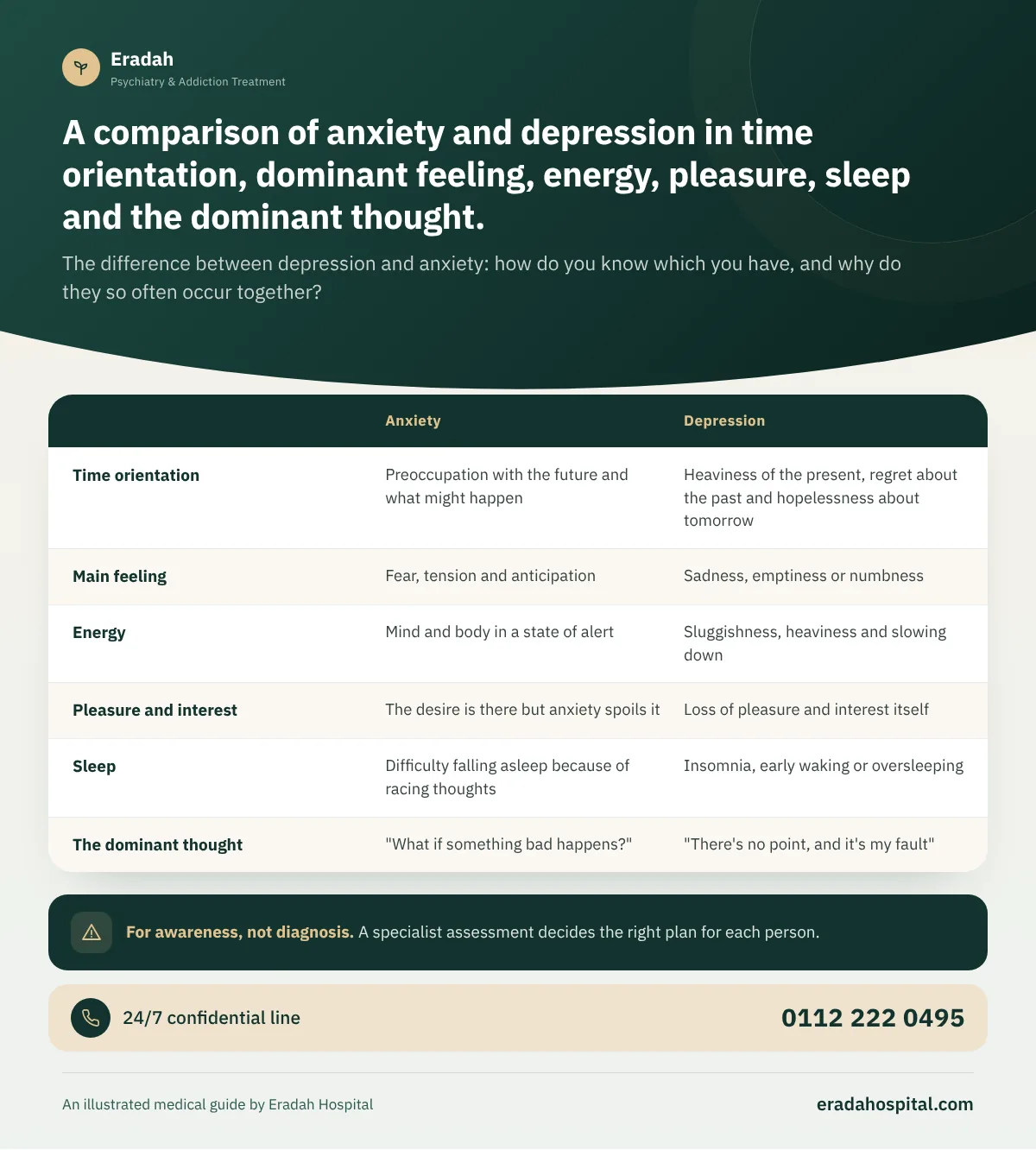
Note that the clearest difference is in pleasure and motivation: an anxious person wants to go out, work and enjoy themselves, but fear holds them back. A depressed person has lost the desire itself, so is not excited even about what they used to love.
Why do anxiety and depression get mixed up? The shared symptoms
Many symptoms of the two conditions fall in the same area, which makes telling them apart difficult without an assessment:
- Sleep disturbance: appears in the criteria for generalized anxiety and in the symptoms of depression alike.
- Fatigue and poor concentration: NIMH lists them for generalized anxiety, and they are also among the best-known symptoms of depression.
- Irritability and quick temper: may be the visible face of either condition, especially in men and teenagers.
- Physical symptoms: headaches, muscle aches and stomach upset with no clear organic cause.
- Mood swings: the World Health Organization notes that depression and anxiety share some symptoms, including rapid, unexpected changes in mood.
That is why a person may walk into the clinic thinking their problem is "anxiety and tension," and the doctor discovers an unnoticed depression beneath the anxiety, or the reverse. You can find the details of each condition's symptoms in symptoms of depression and symptoms of generalized anxiety.
Can anxiety and depression occur together?
Yes. In fact, having both is more the rule than the exception among people who attend clinics. In the large Dutch Study of Depression and Anxiety (NESDA), which included 1,783 participants, the researchers found the following:
In the same study, having both conditions was linked to more severe symptoms, a longer duration, an earlier onset and more childhood trauma. That is why the researchers recommended that both disorders be routinely assessed together, whatever the reason for the first visit.
Which comes first: does anxiety cause depression?
In the same NESDA study, anxiety came before depression in 57% of the combined cases, while depression came before anxiety in only 18%. This does not necessarily mean anxiety "causes" depression, but it points to a common pattern: years of tension, avoidance and exhaustion drain a person, and frustration and hopelessness gradually creep in.
Many patients describe this path in simple words: "I got tired of being afraid, and then I stopped caring." That is why treating anxiety early may protect against later depression, and it is one more reason not to postpone an assessment.
Questions to help you tell them apart before seeing the doctor
Answer honestly, and write down your answers to show the doctor. They are for awareness only and not a diagnostic tool:
- Is fear of what might happen your dominant feeling, or sadness and emptiness about what has happened and where you are now?
- Do you still enjoy things when your tension eases, or have you lost enjoyment even in calm moments?
- Does your body feel tense and keyed up, or heavy and slow?
- Do you put things off out of fear of them, or because you can't find the energy or meaning to do them?
- Do you have thoughts that you are a burden or that life isn't worth living? If the answer is yes, talk to someone now or call 16328.
You can also start with the depression test as a first step, knowing that the result does not replace an interview with the doctor.
Why does telling depression from anxiety matter for treatment?
Treatment of the two conditions is similar in many ways: cognitive behavioral therapy is effective in both, and NIMH notes that SSRI and SNRI antidepressants are used to treat depression and can also help with generalized anxiety symptoms. But the details differ:
- In anxiety, psychotherapy focuses on facing fears, reducing avoidance and dealing with repetitive worry.
- In depression, it focuses on gradually restoring activity and pleasure, and modifying harsh thoughts about oneself.
- Sedatives may ease tension temporarily, but they do not treat depression, and may cause dependence with long-term use.
- The presence of suicidal thoughts changes the priorities completely and calls for an urgent assessment.
The details of the options are in depression treatment and treatment of generalized anxiety. Do not start or stop any medication without a doctor.
When should you see a psychiatrist?
Don't wait until you settle on your own whether what you have is anxiety or depression. See a psychiatrist if the symptoms last two weeks or more and affect your work, sleep or relationships, or if you start turning to sedatives, alcohol or hashish to calm down. At Eradah Psychiatric Hospital, it begins with an assessment that tells the two conditions apart and reveals whether they occur together, followed by a plan combining psychotherapy and medication follow-up when needed, through outpatient treatment or residential care for men. The first consultation is free and confidential for everyone.
Suicidal thoughts or danger to self? Get help now
- Talk about death, about life not being worth living, or about the family being "better off without him"
- Suddenly saying goodbye to family, giving away belongings, or writing a will
- A strange sudden calm after a period of severe despair
- Stopping eating and drinking or caring for oneself altogether
- A sudden increase in drinking, substance use or reckless behavior
Stay with the person and do not leave them alone, and ask calmly and clearly whether they are thinking of harming themselves; asking does not plant the idea, it opens the door to talking. Listen without blame or lecturing, and quietly move medications and dangerous items out of reach. Call the ambulance (123) or go to the nearest emergency room if the danger is imminent, and contact the mental health support line 16328, available around the clock.
Ambulance 123 Mental health support line 16328