What is depression relapse?
"I'd been fine for a year, and suddenly I found myself unable to get out of bed again." This moment is one of the hardest for someone who has recovered from depression, because it brings a feeling of failure and a fear that all the effort was wasted. The truth is that relapse is a known part of the nature of the illness, not evidence of weakness or failure.
Doctors sometimes distinguish between relapse, meaning the return of symptoms before recovery from the same episode is complete, and recurrence, meaning a new episode after a period of full recovery. The World Health Organization describes "recurrent depressive disorder" as a history of at least two depressive episodes. What matters in practice is that both call for the same attention and the same early intervention.
Does depression come back after treatment? The numbers, plainly
In a systematic review published in Acta Psychiatrica Scandinavica in 2010, researchers found that recurrence of depression among patients of specialist psychiatric services is high:
These figures do not mean a return is inevitable; they reflect averages that include people who did not receive adequate follow-up. More importantly, the same review found that the number of previous episodes and mild residual symptoms were the strongest predictors of a return, while sex and social or economic status were not clearly linked to it. In other words, the strongest risk factors are ones you can work on with your doctor.
Why does depression relapse happen?
- Stopping treatment early: feeling better leads many people to stop medication or sessions before the right time.
- Residual symptoms: incomplete improvement, such as ongoing sleep disturbance or losing some of the pleasure in things.
- Life stress: a loss, a financial crisis or a family conflict, especially when it comes without support.
- Substance use: alcohol, hashish and sedatives deepen low mood and interfere with treatment.
- Untreated co-occurring conditions: anxiety, chronic insomnia or physical illness.
If your depression occurs together with substance use, read depression and addiction, because preventing relapse here needs a plan that covers both together.
What are the early signs of depression relapse?
Depression rarely returns all at once. The NICE guidelines state that part of relapse prevention is recognizing warning signs such as anxiety or poor sleep and unhelpful behaviors such as avoidance or rumination. This is a common sequence that many patients describe:
- The startSleep changes
Difficulty sleeping, early waking, or sleeping more than usual.
- After thatQuiet withdrawal
Declining invitations, dropping a hobby, answering fewer calls.
- ThenFamiliar thoughts
The harsh inner voice returns: "I'm a failure," "there's no point."
- Over timeEnergy drops
Simple tasks become heavy, and irritability rises.
- If no one steps inThe episode takes hold
Pleasure fades, eating and concentration are disrupted, and life grinds to a halt.
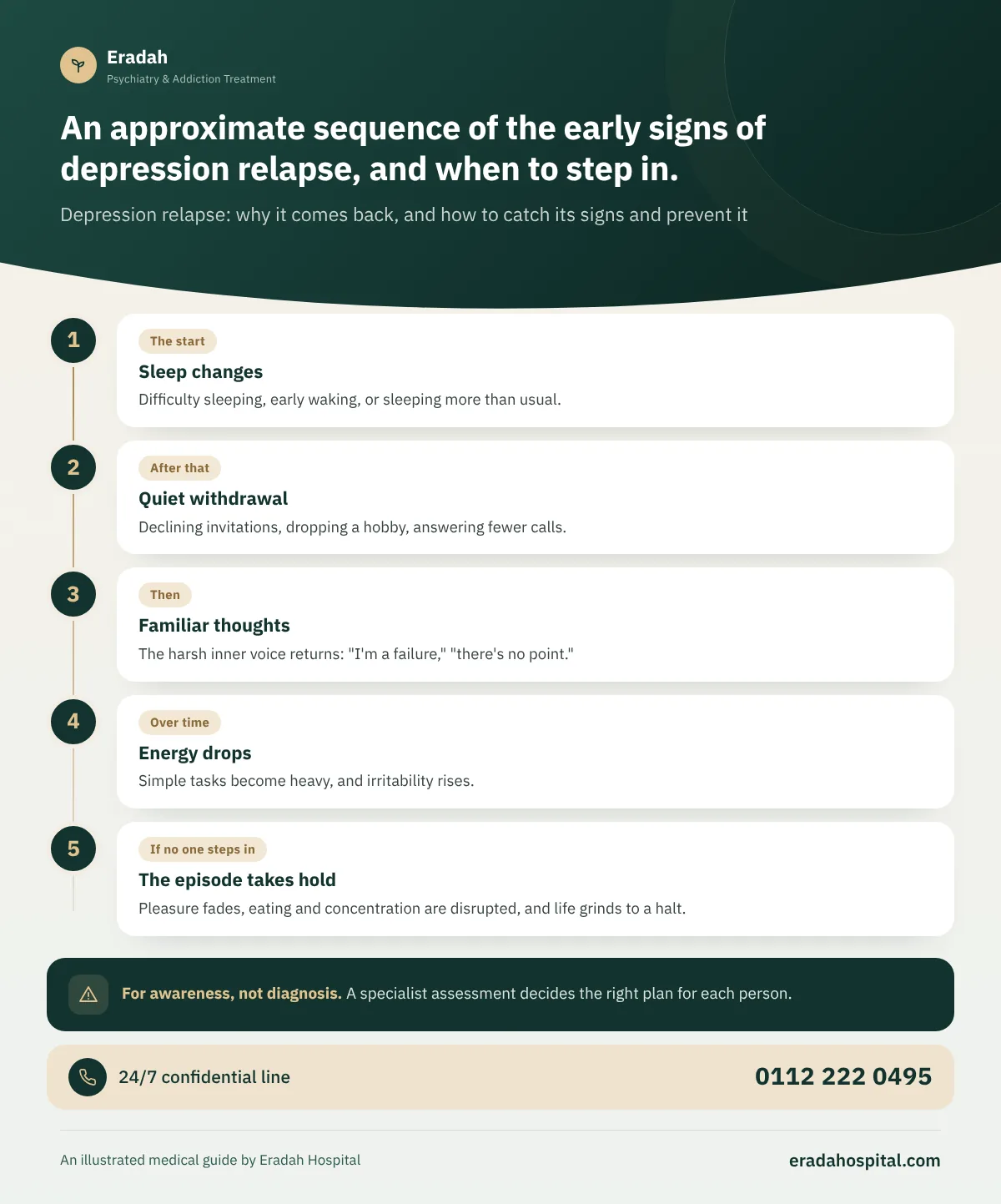
Your own signs may differ, which is why it helps to go over these with your doctor: how did the previous episode begin? And what did your family notice first?
Does staying on treatment prevent relapse?
In a systematic review published in The Lancet in 2003 that pooled 31 randomized trials, the average relapse rate among those whose antidepressant was stopped and replaced with a placebo was 41%, compared with 18% among those who stayed on it. That is, continuing reduced the likelihood of relapse by about 70%, and the effect lasted up to 36 months in some trials.
The NICE guidelines recommend discussing continuing medication for those at higher risk of relapse, or offering preventive psychotherapy to those who do not wish to. If you and your doctor decide to stop, it is done gradually; the symptoms of abrupt discontinuation differ from a return of the illness, as explained in our guide to antidepressant withdrawal. Do not start or stop any medication without a doctor.
Mindfulness-based therapy to prevent a return
Mindfulness-based cognitive therapy (MBCT) is a group program designed specifically for people whose depression has recurred. In an analysis of data from 1,258 patients in randomized trials, published in JAMA Psychiatry in 2016, the risk of relapse over 60 weeks was lower in those who received it than in those who did not (hazard ratio 0.69), and the benefit was clearer in those with more residual symptoms.
NICE notes that group cognitive behavioral or mindfulness-based therapy for relapse prevention usually consists of 8 sessions over two to three months, with the possibility of additional sessions during the following year.
How do you write an early-warning plan?
The NICE guidelines suggest that relapse-prevention components include reviewing what you learned in therapy, clear plans for what to do when each sign appears, and preparing for difficult occasions expected during the year. You can turn this into a simple sheet:
- My three early signs (for example: going to sleep after 2 a.m., canceling plans, snapping at the kids).
- What I do right away: return to my routine, tell someone I trust, and contact my doctor.
- What my family does: notices without suffocating monitoring, reminds me of my appointment, and does not say "you're back to this again?"
- Difficult situations expected this year, such as an anniversary of a death or a job change, and how I prepare for them.
- My doctor's number, the mental health support line 16328, and the ambulance (123) for any thought of self-harm.
Follow-up at Eradah
At Eradah Hospital we treat relapse prevention as a core part of care: assessing residual symptoms, reviewing the medication and psychological plan, sessions that involve the family with the patient's consent, and regular follow-up through the follow-up program. If the relapse is severe or accompanied by substance use, residential treatment is available for men. The first consultation is free and confidential.
Suicidal thoughts or danger to self? Get help now
- Talk about death, about life not being worth living, or about the family being "better off without him"
- Suddenly saying goodbye to family, giving away belongings, or writing a will
- A strange sudden calm after a period of severe despair
- Stopping eating and drinking or caring for oneself altogether
- A sudden increase in drinking, substance use or reckless behavior
Stay with the person and do not leave them alone, and ask calmly and clearly whether they are thinking of harming themselves; asking does not plant the idea, it opens the door to talking. Listen without blame or lecturing, and quietly move medications and dangerous items out of reach. Call the ambulance (123) or go to the nearest emergency room if the danger is imminent, and contact the mental health support line 16328, available around the clock.
Ambulance 123 Mental health support line 16328