Is depression different in men?
"I'm not depressed, I'm just under pressure and can't stand anyone." With this sentence, many men walk into the clinic, often after their wife or mother has insisted. From childhood, men in our societies learn that "real men don't cry," so they express their pain in other ways: irritability, sleepless nights, nonstop work, or a cigarette, a drink and some pills.
World Health Organization data indicate that in 2023, depression affected about 4.1% of adult men compared with 6.2% of women. But this gap may hide part of the truth, because traditional diagnostic criteria focus on sadness, crying and guilt, symptoms that many men hide or do not experience in that form at all.
What are the signs of depression in men?
Outbursts at his wife and children or at work over small things.
Drinking more, or using sedatives, tramadol or hashish "to switch off."
Reckless driving, impulsive financial decisions, or fights.
Nonstop working hours or constant busyness that prevents thinking.
Talking little at home, and sitting alone for long periods in front of the phone or TV.
Fatigue, headaches, aches and pains, and reduced sexual desire or performance.
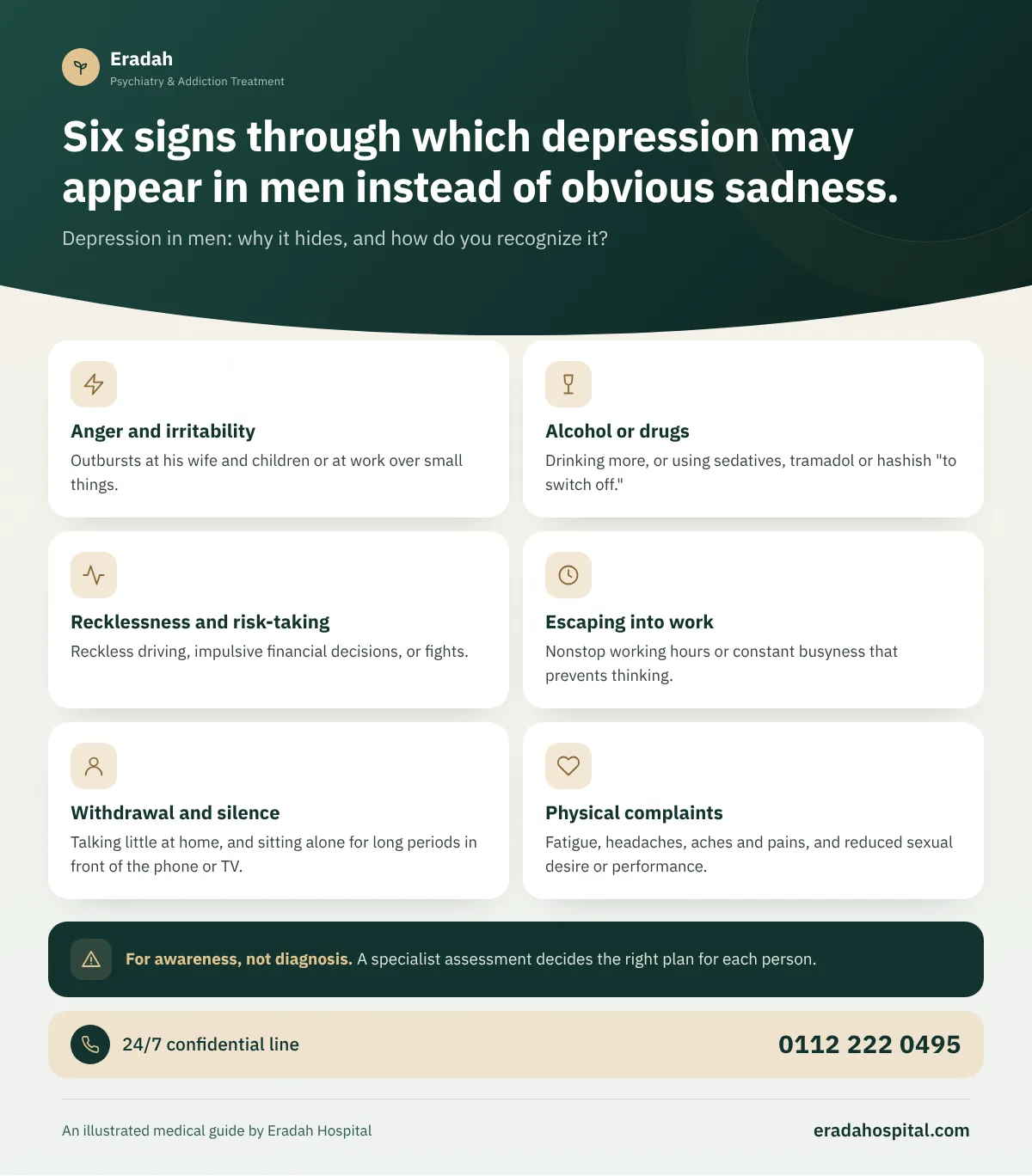
These signs come in addition to the well-known symptoms covered in our guide to symptoms of depression, such as loss of pleasure, disturbed sleep and appetite, and poor concentration.
Depression and addiction in men: numbing that becomes a problem
Many men do not say "I'm sad"; they look for something to silence the feeling. The World Health Organization notes that the link between suicide and mental disorders, especially depression and alcohol use disorders, is well established in high-income countries. Substance use here deepens the depression instead of treating it, and adds problems with sleep, work and family.
One of the most common stories we see in Egypt is a man who started tramadol "so he could work," or hashish "so he could sleep," and then found himself facing depression and addiction together. This is called dual diagnosis, and our guide to depression and addiction explains it in detail.
Why is the risk higher in men?
According to statistics from the US National Institute of Mental Health (NIMH), the suicide rate among males in the United States in 2023 was about four times the rate among females. This is linked to intertwined factors, including delayed help-seeking, substance use, impulsivity and isolation.
The World Health Organization notes that many suicides happen impulsively in moments of crisis, such as financial problems, conflicts or chronic pain. That is why any talk about death, or about the family being "better off without him," deserves to be taken seriously and acted on immediately.
Depression, work and the role in the family
The World Health Organization notes that people who have been through difficult life events, such as unemployment, loss or trauma, are more likely to develop depression, and that depression can in turn add to stress and deepen the problem. Because in many homes the man is the breadwinner, losing a job or struggling financially can strike at the core of his sense of worth.
The effect may show at home as emotional absence, repeated arguments, or a decline in the marital relationship. Here it helps a wife to know that what she sees may be a treatable illness, not a rejection of her or the family. And if workaholism is the dominant picture, it may be an escape from feeling rather than ambition.
How do you persuade a depressed man to seek help?
- Talk about concrete changes, not "illness": "You haven't been sleeping for a while and you're on edge, and that's not you."
- Link treatment to what matters to him: his health, his work, his children, his ability to concentrate.
- Present the visit as a general check-up or a consultation about sleep and fatigue if the word "psychiatric" scares him.
- Stress confidentiality, since many men fear that colleagues or relatives will find out.
- Do not argue with him while he is angry or under the influence of a substance; postpone the conversation to a calm moment.
For more practical steps when he refuses, read how to convince a patient to accept treatment.
How is depression in men treated? And Eradah's role
The treatment is the same in essence: structured psychotherapy such as cognitive behavioral therapy, antidepressants prescribed by a doctor when needed, and treatment of any accompanying substance use. The details of the options are in depression treatment. Do not start or stop any medication without a doctor.
At Eradah Hospital we admit men to the residential treatment program when depression needs intensive care, especially when it occurs together with an addiction that requires safe detox under medical supervision, within a dual diagnosis program. The first consultation is free and completely confidential.
Suicidal thoughts or danger to self? Get help now
- Talk about death, about life not being worth living, or about the family being "better off without him"
- Suddenly saying goodbye to family, giving away belongings, or writing a will
- A strange sudden calm after a period of severe despair
- Stopping eating and drinking or caring for oneself altogether
- A sudden increase in drinking, substance use or reckless behavior
Stay with the person and do not leave them alone, and ask calmly and clearly whether they are thinking of harming themselves; asking does not plant the idea, it opens the door to talking. Listen without blame or lecturing, and quietly move medications and dangerous items out of reach. Call the ambulance (123) or go to the nearest emergency room if the danger is imminent, and contact the mental health support line 16328, available around the clock.
Ambulance 123 Mental health support line 16328