Do depression symptoms differ in women?
“I do everything at home and at work, and people think I'm fine, but inside I feel completely switched off.” Many women experience depression this way: a composed performance on the outside and a silent collapse inside. Their exhaustion is often explained away as “household stress” or “hormones,” so diagnosis is delayed.
The US National Institute of Mental Health (NIMH) stresses that depression is especially common among women because of biological, hormonal and social experiences specific to them, that it is not something a woman did or failed at, nor something she can “shake off” by willpower, and that most women need treatment to get better.
The core symptoms of depression in general, psychological, physical and behavioral, are covered in detail in depression symptoms. Here we focus on what is specific to women: how symptoms appear, when they increase, and how treatment differs.
Why is depression more common in women?
There is no single reason for this difference. A review published in Lancet Psychiatry in 2017 points to an overlap of developmental, biological and social factors, and sees the gap beginning to appear during the teenage years. Added to this is the burden of caregiving that women often carry, for children, older relatives and the home, sometimes alongside a job.
How do depression symptoms appear in women?
NIMH notes that sadness is only part of depression in women, and that other common symptoms include:
- Feeling hopeless, worthless or helpless.
- Loss of interest or pleasure in hobbies and activities.
- Difficulty concentrating, remembering or making decisions.
- Aches or physical pains with no clear physical cause.
- Tiredness, disturbed sleep and appetite, anxiety and irritability.
NIMH advises seeing a professional if symptoms last most of the day, nearly every day, for at least two weeks. It stresses that depression does not look the same in every woman: some have many symptoms and others only a few.
Depression symptoms in women across life stages
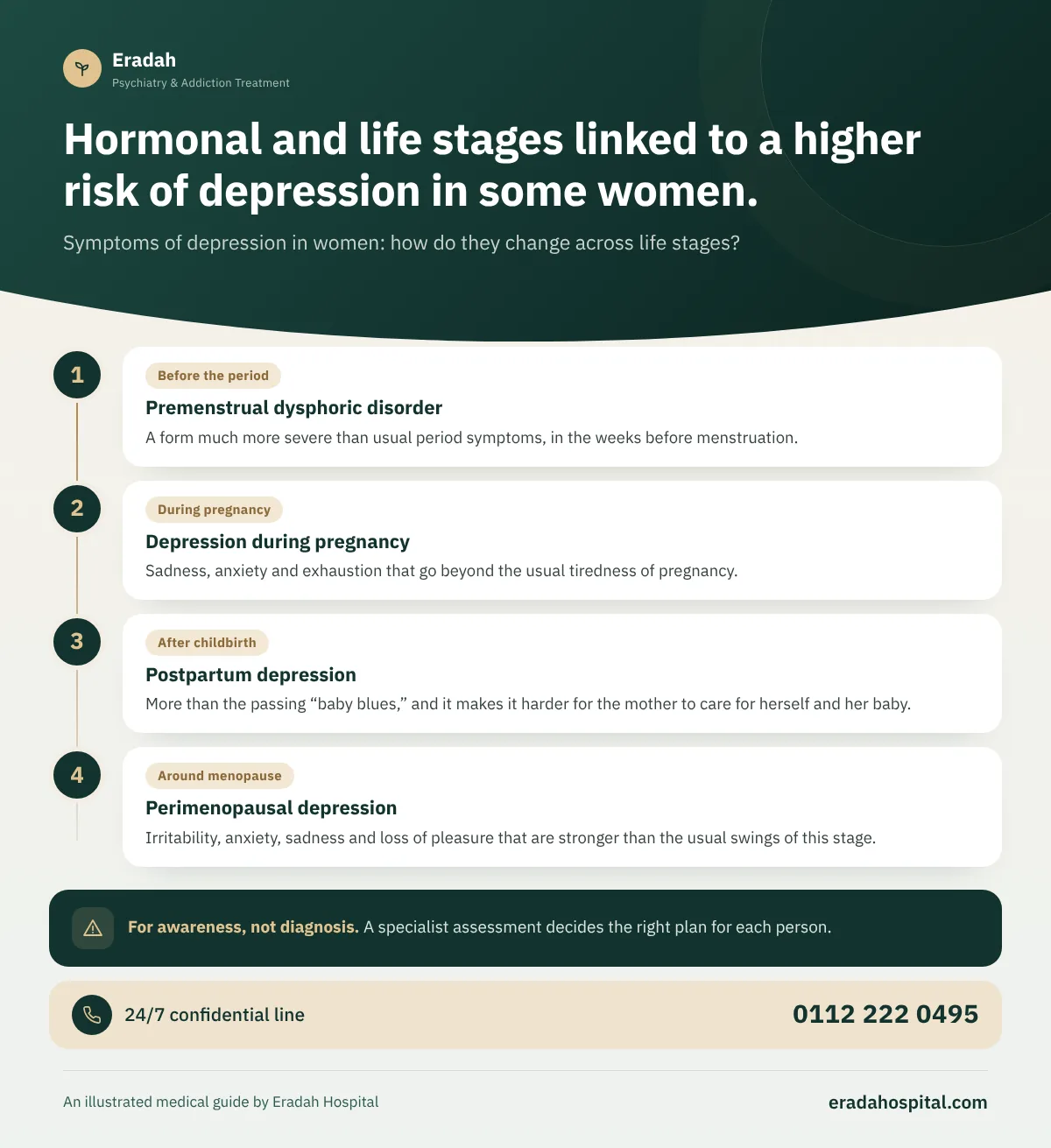
NIMH notes that pregnancy, the postpartum period, the menstrual cycle and the perimenopause are linked to physical and hormonal changes that may trigger a depressive episode in some women:
- Before the periodPremenstrual dysphoric disorder
A form much more severe than usual period symptoms, in the weeks before menstruation.
- During pregnancyDepression during pregnancy
Sadness, anxiety and exhaustion that go beyond the usual tiredness of pregnancy.
- After childbirthPostpartum depression
More than the passing “baby blues,” and it makes it harder for the mother to care for herself and her baby.
- Around menopausePerimenopausal depression
Irritability, anxiety, sadness and loss of pleasure that are stronger than the usual swings of this stage.
Premenstrual depression: when is it more than ordinary symptoms?
NIMH describes premenstrual dysphoric disorder as a more severe form of premenstrual syndrome, appearing in the weeks before menstruation and causing severe symptoms such as depressed mood, anger or irritability, and suicidal thoughts, changes in appetite, bloating, breast tenderness, and joint or muscle pain.
What sets it apart is that the symptoms recur at the same point in every cycle and are severe enough to disrupt work or relationships, then improve once the period starts. Recording your symptoms daily for two or three cycles before seeing the doctor is useful, because it helps a great deal with diagnosis.
Depression during pregnancy and after childbirth
NIMH notes that perinatal depression can occur during pregnancy or after childbirth, and that it is more than the “baby blues” many mothers go through, as the mother feels sadness, anxiety and extreme exhaustion that make it hard for her to care for herself or others. The details are in the guide to postpartum depression.
Depression around menopause
NIMH explains that irregular periods, disturbed sleep, mood swings and hot flashes are common in the transition toward menopause, but irritability, anxiety, sadness or loss of pleasure that is stronger than usual may be signs of depression. This stage often coincides with major life changes, such as children marrying or caring for elderly parents, which adds to the burden.
How is depression treated in women?
NIMH stresses that depression, even in its most severe forms, is treatable, that the common treatments are antidepressants, talk therapy, or a combination of the two, and that there is no “one size fits all,” so it may take some trial to find the best fit. The options are detailed in treating depression. Do not start or stop any medication without a doctor.
Residential treatment at Eradah Hospital is for men only, but the free, confidential first consultation is available to women and their families, to understand the condition and assess its severity, then be directed to the right provider and plan. You can start with the depression self-test as an awareness step that does not replace a doctor.
Suicidal thoughts or danger to self? Get help now
- Talk about death, about life not being worth living, or about the family being "better off without him"
- Suddenly saying goodbye to family, giving away belongings, or writing a will
- A strange sudden calm after a period of severe despair
- Stopping eating and drinking or caring for oneself altogether
- A sudden increase in drinking, substance use or reckless behavior
Stay with the person and do not leave them alone, and ask calmly and clearly whether they are thinking of harming themselves; asking does not plant the idea, it opens the door to talking. Listen without blame or lecturing, and quietly move medications and dangerous items out of reach. Call the ambulance (123) or go to the nearest emergency room if the danger is imminent, and contact the mental health support line 16328, available around the clock.
Ambulance 123 Mental health support line 16328