What is teen depression?
"My son has shut himself in his room, every little word sets him off, and his grades have dropped. They told us it's adolescence and it will pass." This sentence is repeated in psychiatric clinics. Sometimes it is true, and sometimes it hides a depression that needs treatment. The difference between the two is not always clear from the outside.
Teen depression is the same depression when it affects those between childhood and adulthood, but it is colored by the nature of this stage. The US National Institute of Mental Health (NIMH) describes it as "more than a passing mood swing," and advises a teenager who feels sad most of the time for a few weeks or more, and cannot concentrate or enjoy what they used to love, to talk to a trusted adult.
How common is teen depression?
The gap between the global and the American figures looks large because the first measures how common the disorder is at a given moment, while the second counts those who had at least one episode over a whole year in a single country. The message is the same: teen depression is not rare. The World Health Organization notes that suicide is the third leading cause of death among those aged 15 to 29, which makes early attention a duty, not a luxury.
What are the signs of depression in teenagers?
NIMH lists questions that help a teenager notice themselves: Do you often feel sad, anxious, worthless or "empty"? Have you lost interest in what you used to love? Do you get angry or irritable easily? Are you withdrawing from your friends and family? And what families often notice:
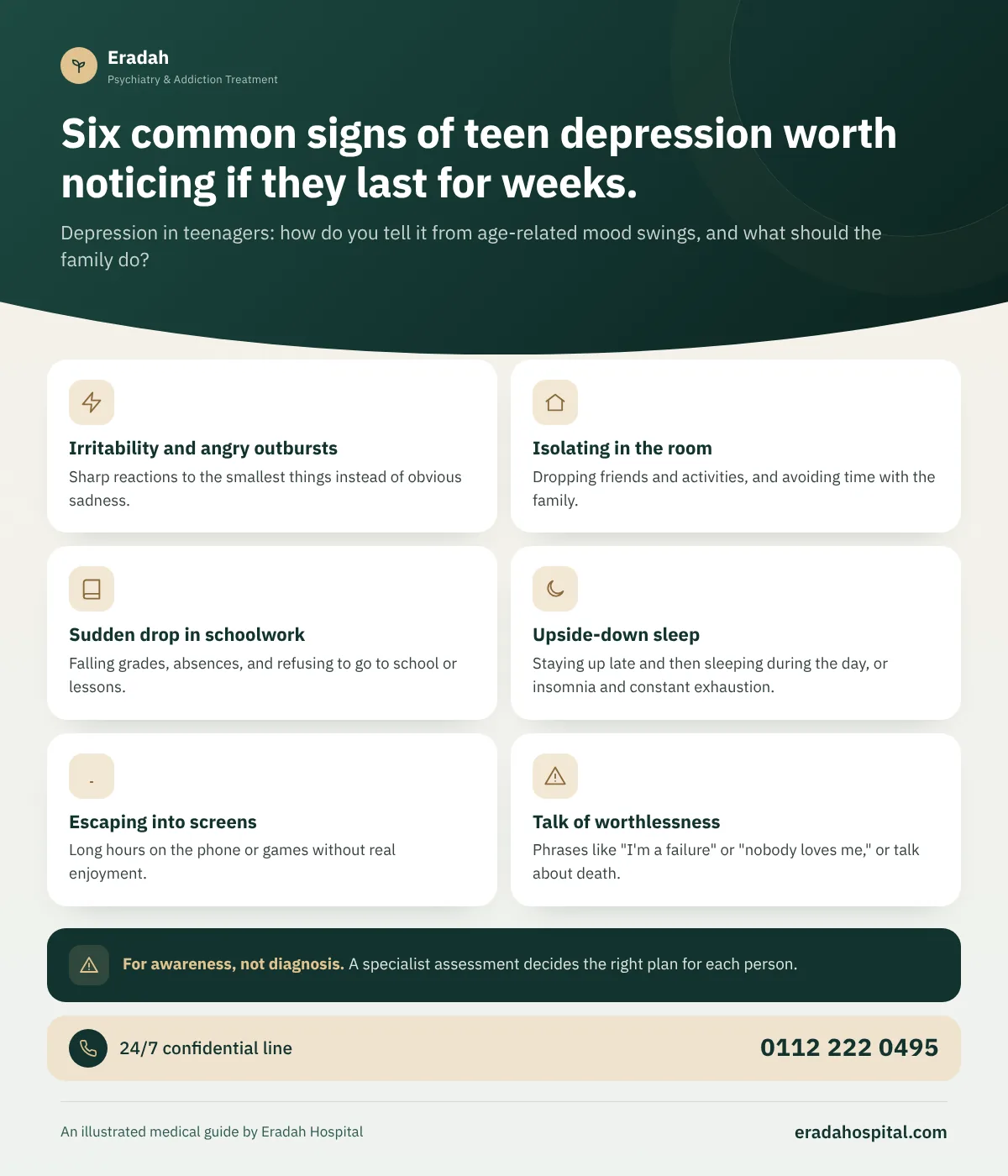
Sharp reactions to the smallest things instead of obvious sadness.
Dropping friends and activities, and avoiding time with the family.
Falling grades, absences, and refusing to go to school or lessons.
Staying up late and then sleeping during the day, or insomnia and constant exhaustion.
Long hours on the phone or games without real enjoyment.
Phrases like "I'm a failure" or "nobody loves me," or talk about death.
The World Health Organization notes that depression and anxiety in adolescents can deeply affect school attendance and achievement, and that social withdrawal can increase isolation and loneliness.
Normal teenage moodiness or depression?
| Aspect | Ordinary teenage ups and downs | Teen depression |
|---|---|---|
| Duration | Hours or days, then the mood returns | Weeks on end without clear improvement |
| Friends | May pull away from family but stays close to friends | Withdraws from family and friends alike |
| Interests | Interests change, but he is enthusiastic about something | Loses enthusiasm for almost everything |
| School | Normal ups and downs | Clear, persistent decline or school refusal |
| How he talks about himself | Rebelliousness or stubbornness | Self-contempt, despair or talk about death |
It is helpful to read about mood swings to know when they are a normal part of life. But if you are unsure, it is better to have a specialist assess the situation than to wait.
What raises a teenager's risk of depression?
The World Health Organization notes that adolescence is a stage of particular psychological pressure: peer pressure, the search for identity, and the gap between reality and what the media shows. Risk factors it lists include violence and bullying, harsh parenting, severe social and economic problems, and the quality of life at home and relationships with peers.
Substance use often begins at this age as an unhelpful way of coping with distress, and the WHO notes that cannabis use among adolescents worldwide exceeded that of adults in 2022. If you notice signs of substance use along with depression, read our guide to teen addiction.
How do you talk to your teenage son about depression?
- Choose a calm time away from arguments, ideally during a shared activity such as walking or a car ride.
- Start with what you have noticed, not with accusations: "I feel like you haven't been happy lately, and it worries me."
- Listen more than you advise, and don't interrupt to correct him or compare him with yourself at his age.
- Avoid phrases like "you're too young for this worry" or "that's just being spoiled."
- Ask directly and calmly whether he is thinking of harming himself or about death; asking does not plant the idea.
- Offer the solution as help: "What do you think about talking to a doctor who can help you sleep and focus better?"
How is teen depression treated?
Medical guidelines usually begin with psychotherapy. The British NICE guidelines recommend against using antidepressants as first-line treatment for mild depression in children and adolescents, and suggest close follow-up within two weeks followed by time-limited psychotherapy of about two to three months for those aged 12 to 18. The World Health Organization notes that antidepressants are not the first choice for adolescents and are used with extra caution.
For major depression in adolescents, the American TADS trial compared 439 adolescents aged 12 to 17, and the response rates after 12 weeks were: 71% with cognitive behavioral therapy combined with fluoxetine, 60.6% with medication alone, 43.2% with cognitive behavioral therapy alone, and 34.8% with placebo.
MedlinePlus warns that medications such as fluoxetine may increase the risk of suicidal thoughts and behavior in children, adolescents and young adults, especially in the first months or when the dose is adjusted. That is why a teenager starting a medication needs close monitoring by the doctor and family, and no medication should be started or stopped without a doctor.
What does the family do during treatment?
- Keep a steady sleep and meal routine as much as possible, without daily battles.
- Encourage movement and getting out, even a short walk; NIMH advises teenagers to stay active even when they don't feel like it.
- Contact the school when needed to ease the pressure temporarily.
- Watch for any sudden change in the first weeks of medication and tell the doctor.
- Take care of yourselves too; supporting a depressed teenager is exhausting for parents.
You can start with the depression test as an awareness step, followed by an assessment with a psychiatrist. Eradah Hospital receives adolescents for assessment, treatment and follow-up, and the first consultation is free and confidential, helping the family understand the condition and make a plan suited to the teenager's age.
Suicidal thoughts or danger to self? Get help now
- Talk about death, about life not being worth living, or about the family being "better off without him"
- Suddenly saying goodbye to family, giving away belongings, or writing a will
- A strange sudden calm after a period of severe despair
- Stopping eating and drinking or caring for oneself altogether
- A sudden increase in drinking, substance use or reckless behavior
Stay with the person and do not leave them alone, and ask calmly and clearly whether they are thinking of harming themselves; asking does not plant the idea, it opens the door to talking. Listen without blame or lecturing, and quietly move medications and dangerous items out of reach. Call the ambulance (123) or go to the nearest emergency room if the danger is imminent, and contact the mental health support line 16328, available around the clock.
Ambulance 123 Mental health support line 16328